
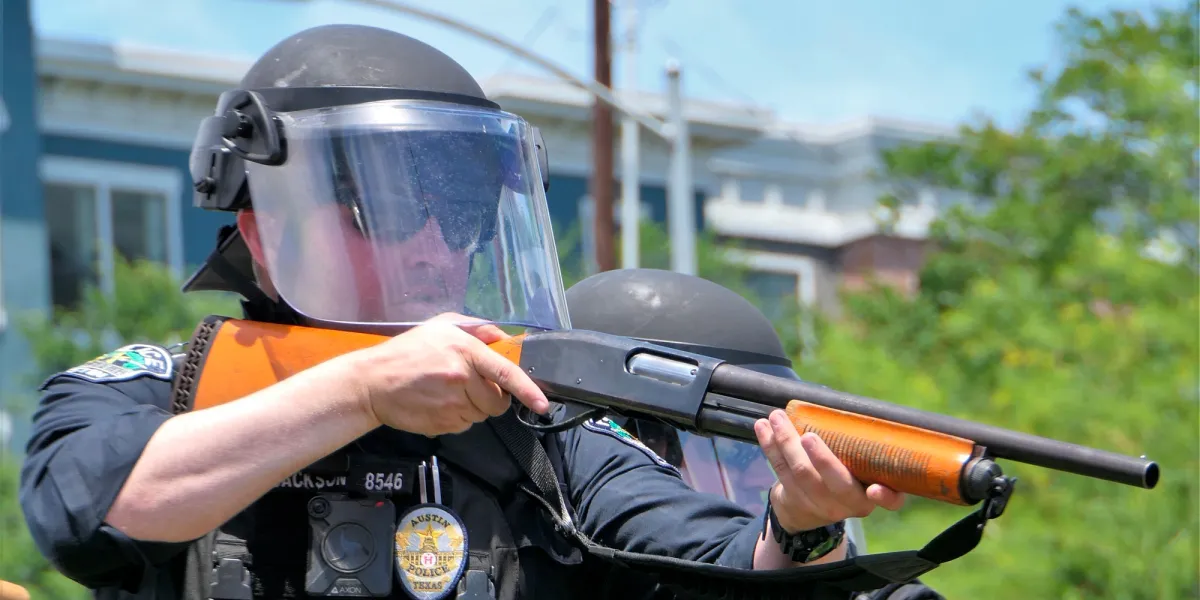
Less-lethal options have emerged as key parts of policing strategies worldwide. Law enforcement agencies are increasingly turning away from deadly force and towards alternatives to help meet the public demand for greater accountability, transparency, and respect for human rights. These tools—ranging from chemical sprays to conducted energy devices—provide a pathway for appropriately managing high-risk scenarios with an emphasis on saving life.
No force is completely without risk, but less-lethal alternatives deliver an informal “grey area” between words and guns. The widespread adoption of these practices is indicative of a larger shift toward less aggressive and more proportional response in law enforcement operations.
- Preserving Life and Reducing Fatalities
Taking lives is one of the major advantages provided by less-lethal alternatives. Conventional firearms are meant to neutralise threats with extreme efficiency, but this more often than not results in a permanent solution. On the other hand, less-lethal tools are designed to incapacitate individuals for a short period of time without causing permanent damage.
This distinction is crucial in examples of suspects that garner their use without requiring lethal force, for example in the cases where a person suffering from with mental problems,situations involving unarmed districts or uncontrolled crowd instances. This way, agencies help those officers avoid uncontrollable loss of life.
- Enhancing Proportional Use of Force
A key tenet of modern policing is proportionality—ensuring that law enforcement use only as much force necessary to deal with a situation. This is a principle that is supported by less-lethal weapons: they provide options to the operator on an escalation scale according to risk.
An officer could begin with some verbal de-escalation and then use other tools like pepper spray or a conducted energy device when the situation escalates. This layered approach gives additional discretion to be more subtle in decision-making and decreases the chance of overuse force.
- Improving Officer Safety
Less-lethal alternatives help keep not just civilians but also officers safe. Without riot shields and other uses of non-lethal force, is there any wondering at the rapidly climbing danger level that confrontations with aggressive individuals become when officers have to rely solely on physical force or firearms.
Tasers or impact projectiles, where cops can stay far away from the suspect when still getting effective control. This helps reduce the chance of injury during these close-quarters tussles as well as situational awareness in unexpected encounters.
- Supporting De-Escalation Strategies
De-escalation is now a cornerstone of modern-day police training. It focuses on attempting to de-escalate situations and conflict with the use of as little force as necessary. With other strategies, less-lethal tools provide a backup option when verbal techniques are not enough to safely resolve the situation.
The very existence of a less-lethal device can serve as a deterrent, persuading compliance without ever being used against the subject. Used proportionately, those tools can assist in reestablishing order quickly and prevent worsening the situation.
- Increasing Public Trust and Accountability
By nature, policing is a very public activity; the way in which force gets used greatly impacts perceptions of law enforcement. Serious or fatal incidents involving excessive use of force have brought widespread calls for reform. Less-lethal solutions that demonstrate an investment to reduce harm can go a long way toward dispelling these worries.
Communities can be more trusting when they see not just that officers and deputies have alternative weapons, but also that there are alternatives to deadly force. Greater accountability is built into the transparent deployment of these tools—backed up by body cameras and clear policies.
- Versatility in Diverse Situations
Police officers deal with a variety of situations, from traffic stops to large demonstrations. More recently, possible less-lethal options have been developed that could be applicable in many of these contexts.
Crowd Control:
Anti-riot tools, such as teargas and acoustic devices that disperse crowds in a non-lethal manner.
Individual Apprehension:
Conducted energy devices can incapacitate an resistive suspect in a timely manner.
Limited Presence in Close Quarters:
With Pepper spray, you can keep a safe distance between yourself and the assailant.
Versatility:
This versatility is what makes less-lethal options a necessary component of modern policing toolkits.
- Reducing Legal and Financial Risks
This unnecessary use of force can result in lawsuits, financial settlements and long term reputational damage to the police organisation. Agencies can minimize the odds of traumatic injury or death — triggering lawsuits and other penalties.
More incidents involving deadly force will increase insurance costs and the financial burden on municipalities; lowering them is a win-win. Thus in this sense, less-lethal solutions are as good from an economic perspective as they are through of ethical.
- Border Security and Immigration Control
Increasingly, police are turning up to assist people experiencing a mental health crisis or someone just taking drugs. In such instances, resorting to the use of lethal deadly force is especially controversial and mostly unnecessary.
Less-lethal tools give officers options that can subdue people without having a permanent impact. This is especially crucial in the case of vulnerable populations, who may not respond predictably to commands or traditional law enforcement methods.
- Encouraging Innovation and Training
Less lethal solutions have advanced technology and training as well. Not that you could not create them, but modern devices are focused on being precise, reliable and specific to a situation. Meanwhile, officers get more training on the use and timing of these tools.
This focus on training aims to ensure that less-excessive options are utilized as necessary and within the standards established. It further cultivates a culture of professional moderation in police agencies.
Challenges and Considerations
Although less-lethal solutions have many advantages, they do not serve as a complete substitute for every situation. They work better or worse according to parameters like distance, environment and individual response. Moreover, misuse or overreliance on these tools can cause a harm and public backlash.
Their use in crowd control, especially against peaceful demonstrators, raises ethical concerns as well. The consequences — weak policies and oversight, rushed or inadequate training.
The Path Forward
With schools safe shooter training, innovation in policing and law enforcement technology continues to develop; less-lethal solutions will increasingly affect the future of policing practices. Meanwhile, technological advances could bring about more selective and safer ways to target viruses, while better training programs can help in the chopper.
Policing in the future will rely on combining effectiveness with compassion — ensuring that officers can keep themselves and the public safe, while at all times respecting every citizen’s right to be treated as a human being.
Conclusion
Less-lethal defense solutions provide a wide range of options for police departments in the 21st century when officers are dealing with complicated situations while attempting to mitigate risk and prevent fatal consequences. Operating by the principles of proportionality force, security and public trust these methods can be defined as a revolutionary breakthrough in policing.
But their success is entirely contingent on responsible use, appropriate training and dedication to ethical principle. When deployed strategically, less-lethal solutions can help ensure an environment that supports the safety of law enforcement officers as well as surrounding communities.