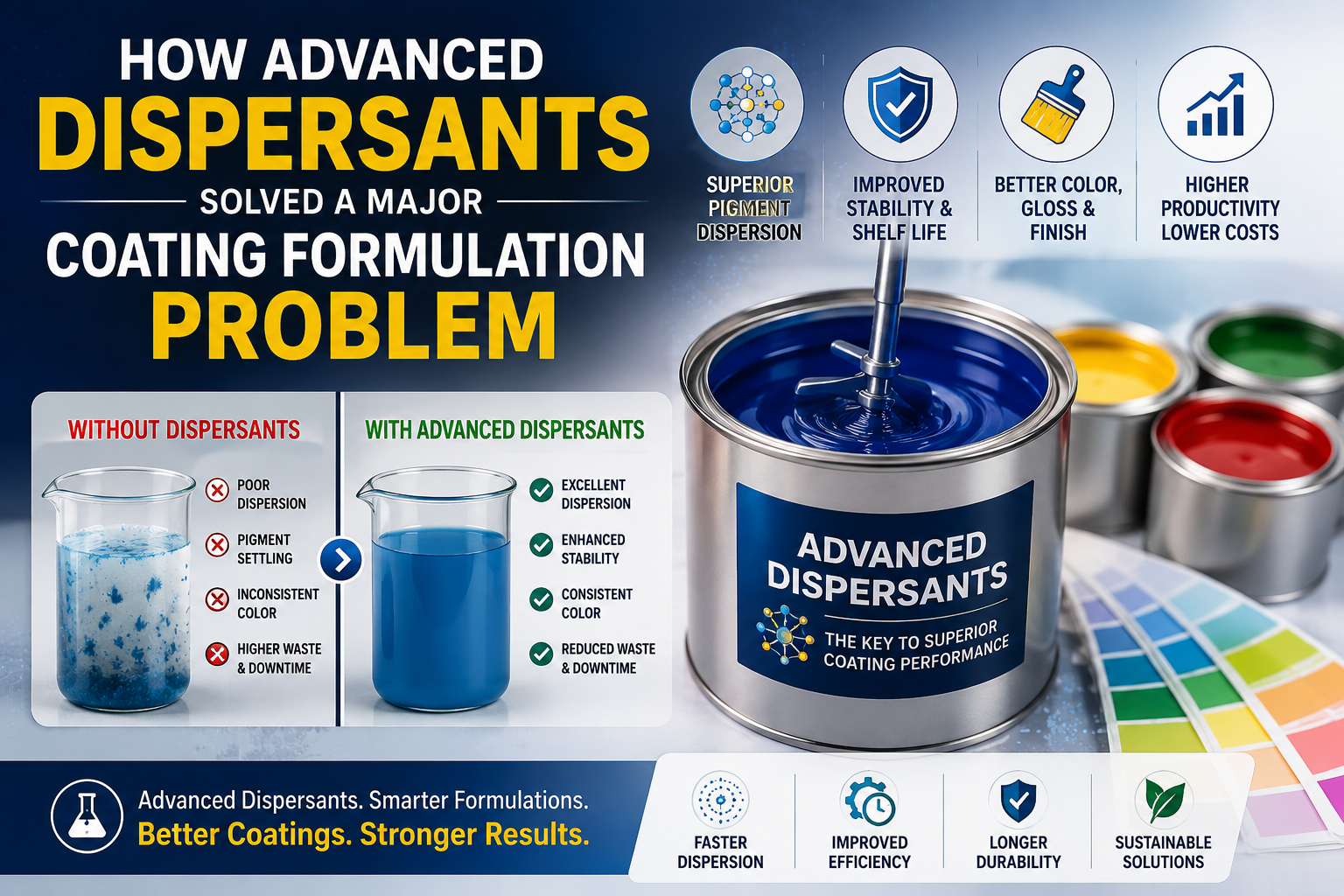
In coating and paint manufacturing, achieving consistent product quality is essential to maintaining a competitive edge, whether it be decorative paint for homes and offices, industrial coatings, automotive finishes, or the protective coatings used in marine applications. Coating and paint manufacturers based in the UAE are under constant market pressure to produce high-performance coatings that can withstand extreme wear and tear, meet strict standards of durability and appearance.
One coatings manufacturer located in the UAE recently successfully resolved a major production issue through the use of advanced Dispersants, which resulted in a significant increase in formulation stability and color uniformity, and subsequently enhanced the performance of the product. The result was an improvement of their production process and product quality while at the same time dramatically reducing waste and production costs.
Read on to see how advanced dispersant technology solved a complex challenge in coating formulation and the reasons why coating manufacturers within the UAE are now actively investing in high-performance dispersant solutions.
The Dispersants’ Rising Significance in Today’s Coatings
Pigments and filler particles in coating formulations must remain uniformly dispersed throughout the liquid coating mixture to ensure that all of the colored solids remain suspended. Without sufficiently stabilizing the pigment in the coating, there are many problems that manufacturers are likely to run into, including:
- Poor color appearance
- Dull and inconsistent finish
- Sedimentation
- Variable viscosity
- Short shelf life
This is where Dispersants become extremely important.
Dispersants are unique additives that are meant to separate and stabilize colored pigment particles in paints, coatings, inks, and industrial formulations. Dispersants accomplish this by helping manufacturers obtain texture smoothness, color value enhancement, and superior application performance by preventing pigment particles from clumping together.
Coating stability is increasingly challenging in hot and humid climates, such as the UAE, as a result of fluctuating temperatures and high-stress storage conditions.
Problems Encountered Due to Varying Coating Performance
One mid-sized manufacturer of industrial coatings in the UAE regularly experienced problems related to a specific high volume protective coating product. Customers’ complaint about inconsistent color shade from batch to batch as well as the finish quality being different from batch to batch was common.
Along with the above complaints about the finish quality and color, the manufacturer also noted:
- Constantly experiencing heavy pigment settling when stored
- Longer mixing time than usual in manufacturing
- Increased raw material waste
- Reduced production effectiveness
Changes in the pigment ratios for mixing and manufacturing the coatings and changes in the process to manufacture the coatings did not result in resolving the issues mentioned above.
The manufacturer’s technical group was eventually able to identify the problems with pigment dispersion in the formulation as the underlying cause of these performance problems.
Why Dispersion in Pigments Causes Major Issues in Version Production
When pigments do not disperse properly, they form micro-clusters of pigment particles, resulting in an impact on overall coating performance. The following issues may occur because of this poor dispersion of pigments:
Uneven Appearances of Surfaces
Poorly dispersed pigments will cause streaks, patchy areas of coating, or dull finishes that negatively affect the overall aesthetics of the applied product.
Reduced Stability of Coatings
Settling of pigment particles can lead to products deteriorating sooner than anticipated, which will require constant remixing before applying the product (lowers overall shelf life).
Increased Costs for Manufacturers
Manufacturers typically end up wasting more raw material as they are trying to make up for pigment that isn’t providing the desired amount of color strength or viscosity stability (higher costs = less profit).
Difficulties in the Application Process
Poor flow/levelling characteristics in coatings make applying coatings uniformly more difficult than it should be, particularly due to the fact that there needs to be precise application in industrial-type environments.
These issues can greatly impact the profitability of manufacturers who operate in the UAE and serve construction, oil and gas and marine infrastructure industries, as well as negatively affect their brand’s reputation.
The Solution: Transitioning to advanced dispersants
After conducting consultation meetings with the company’s formulation specialists, it was decided to upgrade the company’s additive package by developing polymer-based advanced dispersant systems designed specifically for industrial coating systems, rather than using standard dispersant systems.
Unlike conventional dispersants, this advanced dispersant provides:
- Stronger stabilization of pigments as compared to a conventional dispersant,
- Better compatibility versus conventional dispersants with high-performance coatings,
- Improved heat and humidity resistance compared to that of a conventional dispersant,
- Faster wetting and dispersion times during production than those achievable with conventional dispersants.
The company’s process for implementing the new dispersant technology included reformulating their entire coating system and optimizing mixing parameters associated with the use of the new dispersants.
The Results: Improved Quality and Reduced Cost
The company experienced significant improvements in coating performance and manufacturing efficiencies within a few production cycles after transitioning to the new dispersion technology.
Improved Pigment Stabilization
The advanced dispersion technology provided more consistency and stability in pigment suspension throughout the coating formulation as well as minimized sedimentation problems during storage and shipping of the coating intermediate; thereby supporting greater delivery and production efficiencies on subsequent lots manufactured.
Greater Color Strength and Gloss
The coatings produced were better uniformity of color with a more vibrant appearance and a higher level of gloss after they were dry than those produced with the old dispersant.
Faster Production Efficiency
Mixing times were shortened by nearly 30% with the new advanced dispersion technology enabling the company to produce more batches of coating while also reducing energy consumption.
Less Material Waste
Due to improved pigment dispersion efficiency provided by the new dispersion technology, the company was able to use significantly fewer corrective additives than it had previously had to use when utilizing the old dispersants and eliminate batch rejections associated with the use of the old dispersants.
Increasing Customer Satisfaction
Customers are reporting improvements in application processing and consistency of coatings between multiple jobs.
One production manager stated:
“The upgrade for the dispersant changed our formulations for stability, we saw an immediate difference in consistency and speed of production, as well as appearance of the final coatings.”
Manufacturers in the UAE are investing in Advanced Dispersants
The industrial and construction industries have seen significant growth in the UAE over the past few years and have created a strong need for coatings that can withstand:
- The extremely high temperatures (commonly over 50°C)
- High humidity levels (in excess of 90%)
- UV exposure
- Chemical exposure
- Coastal conditions.
As the performance expectations from coatings continue to grow, more and more manufacturers are utilizing advanced Dispersants to provide lasting durability to coatings and more efficient manufacturing processes.
Applications of Dispersants Across Manufacturing Industries
The following manufacturing applications will benefit from improved performance using a Dispersant:
- Industrial Paints and Coatings
- Automotive Coatings
- Decorative Paints
- Marine Coatings
- Printing Inks
- Adhesives & Sealants
According to the latest industry publications, the demand for Specialty Additives in the Middle East will continue to grow at a steady rate, due to the need for manufacturers to produce higher quality, sustainable, and cost-effective products.
Selecting The Appropriate Dispersant For Your Coating Application
Not all dispersants work well in different applications, as the selection of a dispersant depends on the following factors:
- Type of pigment
- Compatibility with resins
- Solvent or water-based system type
- Processing conditions
- Desired finish quality.
The best method for manufacturers to determine the most suitable dispersant for their application is to work closely with a qualified chemical supplier.
Final Thoughts
Formulation stability and product consistency for coating manufacturers in the UAE are crucial components to remaining competitive in today’s marketplace. Advanced dispersants have proven to be effective solutions to problems associated with coatings by providing greater pigment stability, minimizing waste and improving finished product performance.
Investing in the right additive technology is no longer considered merely a technical advancement; it is also considered a business advantage in the current market where industrial requirements are extreme.
If you are experiencing issues pertaining to settled pigments, inconsistent finishes or inefficient production as it relates to your coatings, you should consult with an expert in specialty chemicals to determine how proper use of advanced dispersants can positively impact your coating performance and efficiency through the optimisation of your manufacturing process.