Introduction
If you want to start a non-profit organization in India for education, social welfare, charity, environmental protection, healthcare, research, or community development, registering a Section 8 Company is one of the best legal structures available.
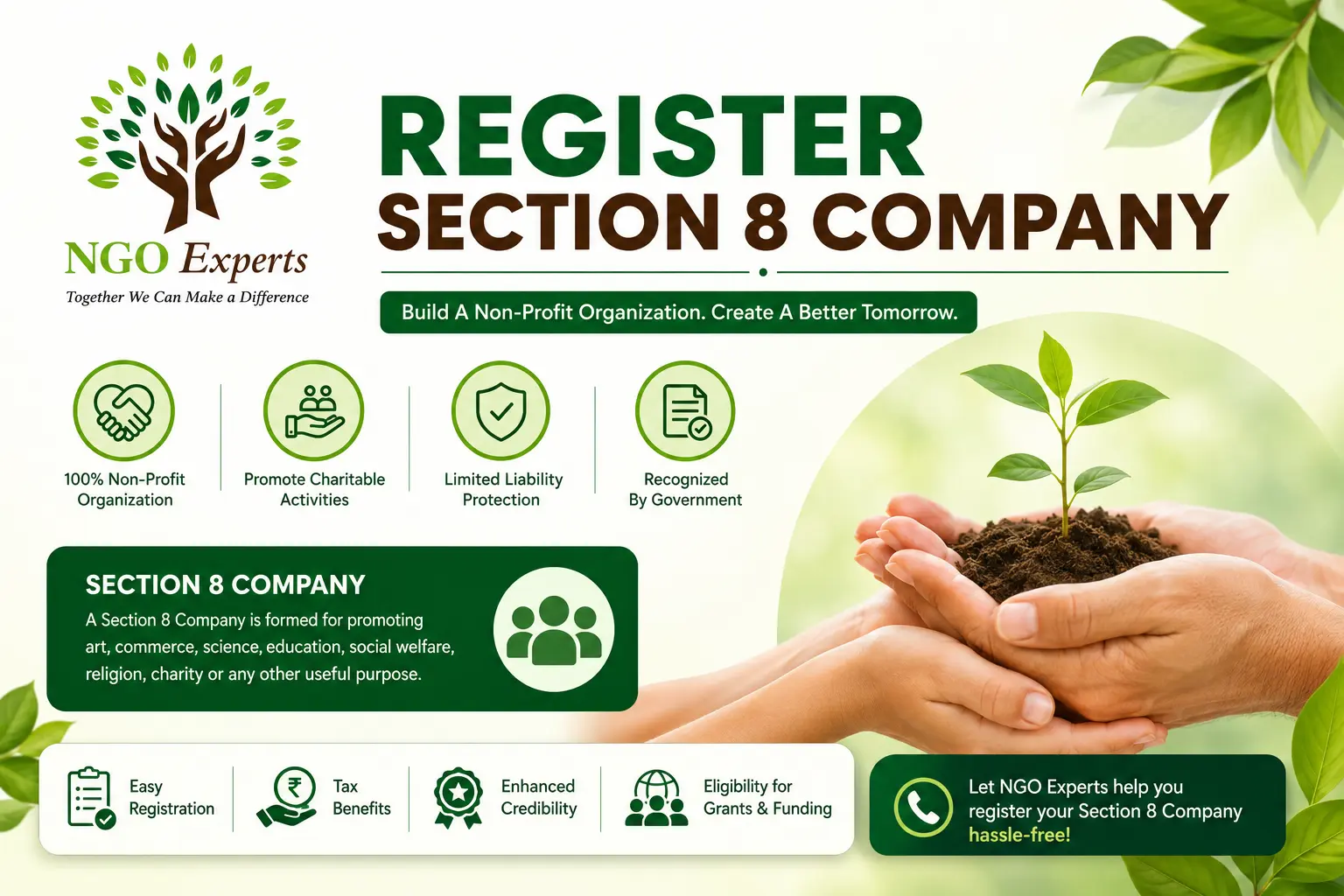
A Section 8 Company is governed under the Companies Act, 2013 and is created for promoting charitable objectives without distributing profits among members. It provides higher credibility, better transparency, tax advantages, and improved fundraising opportunities compared to many other non-profit structures.
In this detailed guide, you will learn:
- What a Section 8 Company is
- Benefits of registration
- Eligibility criteria
- Required documents
- Step-by-step registration process
- Government fees and costs
- Compliance requirements
- Tax exemptions
- Common mistakes to avoid
- FAQs
This blog is written in simple language so both beginners and professionals can easily understand the complete process of Section 8 Company registration in India.
What is a Section 8 Company?
A Section 8 Company is a non-profit organization registered under Section 8 of the Companies Act, 2013.
It is formed with the objective of promoting:
- Education
- Arts
- Commerce
- Charity
- Sports
- Social welfare
- Environmental protection
- Research
- Religion
- Healthcare
- Rural development
- Financial inclusion
- Public welfare activities
The profits earned by the company cannot be distributed among directors or members. Instead, the income must be used only for promoting the objectives of the organization.
Unlike normal companies, a Section 8 Company operates for social development and charitable purposes.
Why Choose Section 8 Company Registration?
Many NGOs, charitable trusts, and social entrepreneurs prefer Section 8 Company registration because it offers a professional and legally recognized structure.
Key Benefits of Section 8 Company Registration
1. Higher Credibility
Section 8 Companies are regulated by the Ministry of Corporate Affairs (MCA), which increases trust among donors, government departments, funding agencies, and corporate sponsors.
2. Separate Legal Entity
The company has its own legal identity separate from its members.
It can:
- Own property
- Open bank accounts
- Enter contracts
- Receive donations
- Sue or be sued
3. Limited Liability Protection
Members and directors enjoy limited liability protection.
Their personal assets remain protected from organizational liabilities.
4. Better Funding Opportunities
Many CSR donors, international agencies, and grant providers prefer funding registered Section 8 Companies due to better transparency and compliance standards.
5. Tax Benefits
After obtaining registrations such as 12A and 80G, the organization can enjoy tax exemptions and donors can claim tax deductions.
6. No Minimum Capital Requirement
There is no minimum capital requirement for incorporating a Section 8 Company.
7. Exemption from Using Private Limited or Limited
A Section 8 Company can use words like:
- Foundation
- Association
- Federation
- Council
- Forum
- Chamber
- Confederation
instead of “Private Limited” or “Limited”.
Who Can Register a Section 8 Company?
The following persons can form a Section 8 Company:
- Individuals
- NGOs
- Professionals
- Social entrepreneurs
- Trusts
- Societies
- Corporate entities
The company can be registered as:
- Private Limited Section 8 Company
- Public Limited Section 8 Company
Eligibility Criteria for Section 8 Company Registration
To register a Section 8 Company in India, the following conditions must be satisfied:
Charitable Objective
The company must work for charitable or non-profit purposes.
Profit Utilization
Any profit or income generated must be used only for promoting organizational objectives.
No Dividend Distribution
The company cannot distribute profits among members or directors.
Legal Compliance
The organization must comply with the Companies Act, 2013.
Minimum Requirements for Section 8 Company Registration
For Private Limited Section 8 Company
- Minimum 2 Directors
- Minimum 2 Members
- At least 1 Indian Resident Director
For Public Limited Section 8 Company
- Minimum 3 Directors
- Minimum 7 Members
- At least 1 Indian Resident Director
Documents Required for Section 8 Company Registration
Below are the important documents required during registration.
Documents of Directors and Members
Identity Proof
- PAN Card (mandatory for Indian nationals)
- Passport (for foreign nationals)
Address Proof
- Aadhaar Card
- Voter ID
- Driving License
- Passport
Residential Proof
- Bank Statement
- Electricity Bill
- Telephone Bill
- Mobile Bill
The document should generally not be older than 2 months.
Passport Size Photograph
Recent passport-size photos of directors.
Registered Office Documents
If Premises is Rented
- Rent Agreement
- NOC from Property Owner
- Utility Bill
If Property is Owned
- Ownership Proof
- Electricity Bill or Water Bill
Step-by-Step Process to Register Section 8 Company
The registration process is completely online through the MCA portal.
Step 1: Obtain Digital Signature Certificate (DSC)
All proposed directors must obtain a Digital Signature Certificate.
DSC is used for electronically signing MCA forms.
Step 2: Apply for Director Identification Number (DIN)
DIN is a unique identification number for directors.
It can be obtained during the incorporation process through the SPICe+ form.
Step 3: Name Approval Application
The next step is selecting and reserving the company name.
Tips for Selecting the Name
- Choose a unique and meaningful name
- Ensure the name matches the organization’s objectives
- Avoid identical or trademarked names
- Use suitable suffixes such as:
- Foundation
- Association
- Council
- Forum
- Federation
Examples:
- Helping Hands Foundation
- Green Earth Association
- Social Welfare Forum
Step 4: Draft MOA and AOA
Memorandum of Association (MOA)
MOA defines:
- Main objectives
- Activities
- Scope of operations
Articles of Association (AOA)
AOA defines:
- Internal rules
- Governance structure
- Management procedures
These documents are extremely important because they legally define how the organization will operate.
Step 5: File SPICe+ Incorporation Form
The SPICe+ form is submitted online on the MCA portal.
It includes:
- Company details
- Director details
- Registered office details
- PAN and TAN application
- Section 8 license request
Necessary attachments are uploaded along with the form.
Step 6: Approval from Registrar of Companies (ROC)
The Registrar of Companies verifies the documents and application.
If everything is correct, the ROC issues:
- Certificate of Incorporation
- Company Identification Number (CIN)
- PAN
- TAN
The company becomes legally registered after approval.
Time Required for Section 8 Company Registration
The complete registration process generally takes:
- 7 to 20 working days
The timeline may vary depending on:
- Document accuracy
- MCA approvals
- Name approval status
- Government processing time
Cost of Registering a Section 8 Company
The registration cost depends on multiple factors:
- Professional fees
- DSC charges
- Government filing fees
- Documentation support
The approximate cost usually ranges between:
- ₹8,000 to ₹30,000 or more
depending on professional services and requirements.
Important Compliance After Section 8 Company Registration
Many people think registration is the final step, but regular compliance is equally important.
Annual Compliance Requirements
1. Maintain Books of Accounts
The company must maintain proper accounting records.
2. Conduct Board Meetings
Regular board meetings must be conducted and recorded.
3. Annual Filing with ROC
Annual returns and financial statements must be filed with MCA.
4. Income Tax Return Filing
The organization must file income tax returns annually.
5. Statutory Audit
Financial statements must be audited by a Chartered Accountant.
Failure to comply can lead to penalties and legal issues.
Tax Exemptions for Section 8 Companies
A Section 8 Company can apply for important tax registrations.
12A Registration
12A registration helps the organization obtain income tax exemption.
80G Registration
80G registration allows donors to claim tax deductions on donations.
CSR Funding Eligibility
Many companies prefer donating CSR funds to compliant Section 8 Companies.
FCRA Registration
If the organization wants to receive foreign donations, it may apply for FCRA registration.
Difference Between Section 8 Company, Trust, and Society
| Basis | Section 8 Company | Trust | Society |
|---|---|---|---|
| Governing Law | Companies Act | Indian Trust Act | Societies Registration Act |
| Credibility | Very High | Moderate | Moderate |
| Regulation | MCA | State Authority | Registrar of Societies |
| Transparency | High | Medium | Medium |
| Compliance | Strict | Moderate | Moderate |
| Funding Preference | Highly Preferred | Accepted | Accepted |
A Section 8 Company is generally considered the most professional and transparent structure among all NGO models.
Common Mistakes to Avoid During Registration
1. Choosing a Conflicting Name
Always verify MCA name availability and trademark status before applying.
2. Incorrect Objective Drafting
The MOA objectives must clearly define charitable purposes.
3. Improper Documentation
Mismatched names, addresses, or expired documents can delay approval.
4. Ignoring Post-Incorporation Compliance
Non-compliance may lead to penalties or cancellation.
5. Selecting Wrong Business Structure
Evaluate whether Section 8 Company is suitable for your long-term goals.
Can a Section 8 Company Earn Profit?
Yes, a Section 8 Company can earn profit.
However:
- Profits cannot be distributed among members
- Income must be used only for organizational objectives
- Funds must support charitable activities
Can Foreign Nationals Become Directors?
Yes, foreign nationals can become directors in a Section 8 Company.
However:
- At least one director must be an Indian resident
- Foreign nationals must provide passport and address proof
Is Section 8 Company Suitable for Startups with Social Objectives?
Yes.
Many social enterprises and impact-driven startups choose Section 8 registration because it combines:
- Legal recognition
- Better governance
- Structured operations
- Funding opportunities
- Social impact credibility
Advantages of Professional Assistance
Professional support can help with:
- Name approval
- Documentation
- Drafting MOA and AOA
- Filing MCA forms
- Compliance guidance
- Tax registrations
This reduces rejection risk and saves time.
Frequently Asked Questions (FAQs)
1. Is Section 8 Company registration fully online?
Yes, the registration process is completed online through the MCA portal.
2. How many directors are required?
A minimum of 2 directors are required for a private Section 8 Company.
3. Can a Section 8 Company receive donations?
Yes, it can receive donations, grants, and CSR funding.
4. Is there any minimum capital requirement?
No, there is no minimum capital requirement.
5. Can Section 8 Companies receive foreign funding?
Yes, after obtaining FCRA registration.
6. Is audit mandatory?
Yes, statutory audit is mandatory.
7. Can salary be paid to directors or employees?
Yes, reasonable salary and remuneration can be paid for services.
Final Thoughts
Registering a Section 8 Company is an excellent option for individuals and organizations working toward social welfare and charitable goals.
It provides:
- Strong legal structure
- High credibility
- Better fundraising opportunities
- Tax benefits
- Transparency
- Long-term sustainability
If you are serious about building a professional non-profit organization in India, Section 8 Company registration can be the right foundation for your mission.
By understanding the process, documentation, compliance, and legal requirements properly, you can establish your organization smoothly and focus on creating real social impact.
Conclusion
A Section 8 Company is one of the most trusted and efficient legal structures for non-profit organizations in India. Whether your objective is education, healthcare, environmental protection, women empowerment, rural development, or social welfare, registering a Section 8 Company gives your organization legal recognition and operational credibility.
Before starting the registration process, ensure that:
- Your objectives are clearly defined
- Documents are properly prepared
- Compliance requirements are understood
- Professional guidance is taken when necessary
A properly registered and compliant Section 8 Company can help you build donor confidence, attract CSR funding, and expand your social mission effectively.
If you are planning to register a Section 8 Company, starting with the correct legal and compliance strategy will save time, reduce rejection risks, and strengthen your organization for long-term growth.
Click here for more information