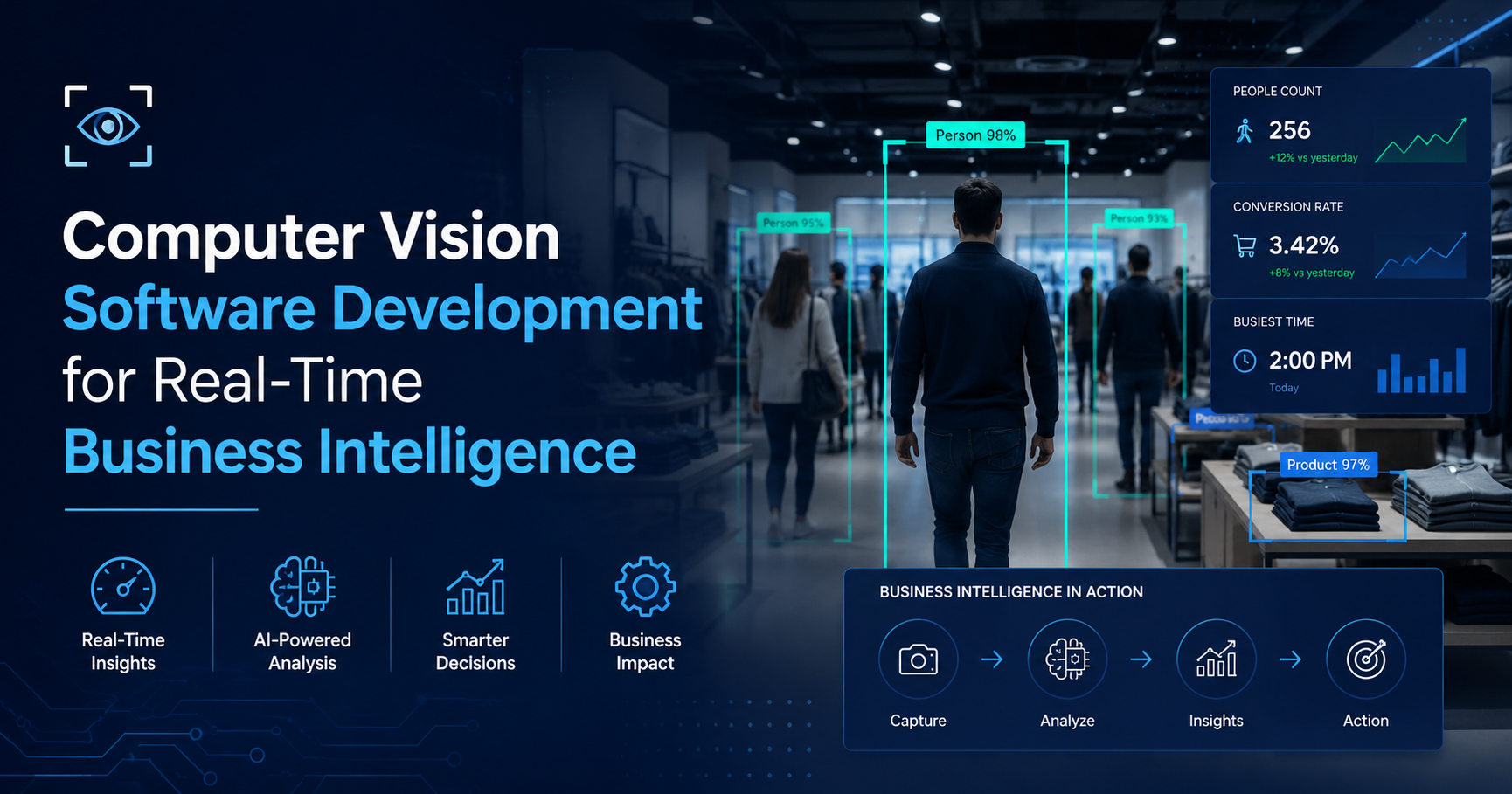
The Gap Between Data and What’s Actually Happening on the Ground
Most business owners have dashboards. They have reports, KPIs, and spreadsheets that summarize what happened yesterday — sometimes last week. But what about right now? What’s happening on your shop floor at this moment? Who walked into your store three minutes ago and left without buying? Is that production line running at capacity or quietly underperforming? Traditional business intelligence tools were never built to answer these questions in real time. They wait for humans to log data, run reports, and interpret trends. That delay costs money.
This is precisely the gap that computer vision software development is closing. Instead of relying on manual observation or after-the-fact reporting, computer vision systems watch, interpret, and respond to visual data in the moment — continuously, accurately, and at a scale no human team can match. For business owners who are serious about operational efficiency, this isn’t a futuristic concept anymore. It’s a working solution being deployed across industries right now.
What Computer Vision Actually Does in a Business Context
There’s a common misconception that computer vision is primarily a research or security technology. In reality, the most impactful applications today are deeply operational — tied directly to revenue, cost, and customer experience. At its core, computer vision software development refers to building systems that can analyze images or video feeds and extract actionable meaning from them. The camera becomes a sensor. The software becomes the brain that converts visual input into structured business data.
Think about what that means practically. A camera pointed at a warehouse aisle isn’t just recording footage — a trained computer vision system, powered by image recognition technology, turns that footage into inventory counts, movement logs, and bottleneck alerts. A camera at a retail checkout isn’t just a security measure — video analytics software transforms it into a queue management tool, a customer flow analyzer, and a staffing optimizer. The hardware is simple. The intelligence behind it is where the value lies, and that’s exactly what experienced computer vision developers design and build.
Real-Time Intelligence: Why Speed Changes Everything
Delayed intelligence is often useless intelligence. If you find out at the end of the day that a checkout queue peaked at 40 people around 2 PM, there’s nothing you can do about it. But if your system alerts you at 2:01 PM — through real-time object detection and queue length tracking — that threshold has been crossed, you can act — open another counter, redirect staff, adjust. That’s the real-time advantage, and it fundamentally changes how you run operations.
This shift matters across sectors. Here’s where real-time computer vision intelligence is generating the most measurable business impact today:
- Retail & QSR: Computer vision for retail is redefining store operations — from footfall counting, shelf occupancy detection, and customer dwell time tracking, to queue management — all feeding into live dashboards that managers can act on during the business day.
- Manufacturing & Warehousing: Machine learning for manufacturing enables defect detection on production lines, worker safety compliance monitoring, equipment utilization tracking, and automated inventory reconciliation.
- Logistics & Supply Chain: Dock management, vehicle identification, load verification, and real-time parcel tracking across large fulfillment centers.
- Healthcare Facilities: Patient flow monitoring, hand hygiene compliance, equipment location tracking, and visitor management — without adding administrative burden on staff.
- Banking & Finance: ATM fraud detection, branch traffic analysis, and behavioral anomaly flagging in high-security areas.
The common thread is this: a camera that was already there, or needs minimal installation, now feeds a continuous stream of business intelligence rather than sitting in a passive recording loop that no one reviews.
What Goes Into Building These Systems
If you’re evaluating whether to invest in a computer vision solution, it helps to understand what’s actually involved in building one. This isn’t a plug-and-play software subscription — it’s engineered infrastructure with several interconnected layers, each of which shapes performance, accuracy, and scalability.
A reputable computer vision development company typically works through the following stages to deliver a production-grade system:
- Problem scoping and data strategy: Defining exactly what the system needs to detect, classify, or measure, and identifying what training data exists or needs to be collected.
- Model development and training: Building or fine-tuning deep learning solutions — often convolutional neural networks or transformer-based architectures — on domain-specific datasets that reflect your actual operating environment.
- Edge vs. cloud architecture decisions: Determining whether inference should happen locally (on-device, for low-latency needs) or in the cloud (for scalability and centralized management), or in a hybrid setup.
- Integration with existing systems: Connecting the vision layer to your ERP, WMS, POS, or BI platform so that visual data flows into the tools your team already uses.
- Monitoring, retraining, and drift management: Maintaining model accuracy over time as environmental conditions, product lines, or operational layouts change.
Each of these stages requires specialized skills. Partnering with a qualified computer vision software development company — rather than attempting to bolt something together internally — significantly reduces the time to deployment and the risk of building something that underperforms in production conditions.
The ROI Conversation Business Owners Actually Need to Have
It’s easy to get excited about the technology and lose sight of the financial rationale. The questions that matter for business owners are straightforward: What does it cost, what does it save, and how long until it pays for itself?
Computer vision development services are not a one-size-fits-all expense. Costs vary significantly based on the complexity of the use case, the volume of camera inputs, the required inference speed, and the depth of integration with existing infrastructure. A retail footfall analytics system is a fundamentally different build than a real-time quality inspection system on a high-speed production line. That said, the ROI picture tends to be compelling for a predictable set of reasons.
- Labor reallocation: Tasks that currently require human observers — automated quality inspection, stock audits, safety walkthroughs — can be handled by the system continuously, freeing staff for higher-value work.
- Loss reduction: In retail, logistics, and manufacturing, real-time anomaly detection catches shrinkage, defects, and process failures before they compound into larger losses.
- Throughput improvements: Eliminating bottlenecks that are invisible to traditional reporting but clearly visible to a real-time monitoring system translates directly into output and revenue.
- Compliance and liability: In regulated industries, automated monitoring creates audit trails and compliance records that would otherwise require dedicated staff to maintain.
- Decision speed: When managers receive actionable alerts instead of next-day summaries, response times collapse — and so do the costs associated with delayed decisions.
The payback period depends on the specific application and scale, but businesses that deploy well-designed computer vision systems typically see meaningful ROI within 12 to 18 months, with ongoing value that scales as operations grow.
Choosing the Right Partner: What to Actually Look For
The market for computer vision development services has grown quickly, and not all providers have the depth to deliver production-ready systems that hold up in real-world conditions. For business owners navigating this landscape, a few evaluation criteria matter more than others.
The most important thing to look for is domain experience — not just technical competence in machine learning, but demonstrated understanding of your industry’s specific operational context. A provider that has built systems for retail environments understands lighting variability, customer privacy requirements, and the integration complexity of POS systems. That context shapes every architectural decision they make. General-purpose AI shops often underestimate these nuances.
Beyond domain expertise, look for evidence of end-to-end capability. Some providers specialize in model development but have limited experience with the infrastructure, integration, and maintenance layers that determine whether a system actually gets used in production. The best computer vision development companies handle the full stack — from camera placement strategy and hardware selection through model training, deployment, and ongoing performance management.
Finally, ask about how they handle model drift and retraining. Computer vision systems degrade when real-world conditions shift — new product packaging, seasonal lighting changes, facility layout updates. A partner that has a clear and operationally manageable process for keeping models accurate over time is far more valuable than one that delivers a precise system at launch that slowly degrades without anyone noticing.
Building Toward an Autonomous Intelligence Layer
For business owners thinking beyond the immediate project, the bigger strategic picture is worth considering. Computer vision is not a standalone capability — it’s a foundational layer in a broader move toward AI-powered business intelligence. When visual data feeds are structured, real-time, and integrated with your operational systems, they become the basis for AI-driven decision-making that goes well beyond alerts and dashboards.
The companies investing in computer vision development today are building the data infrastructure that will support predictive operations, automated procurement, dynamic staffing models, and eventually fully autonomous process management. That’s a long-term competitive position, not just a short-term efficiency gain.
Working with skilled computer vision developers who understand both the technical architecture and the business trajectory allows you to build systems that are extensible — designed to scale and connect to broader automation initiatives rather than exist as isolated point solutions. The businesses that approach this strategically, rather than tactically, are the ones that will find the most durable advantage in the years ahead.
Final Thought
The real-time visibility gap in business operations is a solvable problem. The technology is mature, the implementation pathways are well-defined, and the ROI case is clear across industries. What separates businesses that capture this advantage from those that don’t is usually not budget — it’s the quality of the partner they choose and the clarity of the problem they’re trying to solve.
If your operations involve physical environments, physical assets, or physical people — and most do — computer vision software development deserves a serious place in your technology roadmap.