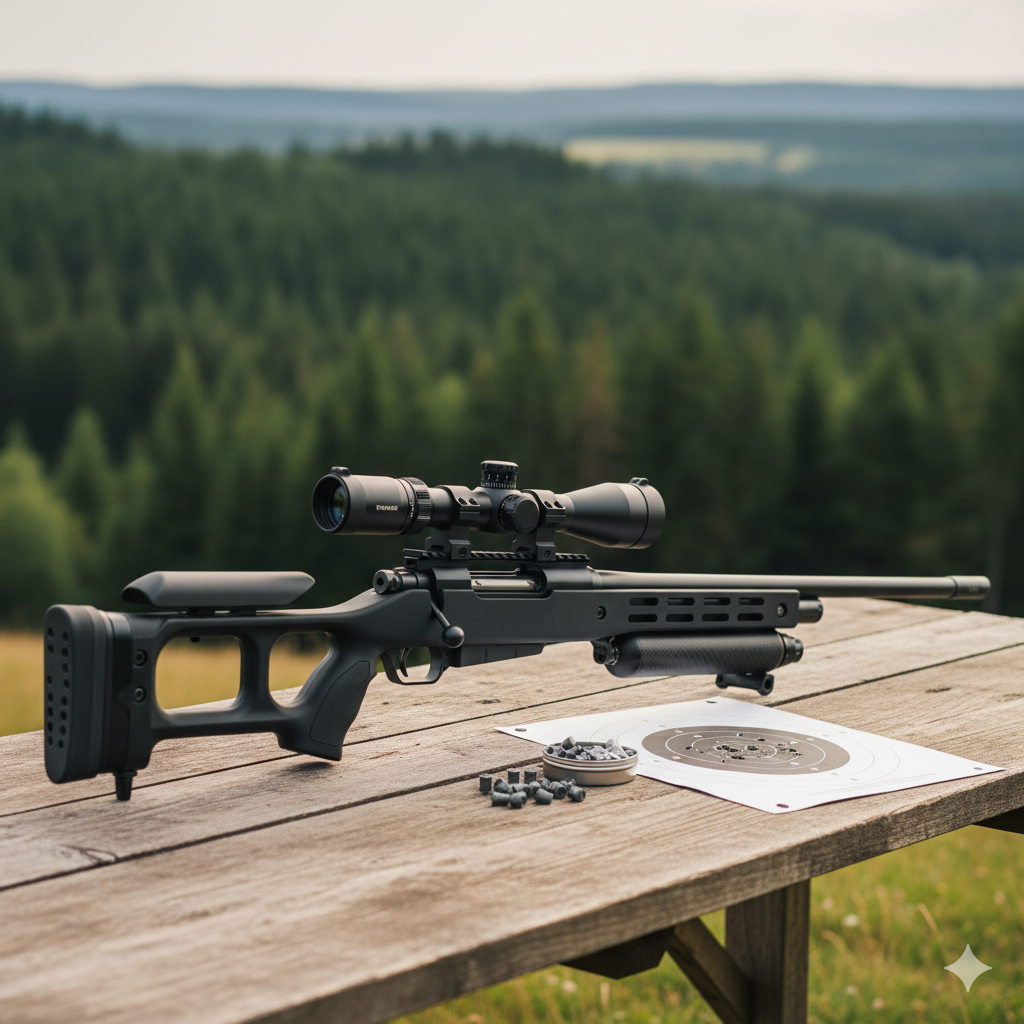
In the evolving world of airgunning, enthusiasts are constantly seeking the perfect balance between power, precision, and consistency. Whether you are a competitive target shooter, a small-game hunter, or a backyard plinker, the technology behind your equipment matters. At the pinnacle of this hobby lies the PCP (Pre-Charged Pneumatic) air rifle.
Unlike traditional break-barrels or CO2-powered guns, PCP rifles offer a level of performance that mimics high-end firearms without the recoil, noise, or powder-burning mess. However, a world-class rifle is only as good as the ammunition it fires. Understanding the synergy between your PCP air rifle and the specific pellet gun bullets you choose is the secret to achieving sub-MOA (Minute of Angle) accuracy.
What is a PCP Air Rifle?
A Pre-Charged Pneumatic (PCP) air rifle uses a high-pressure air reservoir (usually a cylinder or a carbon fiber bottle) to propel pellets. These tanks are typically filled to pressures between 2,000 and 4,500 PSI using a high-pressure hand pump, a scuba tank, or a specialized compressor.
Why PCP is the Gold Standard
The primary advantage of PCP technology is the lack of movement. In a spring-piston rifle, a heavy metal piston slams forward when you pull the trigger, creating a “double recoil” that can throw off your aim. In a PCP rifle, a small hammer simply strikes a valve to release a measured burst of air. The result? A virtually recoil-free shooting experience that allows you to watch your pellet impact the target through your scope.
Understanding Pellet Dynamics: More Than Just Lead
If the rifle is the engine, the pellet is the tires. You wouldn’t put budget tires on a supercar, and you shouldn’t put low-quality pellets in a high-end PCP air rifle. When we talk about “pellet gun bullets,” we are usually referring to Diabolo-shaped projectiles, but the nuances in weight, shape, and head size are vast.
1. Caliber Choice: .177 vs. .22
- .177 (4.5mm): The standard for Olympic target shooting. It offers a flatter trajectory and higher velocity, making it easier to hit targets at varying distances.
- .22 (5.5mm): The favorite for hunters. While it drops faster than a .177, it carries significantly more kinetic energy downrange, ensuring a humane kill on small game.
2. Weight and Sectional Density
PCP rifles are powerful. If you use a pellet that is too light, it may break the sound barrier. While “supersonic” sounds cool, it’s actually detrimental to accuracy. As a pellet slows back down and crosses the “transonic” zone, it becomes unstable and “tumbles.” For high-power PCP rifles, heavy, aerodynamic pellets are essential for maintaining stability at long ranges.
The Anatomy of Accuracy: Matching Pellet to Barrel
Every air rifle barrel is unique. Even two rifles of the same model from the same manufacturer may “prefer” different ammunition. This is due to microscopic differences in the rifling.
Why Head Size Matters
Many professional shooters buy pellets based on specific head sizes (e.g., 4.50mm vs. 4.52mm). A slightly larger head size ensures a tighter fit in the rifling, creating a better air seal and more consistent spin. This consistency is what eliminates “flyers”—those frustrating shots that land inches away from your grouping for no apparent reason.
Maintenance for Long-Term Precision
Owning a PCP air rifle comes with specific responsibilities. Because you are dealing with high-pressure air, moisture is your enemy.
- Dry Air: Always use a moisture filter if you are filling with a hand pump. Internal rust can ruin a PCP reservoir and valve system.
- Barrel Cleaning: Unlike powder-burners, air rifles don’t suffer from carbon buildup, but they do get “leaded.” Periodically cleaning your barrel and then “seasoning” it with 10–20 shots of your preferred pellet will keep your groups tight.
- O-Ring Care: Keep your seals lubricated with pure silicone oil. Never use petroleum-based oils, as they can combust under high pressure (a dangerous phenomenon known as dieseling).
Shooting Techniques for PCP Rifles
While PCP rifles are easier to shoot than springers, mastering them still requires discipline.
The Artillery Hold vs. A Firm Grip
Because PCP rifles don’t have the violent vibration of a spring-piston, you don’t need the loose “artillery hold.” You can hold a PCP rifle more like a traditional firearm. However, consistency is still king. Your cheek weld, shoulder pressure, and trigger pull must be identical every time.
Managing the “Shot String”
Unless your rifle is “regulated” (equipped with an internal device that ensures every shot uses the exact same air pressure), your velocity will change as the tank empties. Understanding your rifle’s “sweet spot”—the pressure range where the velocity is most consistent—is vital for long-range accuracy.
Conclusion: The Perfect Pairing
The journey to becoming a master airgunner is one of experimentation. By investing in a high-quality PCP air rifle, you provide yourself with a platform capable of incredible feats. But to truly unlock that potential, you must treat your pellet gun bullets as a critical component of the system.
Test different weights, try various head sizes, and always prioritize quality over price. When the right rifle meets the right pellet, the results are nothing short of surgical.
Frequently Asked Questions (FAQ)
1. How many shots can I get from one fill of a PCP air rifle?
This depends entirely on the size of the air reservoir and the power setting of the rifle. A small carbine might get 30–40 consistent shots, while a large bottle-forward rifle regulated for target shooting can get over 200 shots per fill.
2. Can I use a standard bicycle pump to fill my PCP rifle?
Absolutely not. A bicycle pump reaches maybe 100–120 PSI. A PCP rifle requires upwards of 3,000 PSI. Attempting to use a non-rated pump is not only impossible but can be dangerous. You must use a specialized high-pressure hand pump or a compressor.
3. Why are my pellets “spiraling” in the air?
Spiraling usually occurs when a pellet is driven too fast for its weight or if the barrel is dirty. If you are using a high-power PCP, try switching to a heavier, “magnum” grade pellet to stabilize the flight path.
4. Is a .177 pellet better than a .22 for backyard practice?
For general target practice, .177 (4.5mm) is usually preferred because the ammunition is cheaper, and the flatter trajectory is more forgiving for beginners. However, .22 is better if you eventually plan to transition into small game hunting.
5. Do PCP air rifles require a license?
This depends on your country and local regulations. In many regions, air rifles under a certain power limit (measured in Joules or Foot-Pounds) are unregulated, while high-power versions may require a firearm competency or permit. Always check your local laws before purchasing.
6. What are “slugs” and can I use them in my PCP rifle?
Slugs are pellets shaped more like traditional bullets (without the “waist” of a Diabolo). They are heavier and more aerodynamic, making them great for extreme long-range shooting. However, they usually require a specific barrel twist rate to stabilize, so check if your rifle is “slug-ready” before switching.