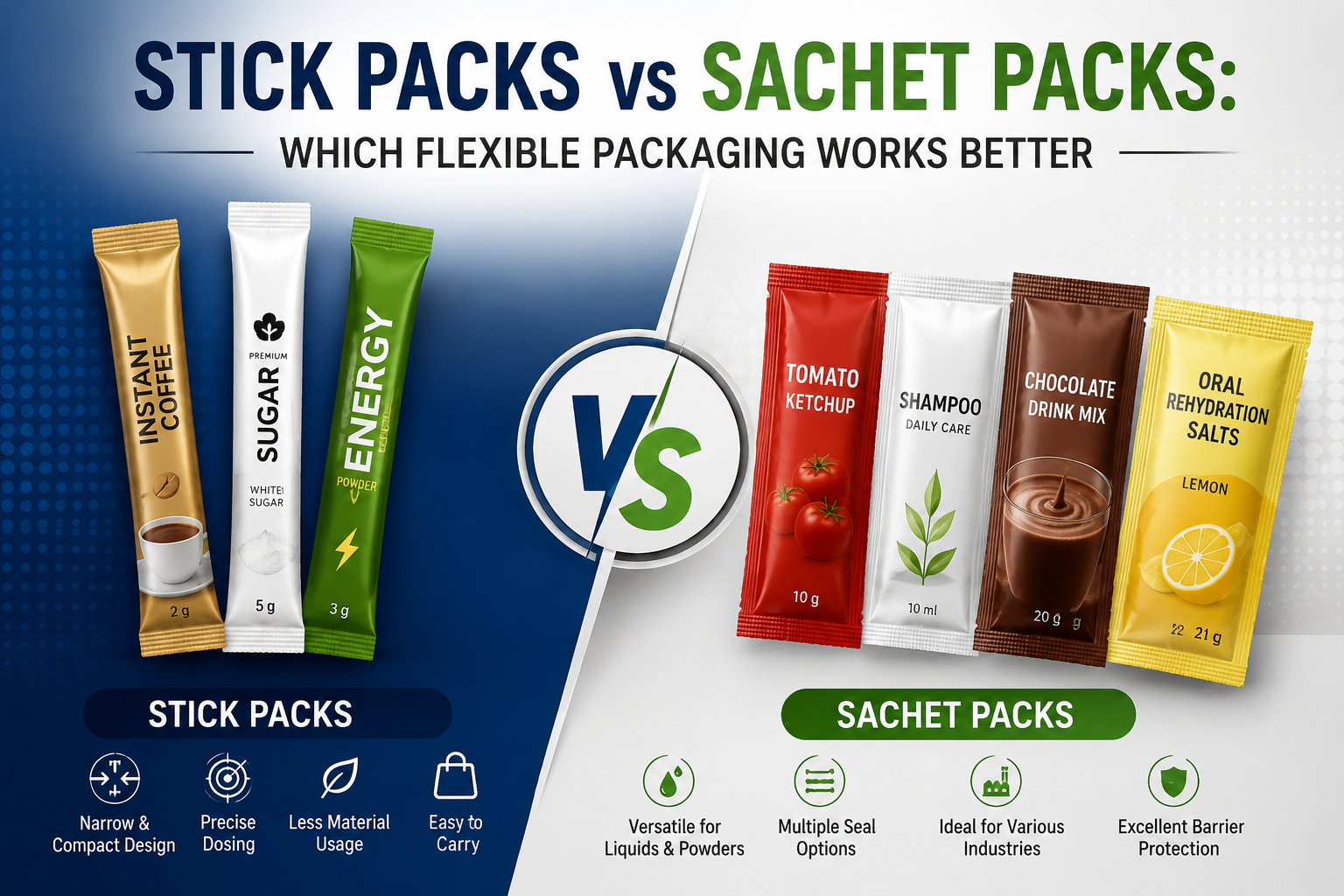
Flexible packaging is a key element in today’s product delivery which in turn is seen in industries like food, beverages, nutraceuticals, cosmetics, and pharmaceuticals. In terms of types of packages, stick packs and sachet packs are very much in use for single dose applications thanks to their convenience, cost effective nature, and performance in preserving product integrity.
At first look both formats are the same but in fact have different structures, fillers’ behavior, machine compatibility, and production performance. What manufacturers’ choice of which to use is concerned with is beyond just appearance it also includes production efficiency, material performance, and filling accuracy.
This blog looks at in detail stick packs and sachet packs with respect to their structure, application and production requirements which also includes the role of Sachet Packaging in present day packaging systems which we support with Pouch Filling Packing Machine technology.
What is Sachet Packaging?
Sachet packaging is of small sealed flexible pouches which we use for single use or limited quantity products. We see them in powders, liquids, gels, sauces, and granular materials.
Sachets tend to be of a flat rectangular design which they maintain until filled with product at the point of manufacture. Also because of their small size they are well suited for precise dose delivery and cost sensitive products.
In many sectors we see a preference for Sachet Packaging as a result of it’s flexibility that allows for various products to be put in them. They are used in food seasonings, ketchup, shampoo samples, coffee mixes, and pharmaceutical powders.
Sachet products also do very well in what we have for high speed production of fillers, also our machines which we designed for that purpose.
What are Stick Packs?
Stick packs are a narrow flexible design that mostly include single serve items. They are very long and slim as a contrast to sachets, out of the box which they put in the tea bag processor for items like powders, sugar substitutes, instant coffee, and dietary supplements.
Stick pack design which features controlled dispensing is what makes them a great choice for products that require precise dosing and easy pour.
Stick pack production often uses high speed vertical form fill seal systems which also produce uniform seals and the same fill weights.
Main Points That Differ Between Stick Packs and Sachet Packs
Both of the packages do the same things but vary in many areas:.
1. Form and Framework
- Stick packs: Extended and narrow tube shape.
- Sachets: Rectangular or square in shape.
2. Material Application
- Packets of that which tend to use less material per unit.
- Sachet size will determine that a little more film is used.
3. Product Fit
- Stick packs: Pastes, powders, tablets.
- Sachets: Liquids, pastes, dusts, powders.
4. Fill Rate
- Stick packs require precise dosing systems
- Sachets allow more flexible filling options
5. Seal out Behavior
- Stick pack longitudinal seal consistency.
- Sachets require proper seal around all edges.
Benefits of Sachet Packaging
Sachet packaging has wide scale use because of its flexible and economic structure. It covers a great deal of product categories and production environments.
Key benefits include:.
- Suitable for a wide range of products which are liquid or dry.
- Easy to scale in production lines
- Supports multiple barrier film structures
- Efficient for single-use applications
- Works with different sealing configurations
- Reduces waste of products via precise dosing.
In industries that value product samples and portion control sachet packaging is very useful.
Benefits of Stick Pack Packaging
Packets for sticks are also present which is to the benefit of the user and the material.
Key benefits include:.
- Compact and lightweight design
- Easy to carry and use
- Controlled dispensing of product
- Reduced packaging material usage
- Suitable for high-speed production systems
- Consistent dosing accuracy
In large part due to their shape stick packs are used in premium supplement and beverage lines.
Role of the Pouch Filling Machine in Manufacturing
The quality of both sachet and stick pack formats is very much a function of the Pouch Filling Packing Machine which we use in production.
These machines are responsible for:.
- Accurate product dosing
- Consistent sealing quality
- Film alignment during forming
- Speed control for production efficiency
- Reducing operator intervention during long runs
In today’s packaging equipment we see that machine stability is a key factor in the reduction of issues like misalignment, sealing defects, and inconsistent fill weights.
For in sachet and stick pack forms machine compatibility is what sees out the production stability in the long term as opposed to trial performance.
Production Considerations in Real Manufacturing
In live production settings we see that performance is evaluated beyond the initial trials. We have that at scale issues of long term stability, roll changes, and SKU variations play into output consistency.
Common production challenges include:.
- Changes in film thickness which affect sealing behavior.
- Friction variation causing tracking issues
- Seal inconsistency during high-speed operation
- Operator adjustments required during long shifts
Both in sachet and stick pack forms these systems have to perform stably.
Which Packaging Works Better?
There isn’t a one size fits all answer, as each format has its own benefits.
- Packs of units are better for controlled, dry, and supplement based products.
- Pouch packaging is for a variety of product types which includes liquids and sauces.
The decision depends on:.
- Product type
- Filling requirements
- Machine capability
- Production speed
- Packaging cost structure
In many manufacturing settings sachet packaging is what we see put to use for its flexibility and wide range of uses which in turn stick packs are used for exact dose applications.
Applications in Different Industries
Food Industry
- Sachets: Sauces, tomato sauce, seasonings.
- Stick packs: Sweeteners, coffee blends.
Beverage Industry
- Sachets: Mix drinks, syrups.
- Stick packs: Energy bars, gels.
Pharmaceutical Industry
- Sachets: Dusts, pellets.
- Stick packs: Dose controlled supplements.
Cosmetic Industry
- Sachets: Sample of shampoo, conditioner sample.
- Stick packs: Skin care samples of liquid form.
FAQ Section
What do we use for sachet packaging?
In the case of food, cosmetic, and pharmaceutical industries, single use products that come in sachet packaging include those such as sauces, powders, liquids, and gels.
Which is better, stick packs or sachets?
Neither is a one size fits all solution. Stick packs do well with dry and dosed products, at the same time sachets present a more flexible option for liquid and mixed applications.
What is the machine for sachet and stick pack production?
Also what you will see are machines that produce both formats which are used in flexible packaging operations.
What can be done with liquid products in terms of sachet packaging?
Yes, we see that sachets are used for liquid products like sauces, shampoo samples, and cosmetic liquids.
What do we see as the primary difference between stick packs and sachets?
The primary distinction is in shape and application. Stick packs are narrow and tubular, and sachets are flat which also allows for a greater range of product uses.
Conclusion
Stick packs and sachet packs in the field of flexible packaging are very much important. In terms of stick packs we see precise dosing and compact design as key features, for sachets it is about which industry can use them in which they excel.
Selecting the appropriate format is a function of product requirements, machine compatibility, and production conditions. In stable Sachet Packaging systems which feature reliable Pouch Filling Packing Machine technology manufacturers are able to maintain constant output and reduce operational variation in real production settings.