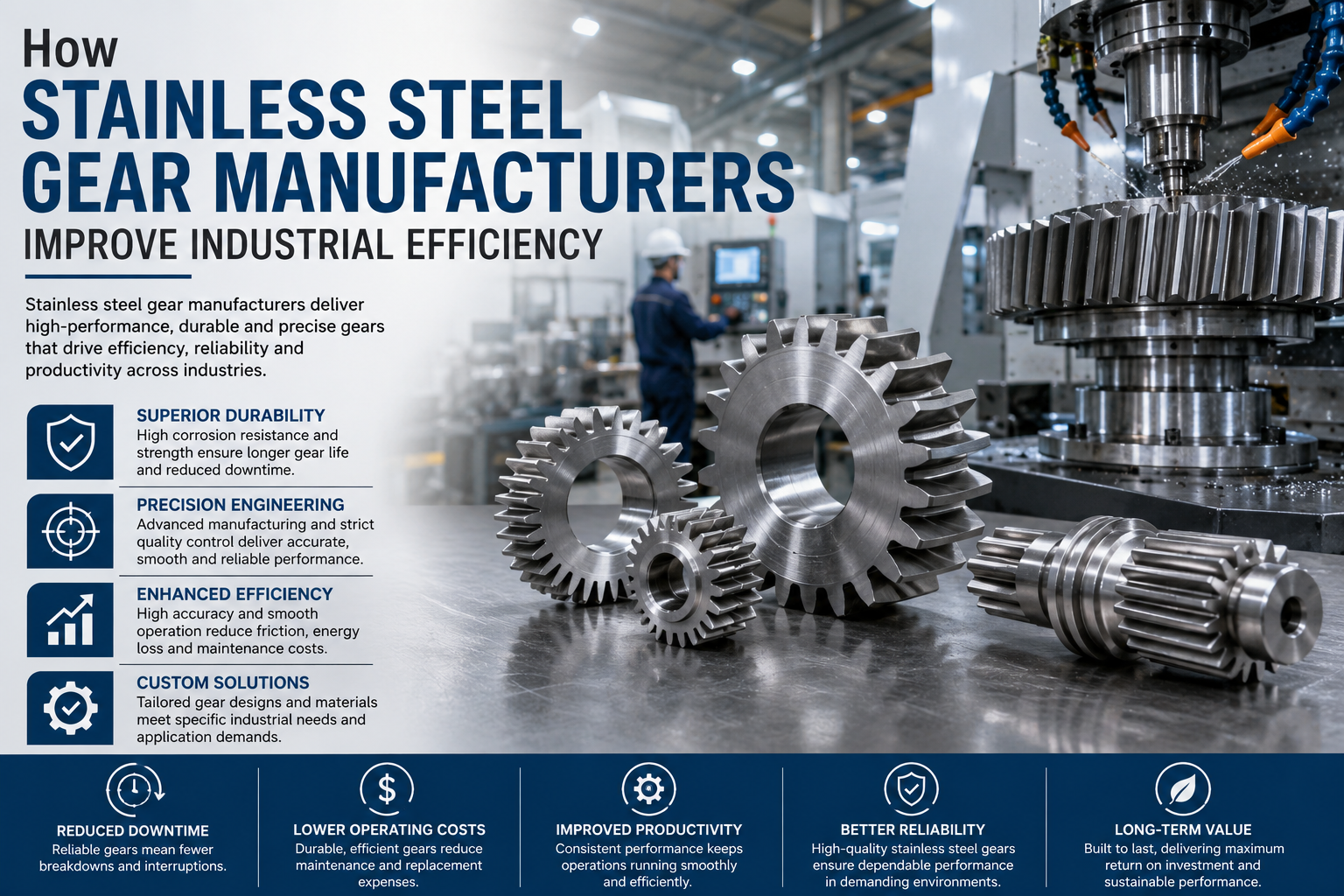
A gearbox failure during peak production doesn’t announce itself. It just stops the line. That’s where Stainless Steel Gear Manufacturers quietly decide whether your output holds or collapses.
Most buyers only realize this after a batch of gears starts corroding in humid storage yards or oil-heavy environments. And yet, the material choice was made on price, not performance. That decision usually costs more later than it ever saves upfront.
We’ve seen procurement teams switch from standard alloys to stainless setups after repeated breakdowns in pump assemblies used in 24/7 operations. One refinery client lost nearly 14 hours of uptime in a single quarter due to surface pitting. That wasn’t a design flaw. It was a material shortcut.
And here’s the part nobody likes to admit—gear efficiency rarely fails in theory. It fails in the gap between specification sheets and real factory conditions.
Specification: What Actually Defines Industrial Gear Performance
Material Composition That Survives Load Cycles
Stainless Steel Gear Manufacturers typically use grades like 304, 316, and hardened variants for corrosion-heavy environments. 316 alone improves corrosion resistance by nearly 2–3x in saline or chemical exposure zones (industry metallurgical benchmarks).
Precision Tolerance and Fit Accuracy
Even a 0.02 mm deviation can create vibration buildup in high-speed assemblies. That’s not theory—it shows up as heat, noise, and early bearing failure.
Surface Hardness Treatment
Case hardening and carburizing extend gear life by 30–40% in continuous-duty applications, especially in oil pump systems.
Sintered Gear Options for Cost Control
Sintered variants are often underestimated. Sintered Gears Manufacturers in India report up to 25% material efficiency savings in mass production, but buyers often ignore density variation risks.
One detail most buyers miss: lubrication compatibility. A perfectly machined gear still fails if surface finish and oil viscosity don’t align.
Objective: How to Evaluate a Supplier Without Guesswork
- Dimensional consistency across batches
Bad answer: “We check randomly.” That usually means quality drift after 200–300 units. - Material traceability
Bad answer: “We use certified steel.” Without heat number tracking, that certificate means very little. - Load testing under real conditions
Bad answer: “Lab tested.” Lab loads rarely match industrial shock loads in oil pumps. - After-sales defect handling
Bad answer: “We’ll adjust case by case.” That’s not support. That’s uncertainty shifting back to you. - Production scalability without quality drop
Bad answer: “We can scale easily.” Most shops can’t maintain tolerance when volumes jump 5x.
Procurement teams that skip these checks usually pay for it in downtime, not invoices.
Benefits: What Changes When Material Choice Is Right
- Reduced corrosion failure in humid and chemical-heavy plants
- Extended lifecycle of pump assemblies by up to 35% based on industrial usage patterns
- Lower vibration levels in high-speed gear trains
- Improved energy efficiency due to reduced friction losses
- Fewer emergency shutdowns in continuous operations
- Better compatibility with Oil Pump Gears systems used in hydraulic setups
Here’s the uncomfortable truth—most buyers don’t lose money on gear price. They lose it on downtime that never gets itemized properly.
And yet, switching suppliers is harder than switching specs. That friction keeps many stuck with underperforming components far longer than they should be.
Availability: Where Supply Actually Matters
We supply across India, including industrial clusters where machining demand is constant—Gurugram, Faridabad, Pune, and Ahmedabad.
Most Oil Pump Gears Suppliers concentrate only on metro-based dispatch efficiency. That sounds fine until you need urgent replacement in a plant operating 24/7 in a Tier-2 industrial zone. Logistics delay becomes production loss.
India’s gear manufacturing ecosystem has expanded rapidly, but consistency still varies widely between exporters and local job shops. According to MSME tooling data, nearly 42% of rejections in industrial procurement are linked to dimensional inconsistency, not design errors.
That gap is where sourcing strategy matters more than sourcing cost.
About Us
We’re Swadeshi Gears. And we don’t separate production from responsibility.
We’ve been supplying to export-linked industrial buyers since 2013, and one thing changed our internal process permanently. A batch of gears used in a hydraulic oil system failed in a Gulf shipment because we skipped a secondary hardness check on a “routine” order. We ate the cost. No negotiation.
That’s why every lot now passes through torque simulation before dispatch. Not because a certificate demands it, but because field failure is more expensive than inspection.
We currently support clients across 31 countries, and yes, we’ve stopped production lines mid-cycle just to recheck tolerances. That’s not efficiency loss. That’s long-term discipline.
Send us your drawing, load requirement, and application type. We respond within 12 hours with feasibility feedback, MOQ details, and production timeline.
MOQ starts at 500 units depending on geometry. For urgent Stainless Steel Gear Manufacturers requirements, include material grade and application pressure rating in your inquiry.
Conclusion
Stainless Steel Gear Manufacturers decide more than part quality—they decide whether your production line stays predictable or becomes reactive. Material choice isn’t a specification detail. It’s a downtime strategy.
Which means the next procurement decision isn’t about buying gears. It’s about buying stability under load.
Here is another blog you might be interested in.
Sintered Gears vs Traditional Gears: Key Performance Guide
FAQs
1. What makes an Oil Pump Gear Suppliers trustworthy?
What makes a company trustworthy is the batch traceability that they offer and not only catalogs. A majority of Oil Pump Gear Suppliers avoid load simulation, which results in premature damage in actual pump conditions.
2. What is the compelling reason that one would consider a Stainless Steel Gear Manufacturer in India when there are other Stainless Steel Gear Manufacturers in other countries?
Manufacturers in India are cost effective, and only a few can keep tight tolerances and control across the entire production process. Otherwise, cost advantage dissipates and the majority ends up spending more on maintenance cycles.
3. How does Sintered Gears Manufacturers India vary from other standard machining units?
Sintered Gears Manufacturers India involve powder metallurgy, and while it creates less waste, control among varying density gaps can be a challenge.
4. Can Sintered Gears Suppliers in India be used in high load systems?
Yes, they can, as long as they are compacted and heat treated. Under severe shock loading, support fails if surface porosity is not controlled.
5. What are the precautions one must take prior to purchasing Oil Pump Gears?
The precautions that need to be checked for fittings and the process must include the grade of the material, the depth of hardness and a full real load test. Bypassing any of these checks and tests are usually the causes of early system fatigue.
6. Can Stainless Steel Gears help decrease the maintenance cycles?
Yes, in the case of systems that are exposed to corrosion and/or systems that operate in the case of high moisture. However, improper lubrication can cause a decrease in lifespan.
7. How soon do Oil Pump Gears Manufacturers in India respond to transacted orders?
Most will respond within 24 to 72 hours, and only a few, like structured exporters, will place an emergency order while there is still no change in the quality of the goods produced.