A practical guide to supplier selection, product clarity, documentation support and repeat sourcing for healthcare distribution teams
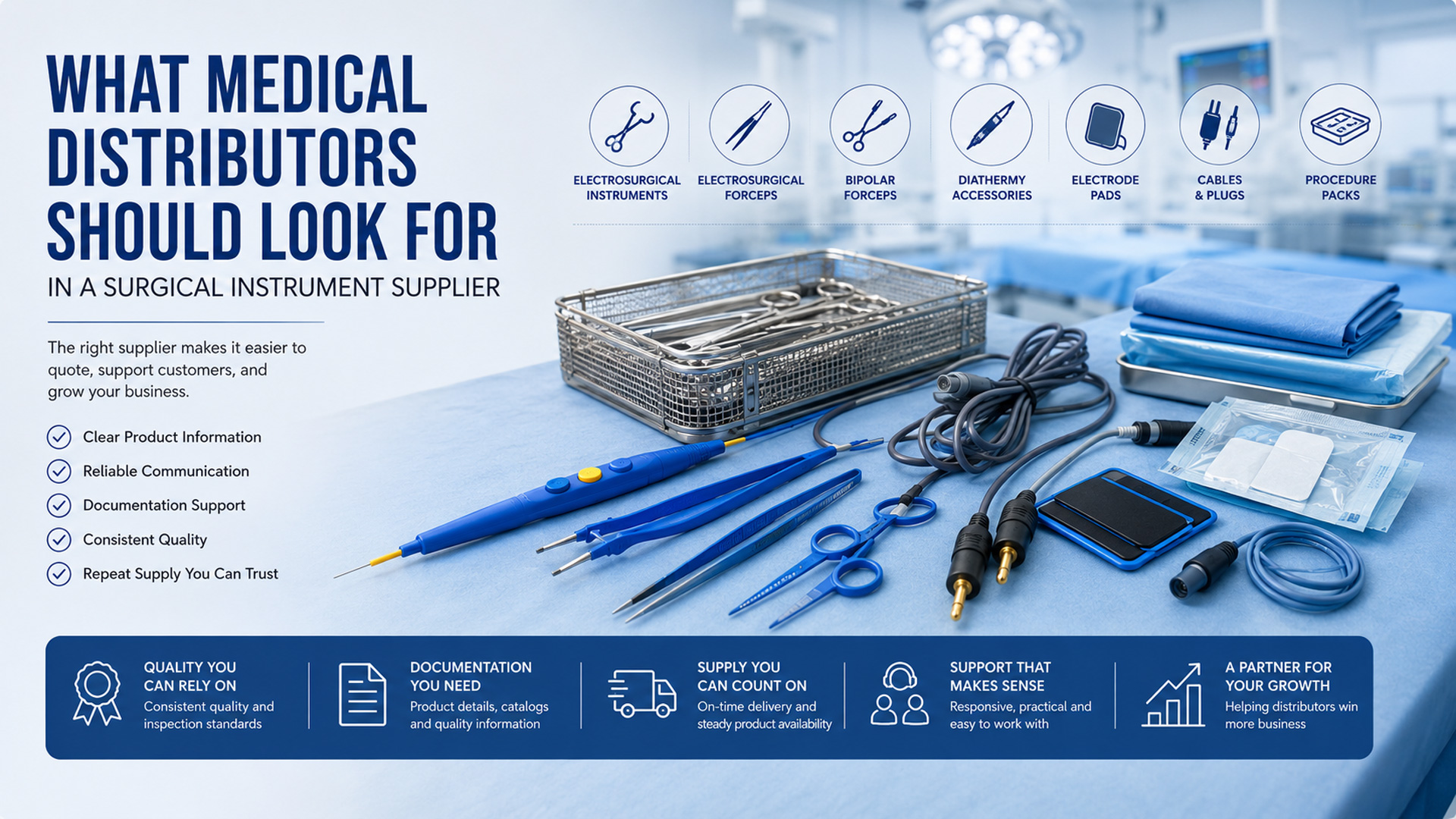
Medical distributors play an important role in helping hospitals, clinics, and healthcare procurement teams access surgical products with confidence. But distributor success depends heavily on supplier quality, communication, product clarity, and documentation support. When a distributor is sourcing electrosurgical instruments, forceps, bipolar products, diathermy accessories, electrode pads, cables, plugs, or procedure packs, the right supplier can make customer quotations and repeat purchasing far easier to manage.
A reliable surgical instrument supplier should give medical distributors clear product information, responsive quotation support, documentation guidance, and access to connected categories such as electrosurgical instruments, bipolar forceps, diathermy accessories, and procedure packs. Distributors should choose suppliers that make products easier to explain, quote, present, and reorder for healthcare customers.
Why Supplier Choice Matters for Medical Distributors
Distributors need more than a product list. They need supplier information that is accurate, organised, and practical enough to support customer conversations. If product descriptions are incomplete, categories are unclear, or documentation is difficult to obtain, distributors can lose time during quotation preparation, customer onboarding, and tender support.
A strong supplier helps distributors respond faster. Clear product names, practical documentation, organised category information, and realistic quotation communication can improve the way distributors serve hospitals, clinics, and healthcare purchasing teams.
Distributor insight: The best supplier relationships reduce friction. They make it easier for distributors to explain products, prepare quotations, support customer review, and manage repeat purchasing.
Core Product Categories Distributors Often Need
- Electrosurgical instruments for hospital, clinic, and surgical department supply.
- Electrosurgical forceps for buyers reviewing insulated forceps and related instrument options.
- Bipolar forceps for customers comparing standard bipolar forceps, single-use bipolar forceps, and specialist bipolar instruments.
- Diathermy electrodes for electrosurgical accessory sourcing.
- Diathermy cautery pencils for connected diathermy accessory requirements.
- Electrode pads for buyers reviewing patient return electrode options where applicable.
- Diathermy cables and plugs for connection-related accessory requirements.
- Procedure packs for structured surgical kit planning and recurring supply discussions.
Supplier Qualities That Support Distributor Growth
Clear Product Categories
Distributors need products to be easy to understand and present. A supplier should organise products in a way that supports customer conversations, catalogue preparation, and quotation accuracy. Confusing category names or unclear product descriptions can create unnecessary delays.
Responsive Quotation Communication
Distributor enquiries often move quickly because healthcare customers may be comparing multiple options. Suppliers should provide practical responses around product categories, quantities, packaging expectations, documentation needs, and delivery considerations.
Documentation and Quality Information
Hospitals and clinics may request product details, catalogue resources, specifications, packaging information, and quality-related information before moving forward. Distributors should work with suppliers that understand these review needs and respond with organised information.
Connected Product Availability
A distributor may begin with a forceps enquiry and later need diathermy accessories, electrode pads, cables, plugs, or procedure pack components. Suppliers that understand connected surgical categories can help distributors avoid managing too many fragmented sourcing conversations.
Supplier-side perspective: Distributor enquiries are easier to support when they include the product category, expected quantity, destination market, packaging preference, documentation needs, and any related accessories or procedure pack requirements.
Electrosurgical Instruments and Forceps: Why Clarity Is Essential
Electrosurgical instruments and forceps are common distributor sourcing categories, but they require clear product information. Distributors should confirm instrument type, available options, packaging details, connection requirements where relevant, and any documentation required by the customer.
Electrosurgical Forceps
Electrosurgical forceps should be presented with clear product naming, organised category information, and practical product details. This helps distributors explain products to healthcare customers with greater confidence.
Bipolar Forceps
Bipolar forceps may require a more detailed discussion, especially when customers are comparing standard bipolar forceps, single-use bipolar forceps with integrated cable, or specialist bipolar instruments. Distributors should request enough product information to support customer review before quoting.
Diathermy Accessories: A Valuable Connected Category
Diathermy accessories are often sourced alongside electrosurgical instruments and forceps. A distributor may need cautery pencils, diathermy electrodes, electrode pads, cables, plugs, or related products within the same sourcing request.
- Diathermy electrodes should be reviewed by type, quantity, packaging expectations, and documentation requirements.
- Diathermy cautery pencils may be sourced alongside electrodes and other accessories.
- Electrode pads should be discussed with clear product information and customer requirements.
- Cables and plugs should be reviewed early when connection-related requirements are part of the enquiry.
Procedure Packs: A Strong Opportunity for Distributor-Led Supply
Procedure packs can help distributors offer structured sourcing support to hospitals and clinics. When pack contents are clear and repeat purchasing is likely, a defined kit can reduce procurement complexity for the customer.
Before requesting a procedure pack quotation, distributors should prepare:
- Required instruments, accessories, and components
- Quantity of each item per pack
- Packaging and labelling expectations
- Expected order volume
- Destination market and delivery requirements
- Documentation required by the customer
- Any catalogue or customer-facing presentation needs
Single-Use and Reusable Products: What Distributors Should Ask
Distributors may receive enquiries for both single-use and reusable electrosurgical instruments. The right sourcing route depends on customer requirements, clinical workflow, stock handling, sterilisation arrangements, product preference, and documentation needs.
- Reusable instruments may be relevant where customers have established handling and reprocessing processes.
- Single-use instruments may be relevant where customers prefer defined usage models or simplified stock handling.
- Distributor planning should consider product demand, documentation requirements, catalogue positioning, and repeat-order feasibility.
Procurement guidance: Distributors should encourage healthcare customers to confirm product suitability through their own clinical, technical, procurement, and compliance review before selecting single-use or reusable options.
Choosing a Supplier That Supports Distributor Confidence
A dependable surgical instrument supplier helps distributors move faster and communicate more clearly. The right supplier should understand how product information, documentation, packaging expectations, and repeat purchasing affect distributor success.
Distributors reviewing connected electrosurgical and surgical product categories may find value in suppliers such as Cosil Instruments’ electrosurgical instruments range, where related categories such as forceps, bipolar instruments, diathermy accessories, procedure packs, and surgical accessories can be discussed as part of a broader sourcing requirement.
FAQs About Surgical Instrument Supplier Selection for Distributors
What should distributors look for in a surgical instrument supplier?
Distributors should look for clear product information, responsive quotation support, documentation availability, organised product categories, and access to related surgical products such as forceps, diathermy accessories, cables, plugs, and procedure packs.
Why is product clarity important for medical distributors?
Product clarity helps distributors prepare accurate quotations, support customer review, build catalogue information, and reduce delays during procurement conversations.
Can distributors source procedure packs from a surgical supplier?
Yes. Procedure packs can support distributor customers when kit contents, quantities, packaging expectations, and documentation needs are clearly defined.
Should distributors ask about related accessories early?
Yes. Discussing related accessories early can reduce duplicated communication and help suppliers provide more complete quotation support.
Final Thoughts
Medical distributors need supplier relationships that support speed, clarity, and confidence. By choosing suppliers with organised product information, responsive communication, documentation support, and connected surgical categories, distributors can serve healthcare customers more effectively and build stronger long-term sourcing relationships.
Strengthen your distributor sourcing process by choosing suppliers with clear product information, documentation support, and connected surgical product categories.