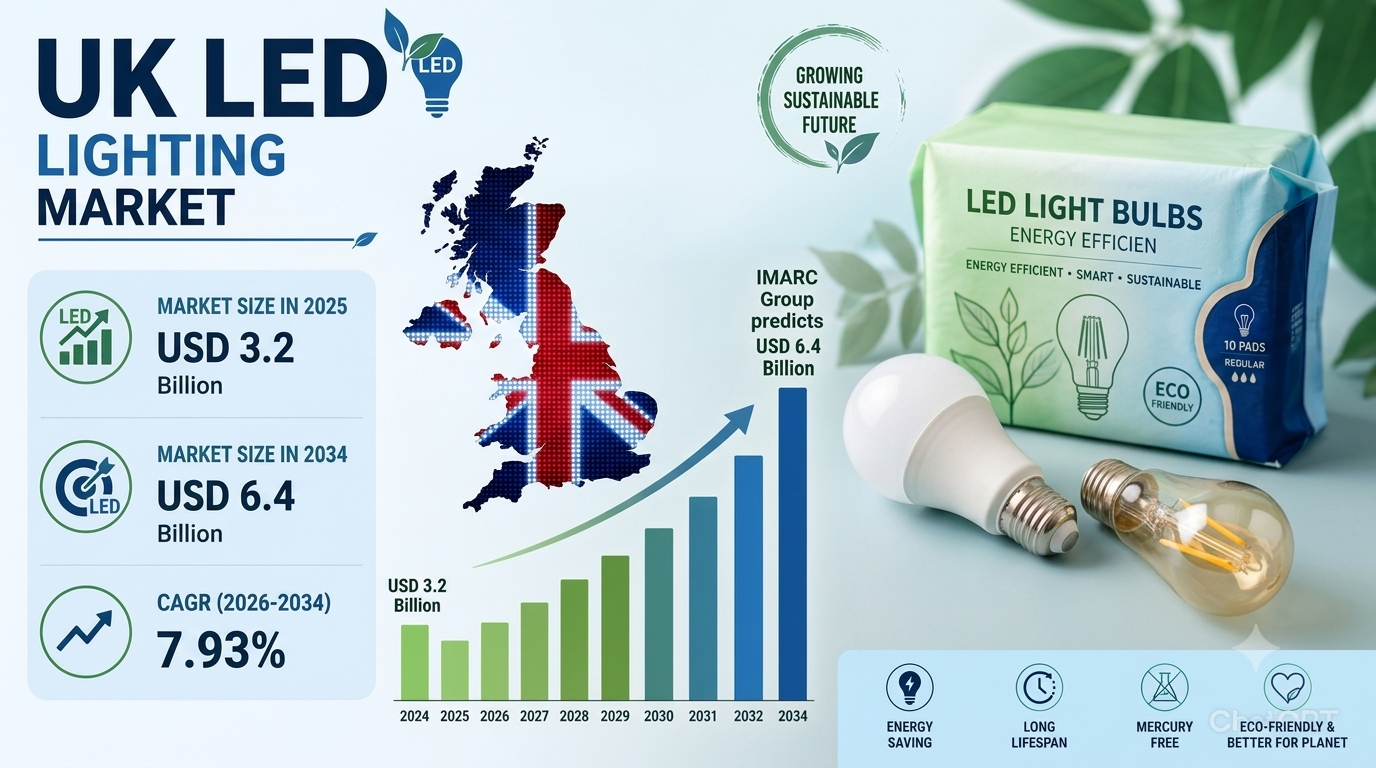
IMARC Group, a leading global market research and management consulting firm trusted by Fortune 500 companies, investors, and government agencies across more than 100 countries, has published its latest intelligence report on the UK LED Lighting Market. The market is benefiting from rising investments in sustainable infrastructure, energy efficiency regulations, smart city development, and the modernization of commercial, industrial, and residential lighting systems. Increasing demand for intelligent lighting solutions, connected buildings, and low-carbon infrastructure is further strengthening market expansion across the United Kingdom.
LED lighting has become a critical component of the UK’s net zero transition, with businesses, public authorities, and homeowners replacing conventional lighting systems to reduce electricity consumption and maintenance costs. The integration of IoT-enabled lighting, occupancy sensors, daylight harvesting technologies, and smart controls is creating new opportunities for manufacturers, installers, and technology providers. IMARC Group’s comprehensive research combines primary interviews, proprietary data analysis, and continuous market monitoring to deliver actionable insights for investors and businesses.
Request Sample For PDF Report: https://www.imarcgroup.com/uk-led-lighting-market/requestsample
How AI Is Reshaping the Future of the UK LED Lighting Market
AI Driven Smart Lighting Management
- Artificial intelligence enables real time monitoring of lighting networks by automatically adjusting brightness based on occupancy, daylight availability, and energy demand.
- Smart commercial buildings can reduce lighting energy consumption by up to 60% through intelligent automation and predictive controls.
Predictive Maintenance for Infrastructure
- AI analyzes sensor data to identify potential fixture failures before breakdowns occur.
- Predictive maintenance minimizes downtime in airports, rail stations, highways, hospitals, and manufacturing facilities while lowering maintenance costs.
Intelligent Urban Lighting Systems
- AI powered street lighting platforms optimize illumination according to pedestrian movement, traffic density, and weather conditions.
- Connected lighting systems also improve public safety while reducing municipal electricity expenditure.
UK LED Lighting Market Growth Drivers and Emerging Trends
The UK continues to prioritize energy efficiency as part of its broader sustainability strategy. Buildings account for approximately 30% of UK greenhouse gas emissions, making energy efficient lighting one of the fastest and most cost effective carbon reduction measures. LED lighting typically consumes up to 80% less electricity than traditional incandescent lighting while lasting up to 25 times longer, making it highly attractive for public and private sector investments.
Commercial property owners are increasingly upgrading office buildings with smart lighting systems integrated into building management platforms. Retail chains, logistics warehouses, educational institutions, healthcare facilities, and hospitality businesses are also replacing conventional lighting to lower operating expenses.
Industrial facilities are adopting high efficiency LED high bay lighting combined with occupancy sensors, helping manufacturers reduce electricity bills while improving workplace safety and visibility.
Residential demand is also increasing as homeowners seek lower electricity costs and smart home integration through voice assistants and mobile applications.
The growing adoption of electric vehicles is creating additional opportunities for LED lighting across charging stations, parking facilities, and transport infrastructure.
Sustainability Is Driving Infrastructure Investments
The UK’s transition toward sustainable infrastructure continues to accelerate LED adoption across public projects.
Key sustainability trends include:
- Expansion of smart city infrastructure
- Energy efficient public buildings
- Modern railway and transport facilities
- Green commercial office developments
- Low carbon industrial manufacturing
- Sustainable residential housing
LED lighting contributes significantly toward reducing electricity demand while supporting national carbon reduction targets.
Government Initiatives Supporting LED Lighting Adoption
Government policies continue encouraging the replacement of inefficient lighting systems across multiple sectors.
Public Sector Decarbonisation Scheme
- Public buildings across schools, hospitals, and local government facilities continue receiving funding for energy efficiency improvements, including LED lighting upgrades.
UK Net Zero Strategy
- The government’s long term commitment to achieving net zero emissions encourages investment in low energy technologies such as LED lighting, smart controls, and connected building systems.
Minimum Energy Efficiency Standards
- Commercial property owners are increasingly investing in efficient lighting systems to improve building energy performance ratings and regulatory compliance.
Local Authority Smart City Projects
- Numerous councils are replacing conventional streetlights with LED smart lighting systems equipped with remote monitoring and adaptive lighting controls.
Industry Statistics Supporting Market Expansion
- LED bulbs use approximately 75% to 80% less electricity than incandescent bulbs.
- LED lighting can operate for more than 25,000 to 50,000 hours depending on application.
- Commercial buildings can reduce lighting related electricity consumption by more than 50% through smart LED systems.
- Lighting represents a significant portion of electricity use in commercial buildings, making LED upgrades among the quickest energy saving investments.
- Smart lighting solutions also contribute to lower maintenance costs due to longer operational life.
Company News and Industry Developments
Signify
- May 2026: Signify expanded its connected lighting portfolio by introducing additional smart building solutions focused on energy management and sustainability.
Zumtobel Group
- February 2026: The company introduced advanced intelligent lighting systems designed to improve energy performance across commercial and industrial facilities.
Thorn Lighting
- October 2025: Thorn Lighting launched new outdoor LED luminaires designed to improve efficiency for public infrastructure and smart city projects.
LEDVANCE
- July 2025: LEDVANCE expanded its smart lighting product range across Europe with improved connected lighting capabilities for residential and commercial customers.
Acuity Brands
- March 2025: The company strengthened its intelligent lighting controls portfolio by introducing additional IoT enabled lighting management solutions.
Signify
- September 2024: Signify announced new sustainability initiatives focused on circular lighting products and energy efficient connected lighting technologies.
UK LED Lighting Market Segmentation
Breakup by Product Type
- LED Lamps
- LED Fixtures
Breakup by Installation
- New Installation
- Retrofit Installation
Retrofit installations continue gaining momentum as businesses replace conventional lighting without major structural modifications.
Breakup by Application
- Residential
- Commercial
- Industrial
- Outdoor
- Others
Commercial applications represent a significant share due to offices, retail stores, educational institutions, healthcare facilities, hotels, and logistics centers investing heavily in energy efficient lighting.
Breakup by Distribution Channel
- Offline
- Online
Offline channels remain important because commercial and infrastructure projects typically require professional consultation, customized solutions, and installation support.
Competitive Landscape
The report provides comprehensive analysis covering market shares, strategic developments, product portfolios, innovation, and competitive positioning of major companies operating within the UK LED lighting industry.
Recent News and Developments
- May 2026: Signify announced additional intelligent lighting innovations supporting connected buildings and improved energy management.
- February 2026: Zumtobel Group introduced new digital lighting solutions designed for sustainable commercial infrastructure.
- November 2025: Several UK local authorities expanded smart street lighting programs to improve energy efficiency and public safety.
- July 2025: LEDVANCE expanded its European smart lighting portfolio with enhanced connected lighting technologies.
- March 2025: Acuity Brands introduced intelligent lighting controls supporting data driven building management.
- September 2024: Signify strengthened its circular lighting strategy through sustainable product innovations and energy efficient connected lighting systems.
Future Outlook
The UK LED Lighting Market is expected to remain strongly supported by sustainable infrastructure development, smart building investments, digital transformation, and energy efficiency policies. Increasing adoption of AI powered lighting management, IoT connected fixtures, and intelligent urban infrastructure will continue creating new opportunities across commercial, industrial, residential, and public sectors. Businesses investing in advanced lighting technologies, smart controls, and environmentally sustainable product portfolios will be well positioned to benefit from the evolving UK lighting landscape.