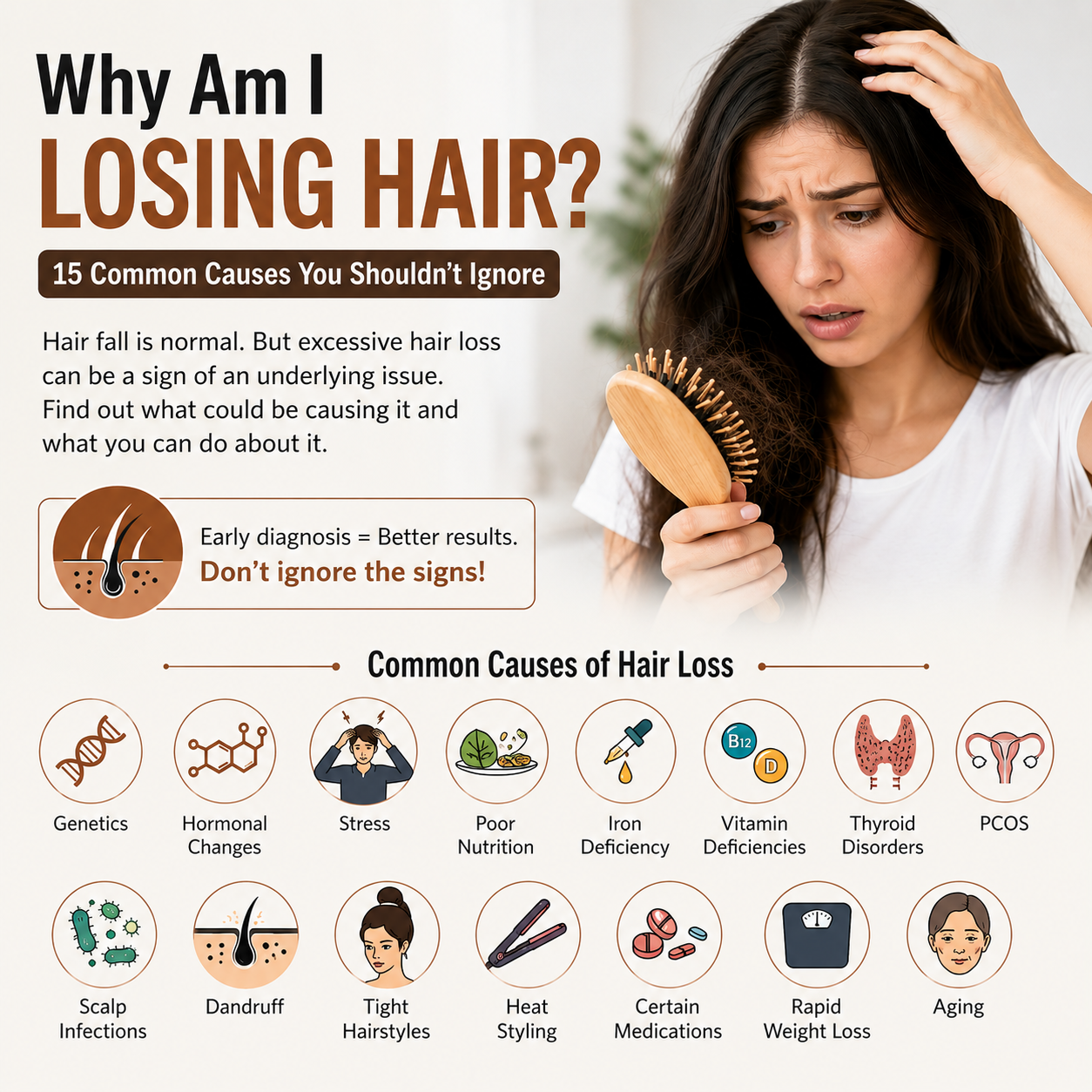
You notice extra hair on your pillow. The shower drain clogs more than usual. Your comb seems fuller after each pass. These moments spark worry is this normal shedding or something serious? Most people shed 50-100 hairs daily as part of a natural cycle, but excessive hair fall signals an underlying issue worth
Investigating.Understanding what causes hair loss is the first step toward effective treatment. This guide explores 15 common reasons your hair might be thinning, helps you identify when professional help is needed, and explains realistic treatment options. Whether you are experiencing mild hair shedding or noticeable bald patches, identifying the root cause matters.
How Much Hair Loss Is Normal?
There are about 100,000 hair follicles on your scalp. They all go through a growth cycle: the telogen (resting) phase lasts two to three months, the catagen (transition) phase lasts weeks, and the anagen (growth) phase lasts two to seven years. During the telogen period, hair naturally sheds. A daily loss of 50–100 hairs is considered typical. Shedding patterns are influenced by seasonal shifts and variations in the hair development cycle. However, significant hair loss may point to a medical condition that needs to be evaluated if you see more than 100–150 hairs in your brush every day, obvious scalp exposure, or abrupt hair thinning.
15 Common Causes of Hair Loss
1. Genetics (Male & Female Pattern Baldness)
The best indicator of hair loss is family history. You probably inherit sensitivity to DHT, a hormone that causes hair follicles to shrink, if your parents or grandparents were bald. While female pattern hair loss results in general thinning, male pattern baldness begins with hairline recession. Without therapy, this is irreversible, although early intervention helps.
2. Hormonal Changes & Thyroid Disorders
Hair loss is brought on by PCOS, thyroid abnormalities, menopause, pregnancy, and postpartum periods. Hormonal changes cause hair to enter the shedding phase too soon. Women who have mood swings or irregular periods should talk to their doctor about hair loss. Thyroid problems can be treated, according to blood testing.|
3-6. Stress, Nutrition & Vitamin Deficiencies
Prolonged stress causes telogen effluvium hair to prematurely initiate the shedding phase. Once stress levels drop, this type typically reverses. Hair follicles are deprived of vital nutrients by iron inadequacy, vitamin B12 deficiency, and protein malnutrition. These deficiencies are detected by blood tests, and hair growth is usually restored within months with supplements.
7-10. Scalp Infections, Dandruff & Inflammatory Conditions
Prolonged stress causes telogen effluvium hair to prematurely initiate the shedding phase. Once stress levels drop, this type typically reverses. Hair follicles are deprived of vital nutrients by iron inadequacy, vitamin B12 deficiency, and protein malnutrition. These deficiencies are detected by blood tests, and hair growth is usually restored within months with supplements.
11-13. Tight Hairstyles, Heat Damage & Medications
Tight braids, ponytails, and extensions can cause traction alopecia by continuously stressing the hair follicles. Hair structure is weakened by excessive blow drying, flat ironing, and chemical treatments. Hair loss is listed as a side effect of some drugs, including beta-blockers, blood thinners, and antidepressants. Talk to your doctor about any concerns you have about medications; there are often alternatives.
14-15. Rapid Weight Loss & Aging
Rapid weight reduction and severe diets deprive hair follicles of vital nutrients, resulting in extensive hair loss. Natural aging thins hair strands, shortens the lifespan of individual hairs, and slows the course of the hair growth cycle. After 50, hair loss is more prevalent in both sexes. When they are worrying, these are natural processes that react to therapy.
Hair Loss in Men vs Women
Male pattern baldness usually begins in the 20s or 30s and advances reliably from hairline recession to crown thinning. Female pattern hair loss typically manifests later in life and results in diffuse thinning throughout the entire scalp. Although total baldness is uncommon in women, significant volume loss may be observed. Women’s hair is greatly impacted by PCOS, menopause, pregnancy, and hormonal cycles. Different treatment strategies are beneficial for men and women: women need hormone management and various drugs, while males respond well to finasteride. The optimum course of action for each individual is determined by early expert examination.
How Is Hair Loss Diagnosed?
Dermatologists assess medical history, perform physical scalp examination, conduct hair pull tests measuring shedding rates, and order blood work identifying nutritional deficiencies or hormonal imbalances. Trichoscopy microscopic scalp examination reveals follicle health and hair shaft damage patterns. In select cases, scalp biopsy confirms diagnoses like alopecia areata. A qualified dermatologist at a skin clinic in PCMC provides comprehensive diagnostic evaluation guiding personalized treatment plans.
Treatment Options for Hair Loss
Treatment depends entirely on underlying cause. Nutritional deficiencies respond to targeted supplementation. Stress-induced shedding resolves with stress management techniques. Genetic baldness may respond to medications like minoxidil or finasteride. Advanced treatments include PRP (platelet-rich plasma) therapy stimulating follicle activity, laser therapy increasing scalp blood flow, and hair transplants for permanent results. Lifestyle improvements reducing heat styling, avoiding tight hairstyles, and managing stress support recovery. A skin clinic in PCMC dermatologist determines which hair loss treatment in PCMC approach suits your specific condition.
Can Hair Grow Back Naturally?
Once triggers are removed, hair loss caused by stress, nutritional deficiencies, or transient hormonal changes frequently goes back to normal. After the triggering incident, post-inflammatory hair loss usually regrows in three to six months. Genetic baldness responds well to early therapy but seldom goes away on its own. If untreated, scarring alopecia results in irreversible harm. The time frame varies; some conditions improve in a matter of weeks, while others require months. Recovery potential is greatly increased by early expert consultation.