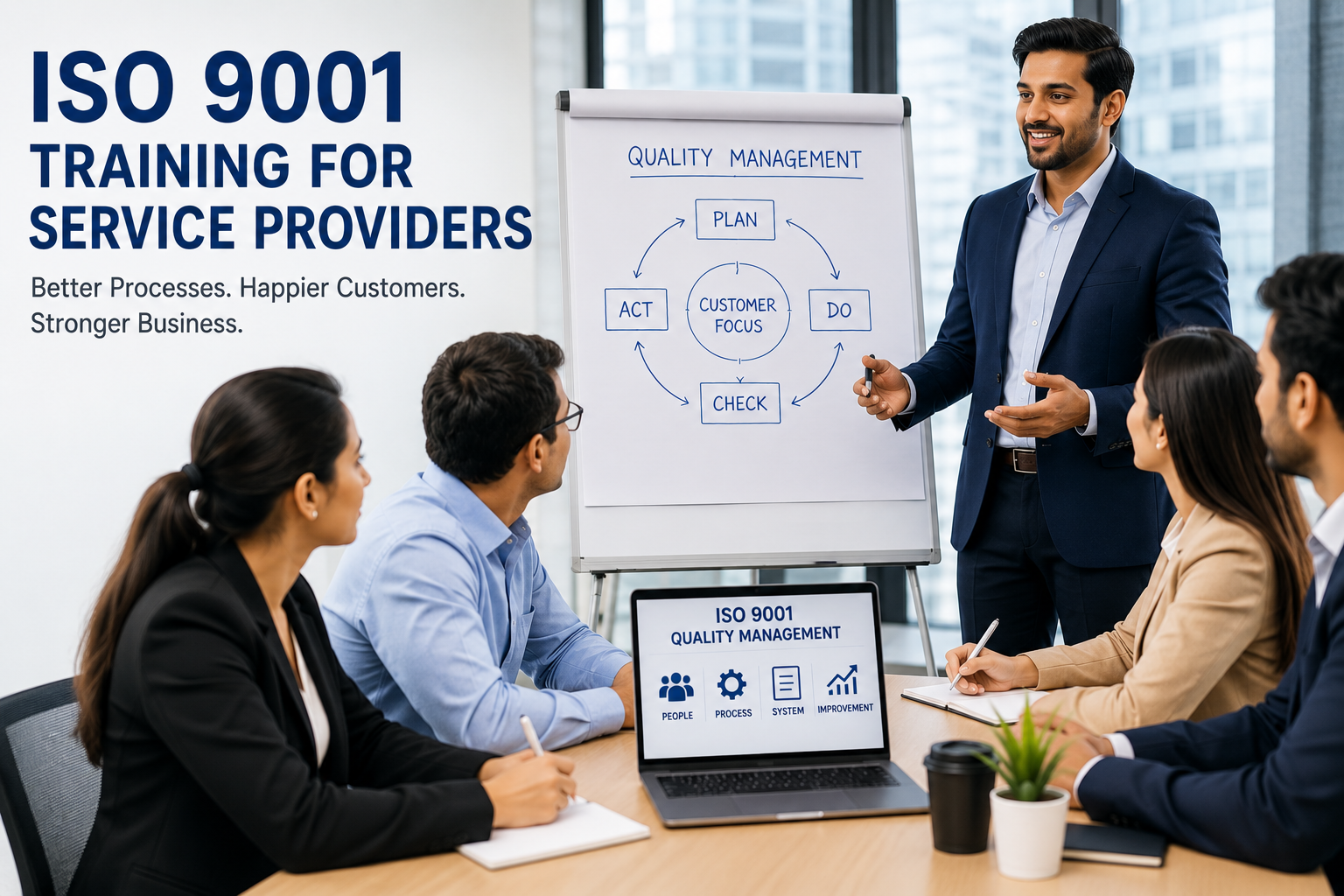
Why Service Providers Are Paying More Attention to Quality Training
Service industries run on reputation. A manufacturing company can physically inspect products before shipping them out, but service providers work differently. Their quality appears in customer conversations, response times, communication clarity, problem-solving ability, and overall experience. Therefore, one delayed email or one unresolved complaint can quietly damage customer trust. That’s why many organizations are now focusing seriously on ISO 9001 training.
For service providers, quality management is no longer limited to paperwork or formal audits. Instead, it has become part of daily business survival. Customers expect smooth communication, fast support, organized processes, and reliable delivery every single time. Honestly, even a small inconsistency can feel huge to clients who are already managing tight schedules and business pressure themselves.
This is where ISO 9001 Quality Management System training becomes valuable. It helps service providers create structured processes that improve consistency without making operations overly rigid. As a result, teams understand their responsibilities more clearly, managers gain better operational visibility, and customers experience more dependable service delivery.
Previously, many businesses believed ISO standards belonged mainly to factories and industrial sectors. However, that perception has changed dramatically. Today, IT companies, consulting firms, healthcare providers, logistics businesses, educational institutions, maintenance contractors, customer support centres, and digital agencies all benefit from ISO 9001 training because service quality directly affects customer retention.
Understanding ISO 9001 Training in Simple Terms
At its core, ISO 9001 training teaches organizations how to establish, maintain, and improve a quality management system. In other words, the training focuses on making business operations more organized, measurable, and customer-focused.
Interestingly, the training does not aim to create robotic employees or endless documentation. In fact, well-designed training programs help organizations simplify operations. Employees learn how to reduce errors, improve coordination, handle customer complaints effectively, and monitor service performance with greater consistency.
For service providers, the training often covers areas such as:
- Customer satisfaction management
- Process control methods
- Documentation practices
- Risk-based thinking
- Internal auditing techniques
- Corrective action procedures
- Performance monitoring
- Continuous improvement methods
At first glance, these topics may sound technical. However, they connect directly to everyday business activities. For example, a customer support company may use training to improve ticket handling consistency, while a logistics provider may focus on reducing communication delays. Similarly, a consulting firm may improve project documentation and reporting accuracy.
Ultimately, the training creates awareness across departments so that employees understand how their individual actions influence service quality.
The Biggest Challenges Service Providers Usually Face
Service businesses often deal with problems that are difficult to detect immediately. Unlike physical defects in manufacturing, service issues can remain hidden until customers become frustrated.
Initially, these issues may seem manageable. Over time, however, they create operational confusion and customer dissatisfaction. You know what? Many companies adapt to inefficient systems without even realizing how much time and energy they waste daily.
ISO 9001 training helps organizations recognize these hidden inefficiencies. Consequently, teams begin understanding where communication gaps exist, where responsibilities overlap, and where processes need improvement.
Sometimes, that awareness alone can create significant operational improvement.
How ISO 9001 Training Improves Customer Satisfaction
Customer satisfaction sits at the center of the ISO 9001 framework. Simply put, service providers succeed when customers feel confident, respected, and supported consistently.
One of the strongest benefits of ISO 9001 training is that it encourages organizations to examine customer expectations carefully. Businesses learn how to gather feedback, monitor complaints, evaluate service performance, and improve customer communication methods.
When employees understand quality objectives clearly, customers notice the difference through:
- Faster response times
- More accurate service delivery
- Better communication consistency
- Reduced service interruptions
- Improved complaint handling
- Clearer documentation
- Reliable follow-up procedures
Imagine calling customer support and receiving completely different answers from different staff members. Frustrating, right? Fortunately, training reduces these inconsistencies by creating standardized procedures across departments.
Customers may never ask whether a company follows ISO 9001 standards. Nevertheless, they certainly notice when service feels organized and dependable.
Why Employee Awareness Matters More Than Companies Expect
Many operational issues happen simply because employees are unclear about procedures. For instance, one department assumes another department handled a task. Consequently, communication becomes fragmented, and eventually customers feel the impact.
ISO 9001 training helps solve this problem by improving employee awareness and operational clarity.
As a result, organizations create a more coordinated work environment. Staff members spend less time guessing and more time performing tasks efficiently.
Interestingly, organizations often notice morale improvements after training programs. Although that may sound surprising, structured systems reduce confusion and workplace tension. Therefore, employees feel more confident when expectations are clearly defined.
For service providers with multiple branches or departments, this consistency becomes especially valuable.
Process Consistency Makes Service Delivery More Reliable
Consistency is one of the hardest things for service providers to maintain. A company may perform excellently one week and struggle the next due to staffing changes, communication problems, or workload pressure.
Naturally, that unpredictability creates customer frustration.
ISO 9001 Quality Management training focuses heavily on process consistency because stable processes usually produce more reliable outcomes. Therefore, the training encourages organizations to document procedures, monitor performance indicators, and review operational effectiveness regularly.
This leads to improvements such as:
- Standardized workflows
- Better task tracking
- Reduced operational confusion
- Improved service timelines
- Clearer escalation procedures
- Stronger performance monitoring
- Reduced repeat mistakes
Think of it like a busy airport. Without organized systems, passengers, baggage, schedules, and flights would quickly fall into chaos. Similarly, service businesses operate in much the same way behind the scenes. Strong process control keeps operations moving smoothly even during high-pressure periods.
Internal Audits Become Useful Instead of Stressful
The word “audit” often creates anxiety among employees. Usually, people imagine strict inspections designed to expose mistakes. However, during proper ISO 9001 internal auditor training, organizations learn that audits are actually improvement tools.
Internal audits help businesses identify weaknesses before customers notice them.
For service providers, audits may reveal:
- Delayed approvals
- Incomplete customer records
- Communication breakdowns
- Missing service documentation
- Unclear responsibilities
- Process inconsistencies
- Repeated complaint patterns
Rather than blaming employees, audits help organizations improve systems and procedures.
Here’s the thing—most operational problems are caused by weak systems rather than individual incompetence. Therefore, training helps organizations recognize that difference.
When internal audits are handled professionally, they create learning opportunities instead of fear.
Risk-Based Thinking Helps Prevent Service Failures
One major part of modern ISO 9001 training involves risk-based thinking. Simply explained, this means identifying possible problems before they create customer dissatisfaction.
Service providers face risks constantly, including:
- Employee turnover
- Communication delays
- Technology failures
- Documentation mistakes
- Scheduling conflicts
- Data handling errors
- Customer escalation issues
Without proper systems, these risks can quickly affect service quality.
Therefore, training teaches organizations how to evaluate operational risks systematically and create preventive measures. Consequently, this proactive approach helps companies reduce disruptions and maintain service reliability.
For example, a facility management company may identify risks related to delayed maintenance scheduling. Similarly, a digital marketing agency may identify risks linked to missed campaign approvals. Once risks become visible, organizations can establish controls more effectively.
As a result, operational stability improves significantly.
Documentation Control Becomes Easier to Manage
Many service providers struggle with documentation. Files go missing, outdated procedures remain in circulation, and employees follow different versions of the same instructions.
Naturally, this creates confusion quickly.
ISO 9001 training helps organizations establish proper documentation control systems. Employees learn how to manage records accurately, maintain updated procedures, and ensure information remains accessible across departments.
Important documentation areas usually include:
- Service procedures
- Customer agreements
- Complaint records
- Audit reports
- Training records
- Performance evaluations
- Corrective action reports
- Operational instructions
Good documentation does not mean excessive paperwork. In fact, strong systems often reduce unnecessary administrative work because information becomes easier to organize and retrieve.
For service providers handling large customer volumes, proper documentation management becomes essential.
Why Service Providers Choose ISO 9001 Certification Training
Many organizations eventually pursue ISO 9001 certification after completing training programs. As a result, certification demonstrates that the company follows internationally recognized quality management standards.
This can strengthen business credibility significantly.
In many cases, clients even prefer working with certified organizations because certification suggests stronger operational control and service consistency.
Service providers choose ISO 9001 certification training for several reasons:
- To improve customer confidence
- To strengthen internal processes
- To reduce service inconsistencies
- To improve employee awareness
- To support business expansion
- To enhance market reputation
- To improve operational efficiency
- To prepare for certification audits
In competitive industries, these advantages matter a great deal.
For example, a consulting company competing for corporate contracts may gain stronger customer trust through an established quality management system.
Why Choose Integrated Assessment Services?
Selecting the right training provider makes a major difference in how effective the learning experience becomes. Unfortunately, some training programs overwhelm participants with technical jargon and complicated terminology. As a result, employees leave the session more confused than informed.
Integrated Assessment Services focuses on practical and understandable training methods designed for real workplace situations.
The training approach helps service providers connect ISO 9001 requirements directly to daily operational activities. Instead of treating quality management like a theoretical concept, the sessions explain how proper systems improve communication, customer handling, documentation, and service delivery.
Consequently, this practical style helps employees absorb information more naturally and apply it confidently within their departments.
Long-Term Benefits of ISO 9001 Training for Service Providers
The biggest benefits of ISO 9001 training usually appear gradually. Businesses rarely become perfect overnight. Instead, steady operational improvements develop over time.
Organizations often experience:
- Better service consistency
- Reduced customer complaints
- Improved employee coordination
- Stronger process control
- Better communication flow
- Faster issue resolution
- Improved customer trust
- Greater operational stability
At first, these improvements may seem small. However, they accumulate quietly over time. A company may notice fewer misunderstandings between departments, while customer complaints may reduce slightly each month. In addition, employees may spend less time correcting avoidable mistakes.
Eventually, those improvements create a much stronger organization overall.
And honestly, that stability becomes incredibly valuable during business growth. After all, expanding service operations without process control can create operational chaos very quickly.