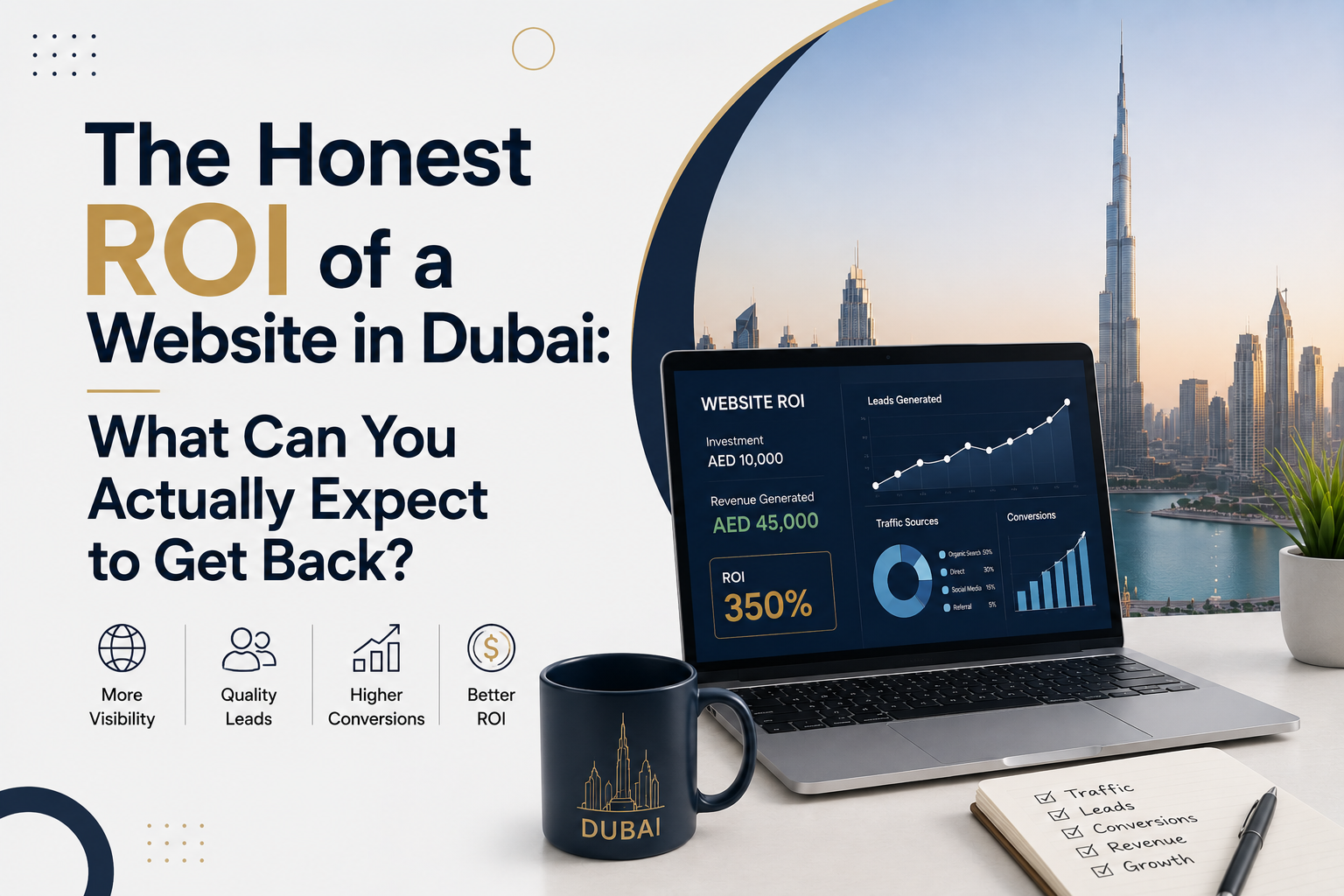
Every business owner in Dubai eventually asks the same question before investing in a website: “What will I actually get back from this?”
It is a completely reasonable question. AED 10,000, AED 20,000, or AED 50,000 is real money. And “a professional online presence” or “better brand credibility” are not satisfying answers when you are trying to justify an investment.
So let us do something most web design content never does: actual maths.
This guide breaks down the return on investment from a properly built website in Dubai, in real numbers, across different business types, with honest assumptions and honest caveats. No hype. Just the calculation.
First: How Do You Measure Website ROI?
Before the numbers, a quick framework. Website ROI is calculated the same way as any other investment:
ROI = (Value Generated − Cost of Investment) ÷ Cost of Investment × 100
The tricky part is measuring “value generated.” For a website, this comes from:
- Direct enquiries: Leads that come through the website contact form, WhatsApp button, or phone click
- Organic traffic value: The value of search traffic your website attracts without paid advertising
- Referral conversion: Referred clients who confirmed their decision after visiting your website
- Ecommerce revenue: Direct online sales if your website sells products
Each of these can be quantified. Let us work through three realistic Dubai business scenarios.
Scenario 1: A Professional Services Firm in Dubai
Business type: Management consulting firm, Business Bay Website investment: AED 18,000 (build) + AED 1,200/month maintenance = AED 32,400 over 12 months Average client value: AED 45,000 per engagement Average conversion rate from enquiry to client: 25%
Month 1–3: Website indexed, rankings building. Two organic enquiries received. Month 4–6: Rankings improving. Eight organic enquiries received. Month 7–12: Consistent organic traffic. Eighteen organic enquiries received.
Total organic enquiries in year one: 28. Converted to clients (at 25%): 7 clients. Revenue generated: 7 × AED 45,000 = AED 315,000
Total website cost year one: AED 32,400 Net return: AED 315,000 − AED 32,400 = AED 282,600 ROI: 872%
Is this realistic? Yes, with important caveats. The 25% conversion rate assumes good follow-up, a genuine service offering, and competitive pricing. The 28 enquiries assume a properly SEO-optimised website with consistent content publication. Neither happens automatically; both require effort alongside the website investment.
But the underlying maths illustrates why professional services businesses in Dubai with high average client values see some of the strongest website ROI of any sector.
Scenario 2: A Retail Ecommerce Store in Dubai
Business type: Ladies’ modest fashion boutique, selling online across the UAE and GCC. Website investment: AED 24,000 (ecommerce build) + AED 8,000 (product photography) + AED 1,500/month maintenance = AED 50,000 over 12 months. Average order value: AED 420 Gross margin: 55% Monthly organic orders (after 6 months): 45 orders/month
Year one organic orders (months 1–6 ramping up, months 7–12 at steady state):
- Months 1–3: 0, 5, 12 orders = 17 orders
- Months 4–6: 25, 35, 40 orders = 100 orders
- Months 7–12: 45 orders/month = 270 orders
- Total: 387 orders
Revenue from organic orders: 387 × AED 420 = AED 162,540 Gross profit (at 55% margin): AED 89,397
Total website cost year one: AED 50,000 Net return on gross profit: AED 89,397 − AED 50,000 = AED 39,397 ROI: 79%
This looks less dramatic than the consulting firm, but remember two things. First, this is only organic traffic. Add even a modest paid advertising budget, and the order volume increases significantly. Second, year two costs drop substantially, no photography, lower maintenance per order, while revenue continues to grow as domain authority builds.
By year two, the same ecommerce store generating AED 162,540 in organic revenue costs only AED 18,000 in maintenance. The ROI in year two is over 800%.
Scenario 3: A Home Services Company in Dubai
Business type: AC maintenance and repair, serving Dubai residential areas. Website investment: AED 9,000 (build) + AED 800/month maintenance = AED 18,600 over 12 months. Average job value: AED 650 Gross margin: 65% Monthly organic enquiries (after 4 months): 18 enquiries/month Conversion from enquiry to booked job: 55%
Year one organic enquiries:
- Months 1–3: 2, 5, 10 enquiries = 17 enquiries
- Months 4–12: 18 enquiries/month = 162 enquiries
- Total: 179 enquiries
Converted to jobs (at 55%): 98 jobs Revenue from organic jobs: 98 × AED 650 = AED 63,700 Gross profit (at 65% margin): AED 41,405
Total website cost year one: AED 18,600 Net return on gross profit: AED 41,405 − AED 18,600 = AED 22,805 ROI: 123%
For a home services business with a relatively modest website investment, a 123% first-year ROI on gross profit is a strong result. And again, this is only organic traffic. Existing referral clients who find the website and rebook directly, or who refer the website to friends, add additional value that is harder to track but very real.
What Makes the Difference Between Good ROI and Poor ROI
Looking at these three scenarios, the pattern is clear. Website ROI in Dubai is driven by four factors, and all four need to be present for the investment to pay back properly.
Factor 1: The right SEO foundation from day one: A website without proper SEO generates almost no organic traffic. No organic traffic means no organic leads. No organic leads means the website’s ROI depends entirely on paid advertising or your existing referral network, neither of which scales independently. A properly built website with strong on-page SEO is the foundation that everything else stands on.
For a clear breakdown of what professional web design, including SEO setup, costs in the Dubai market, this guide on Website Design cost in Dubai covers every business type and budget range honestly.
Factor 2: Content that matches what clients actually search: The consulting firm in Scenario 1 does not rank for “management consulting”; that is far too broad and competitive. It ranks for “operational restructuring consultant Dubai,” “business strategy advisor DIFC,” and similar specific terms. The content on those pages was written around those specific searches. That is why organic traffic converts at a meaningful rate.
Factor 3: A conversion rate worth having: Traffic without conversion is worthless. A website that attracts 500 visitors a month but converts none of them into enquiries is not generating ROI; it is generating data. The conversion rate depends on how clearly the website communicates what you do, how trustworthy it looks, how easy it is to make contact, and how compelling your offer is. These are design and content decisions, not traffic decisions.
Factor 4: Ongoing maintenance and content publication: None of the scenarios above work on a set-and-forget basis. The rankings that drive organic traffic build over time through consistent content, regular maintenance, and active SEO management. A website that is published and then ignored will not sustain the traffic levels these scenarios assume.
The Investments That Kill ROI Before It Starts
Some web design decisions consistently destroy ROI regardless of how much is spent. Watch for these:
Spending heavily on design and nothing on SEO: A beautifully designed website with no SEO foundation generates no organic traffic. None. It looks impressive and performs like a brochure sitting in a locked drawer.
Buying a website without a content plan: A website needs content to rank. If nobody is responsible for publishing content after launch, no blog posts, no case studies, no service page updates, the website’s ranking potential is permanently limited.
Ignoring mobile performance: Over 70% of UAE web traffic comes from mobile. A website with a poor mobile experience, slow load times, difficult navigation, and small tap targets converts mobile visitors at a fraction of the rate of a well-optimised mobile experience. This is not a minor issue. It is a major ROI drain.
Choosing the cheapest option and hoping for the best: A AED 2,500 website that has no SEO foundation, no mobile optimisation, and no post-launch support does not generate ROI. It generates false confidence, the feeling that the job is done, when the real work has not even started.
A Simple Way to Calculate Your Own Website ROI
Before you invest in a website, or before you evaluate whether your current website is performing, run this calculation:
Step 1: What is your average client or transaction value?
Step 2: What is your gross margin on that value?
Step 3: If your website generates X organic enquiries per month and you convert Y% of them, how many new clients or transactions does that represent per year?
Step 4: Multiply by your gross margin to get gross profit from the website.
Step 5: Subtract your total annual website cost (build amortised over three years, plus maintenance, plus content).
Step 6: Divide by the total annual website cost and multiply by 100. That is your ROI percentage.
Run this calculation honestly before you decide on your website budget. It usually clarifies very quickly whether investing AED 8,000 or AED 25,000 makes more sense for your specific business, and what the website needs to do to pay back the investment in a reasonable timeframe.
FAQs
Q1. How long does it take for a Dubai website to start generating positive ROI?
For most well-built websites in Dubai, the break-even point comes between months six and twelve. Professional services businesses with high client values often break even faster, sometimes within the first two to three clients acquired through the website. Ecommerce businesses typically take six to nine months to break even as organic rankings build.
Q2. Is paid advertising included in these ROI calculations?
No, all three scenarios above are based purely on organic traffic. Adding a Google Ads budget accelerates the timeline significantly, particularly in months one to three when organic rankings are still building. The combined ROI of organic SEO plus a targeted paid campaign is almost always higher than either approach alone.
Q3. What conversion rate should I expect from my Dubai website?
Industry averages vary widely, but for a well-optimised professional services website, 2–5% of organic visitors converting to enquiries is a reasonable benchmark. Ecommerce conversion rates are typically 1–3%. If your current website converts below 1% of visitors, something in the user experience or content is preventing conversion, and fixing it is usually more valuable than driving more traffic.
Q4. Does a higher website investment always mean higher ROI?
Not automatically. ROI depends on what the investment achieves, specifically, whether it produces organic traffic, whether that traffic converts, and whether the converted leads have sufficient value to justify the cost. An AED 8,000 website that generates twenty organic enquiries per month in a high-value sector can deliver better ROI than an AED 40,000 website with no SEO that generates two enquiries per month.
Q5. What is the biggest ROI killer for Dubai websites?
No SEO foundation. A website with no proper keyword architecture, no optimised content, and no on-page SEO setup generates no organic traffic, and therefore no organic ROI. This single omission is responsible for more underperforming Dubai websites than any other factor.