
Customer expectations from banks have changed dramatically in the last few years. People no longer compare their banking experience only with other banks. They compare it with food delivery apps, e-commerce platforms, streaming services, and every personalized digital experience they interact with daily.
This shift has completely changed how financial institutions approach customer engagement. Traditional rewards programs are no longer enough. Today, customers expect personalization, instant benefits, seamless digital experiences, and meaningful value across every interaction.
That is where Bank loyalty becomes a strategic growth driver rather than just a rewards mechanism.
According to Accenture’s Global Banking Consumer Study, most customers are willing to stay loyal to one primary bank, but they expect banks to recognize and reward their entire relationship, not just card spending. At the same time, studies show that many customers actively use multiple financial institutions for different needs. This means banks are competing every single day to stay relevant in customers’ lives.
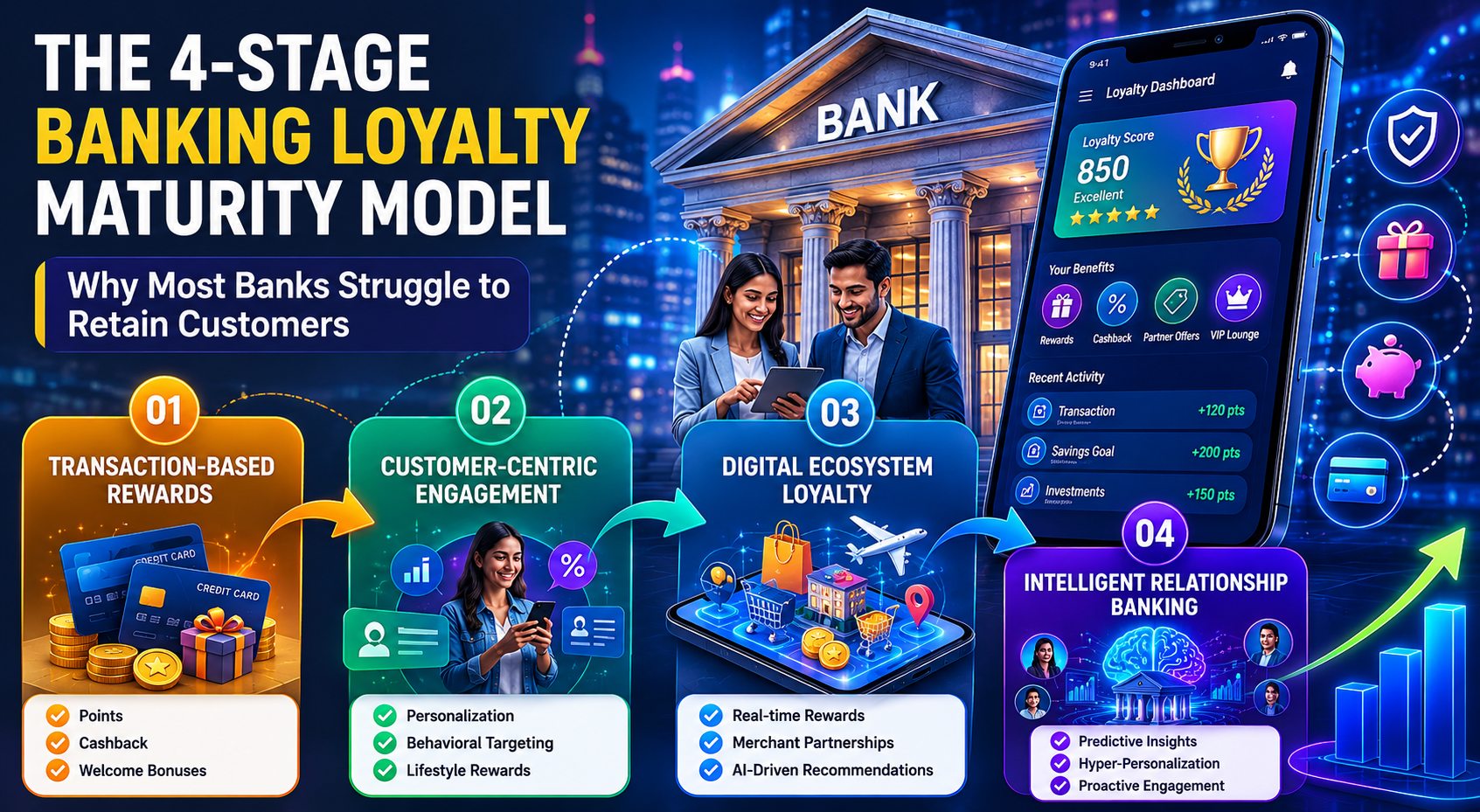
To stay competitive, banks are now moving through different stages of loyalty maturity. Some are still operating basic points programs, while others are building intelligent ecosystems powered by AI, behavioral insights, and real-time engagement.
Understanding this maturity model helps banks identify where they stand today and what they need to improve for long-term customer retention.
Stage 1: Transaction-Based Rewards
This is the starting point for many banks.
At this stage, loyalty is mostly built around transactions. Customers earn points for credit card usage, debit card spending, account openings, or referrals. The focus remains heavily product-centric rather than customer-centric.
Typical features at this level include:
- Cashback offers
- Reward points
- Welcome bonuses
- Referral incentives
- Limited merchant partnerships
While these programs create short-term engagement, they often fail to build emotional connection. Customers participate mainly because they receive a financial benefit, not because they feel attached to the bank.
One major challenge with this stage is that most rewards are isolated. Credit cards, savings accounts, loans, and investments usually operate in separate systems. Customers do not feel rewarded for their complete banking relationship.
According to banking industry research, many customers stay with banks out of convenience rather than genuine loyalty. This creates “passive loyalty,” which can disappear quickly when a competitor offers better digital experiences or rewards.
Banks operating at this stage often struggle with:
- Low engagement rates
- High reward program costs
- Limited personalization
- Weak customer retention
- Poor emotional connection
Stage 2: Customer-Centric Engagement
At this stage, banks start shifting their mindset from transactions to relationships.
Instead of rewarding only purchases, they begin to understand customer behavior, preferences, and financial habits. Loyalty becomes more personalized and experience-driven.
Banks here usually invest in:
- Customer segmentation
- Personalized offers
- Behavioral targeting
- Omnichannel communication
- Lifestyle-based rewards
For example, a customer who frequently travels may receive airport lounge benefits, travel offers, or foreign exchange rewards. A family-focused customer may receive grocery cashback or education-related benefits.
Behavioral segmentation becomes extremely important during this phase. Banks analyze how customers interact across digital channels, products, and services to deliver more relevant engagement.
This stage also focuses heavily on customer experience. Research from McKinsey shows that banks improving customer journeys can significantly increase cross-selling opportunities and customer satisfaction.
The biggest difference here is that banks stop viewing loyalty as a standalone program. Instead, it becomes part of the broader customer experience strategy.
However, many banks still face limitations because their systems remain partially disconnected. Data may exist across departments, making personalization inconsistent.
Stage 3: Digital Ecosystem Loyalty
This is where loyalty programs become deeply integrated into customers’ daily lives.
Banks at this stage move beyond simple rewards and build entire ecosystems around customer engagement. The goal is to create continuous value across multiple touchpoints.
Common characteristics include:
- Real-time rewards
- Merchant-funded offers
- Wallet integrations
- Gamification
- Lifestyle partnerships
- AI-driven recommendations
- Mobile-first engagement
Customers no longer have to wait weeks to redeem their points; instead, they can now earn instant rewards and enjoy personalized experiences in real-time.
Banks have partnered with retailers, airlines, hotels, entertainment brands, and food delivery services to allow customers to earn and redeem their points more easily.
Digital convenience is key at this stage of the loyalty strategy. Customers expect to be able to use their mobile phones at any time, have instant access to their loyalty account(s), and be able to interact with their bank through multiple channels without encountering obstacles.
Data will serve as the foundation for loyalty strategy. Banks will use analytics to help them anticipate customer needs, identify customers who are at risk of leaving, and determine the best time to engage their customers.
Modern loyalty technology providers such as Novus Loyalty are now helping banks create ecosystem-based loyalty programs that integrate the following elements into a single platform: personalized customer experiences, rewards for loyal customers, merchant offers, and actionable insights about the customer.
At this maturity level, loyalty starts contributing directly to:
- Customer lifetime value
- Cross-selling success
- Reduced churn
- Higher digital adoption
- Better customer satisfaction
Stage 4: Intelligent Relationship Banking
This is the most advanced stage of loyalty maturity.
Here, loyalty becomes fully embedded across the entire banking relationship. The bank no longer rewards isolated actions. Instead, it recognizes customer value holistically.
Artificial intelligence, predictive analytics, and automation play a major role in this phase.
Banks operating at this level can:
- Predict customer needs proactively
- Deliver hyper-personalized experiences
- Offer contextual financial guidance
- Automate engagement journeys
- Detect churn signals early
- Personalize rewards dynamically
For example, if a customer’s spending pattern changes suddenly, the system may automatically recommend savings solutions, investment products, or tailored offers before the customer even asks.
According to recent banking transformation studies, intelligent engagement models are becoming the future of digital banking maturity. Banks are moving from fragmented systems toward connected, intelligent ecosystems that deliver highly personalized customer experiences.
At this stage, Bank loyalty becomes an invisible but powerful layer inside the customer experience. Customers stay because the bank consistently understands, supports, and rewards them across every financial interaction.
Why This Maturity Model Matters
In today’s world of banking, competition is no longer just about product selection, rate margins, or other product-related aspects. It is becoming more clear than ever that banks’ capabilities to serve their customers effectively is a major factor in determining which banks will succeed in the marketplace. For banks seeking to evolve beyond transactional rewards programs to develop a long-term strategy of customer loyalty, understanding the evolution of customer expectations through a 4-stage maturity model along with building the capabilities necessary to be competitive in a rapidly changing environment will be necessary.
Intelligent relationship banking will enable banks to develop deeper and more meaningful relationships with customers while enhancing customer trust, engagement, and sustainable long-term growth for the bank.