
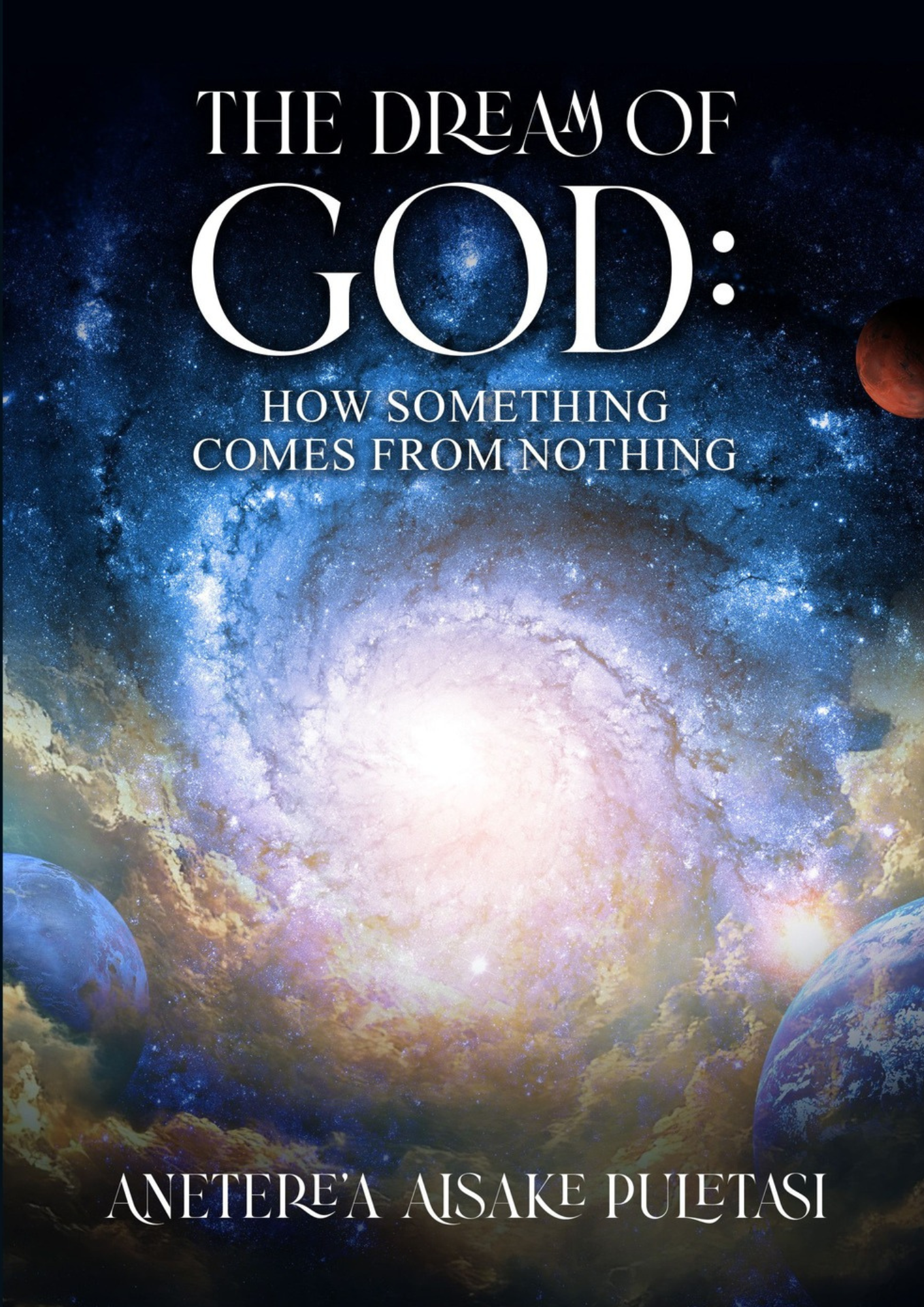
The question of creation has always existed at the edge of human understanding. Science explains how the universe expands, religions describe why it exists, and philosophy tries to interpret what it all means. Yet very few books attempt to stand between these worlds and speak to all of them at once. The Dream of God: How Something Comes From Nothing by Anetere’a Aisake Puletasi, writing under the name Son of Man, enters this space with an unusual and deeply reflective perspective.
Rather than treating creation as a fixed event in the distant past, the book approaches existence as a living process unfolding through consciousness itself. It asks difficult questions that many systems avoid entirely: What existed before time? What if “nothing” was never truly empty? Could reality itself be part of a divine dream rather than a mechanical accident?
These questions form the philosophical core of the book. Through spiritual reflection, cosmological thought, and symbolic metaphors, Son of Man presents a vision of existence that challenges traditional assumptions while remaining accessible to readers interested in philosophical books, spiritual literature, and modern book analysis.
Rejecting the Empty Void
Why Absolute Nothing Fails
One of the strongest ideas in The Dream of God: How Something Comes From Nothing is its rejection of absolute emptiness. The book argues that the concept of “nothing” collapses under deeper examination because true nothingness could never produce existence.
This challenge immediately places the book within larger conversations surrounding cosmology, metaphysics, and existential philosophy. According to Anetere’a Aisake Puletasi, the assumption that the universe emerged from a complete void ignores a deeper possibility: that what appeared empty may have contained hidden potential all along.
The author approaches this not as a scientific equation but as a philosophical problem. If absolutely nothing existed, how could energy, consciousness, matter, or even possibility emerge from it? The book suggests that creation itself points toward an underlying field of awareness that existed before measurable reality.
What makes this argument effective is its clarity. The language remains approachable even when exploring abstract ideas. Readers do not need a background in theoretical physics or theology to engage with the core themes. Instead, the book encourages curiosity and reflection.
For readers drawn to thought-provoking books, spiritual philosophy, or speculative literary works, this section forms one of the book’s strongest foundations.
Potential as the Third State
Perhaps the most original concept presented by Son of Man is the idea of potential as a “third state” between existence and nonexistence.
Traditionally, discussions of creation move between two extremes: something or nothing. The Dream of God: How Something Comes From Nothing introduces another possibility entirely. The author suggests that before physical reality emerged, there existed a state of infinite potential not empty, not material, but full of latent possibility.
This idea reshapes how readers may think about creation itself. The universe becomes less like an object built from raw material and more like a thought unfolding into form.
The philosophical implications are significant. Potential is portrayed as the hidden seed beneath all existence, connecting consciousness, matter, and spiritual awareness into one continuous process. This perspective gives the book a unique place within modern spiritual books and reflective literary analysis.
At times, the argument becomes intentionally poetic rather than strictly logical. Yet this style fits the book’s larger purpose. It is less concerned with proving a system and more interested in expanding the reader’s perception of reality.
The Dreamer and the Dream
God as Consciousness, Not Architect
Another defining element of The Dream of God: How Something Comes From Nothing is its portrayal of God not as a distant architect but as living consciousness itself.
This distinction changes the emotional tone of the entire book. Rather than presenting creation as a constructed machine designed from the outside, Anetere’a Aisake Puletasi describes existence as emerging from awareness. The universe becomes participatory rather than mechanical.
In this framework, human beings are not separate observers trapped inside reality. They are expressions of the same consciousness generating the dream of existence.
This concept may resonate strongly with readers interested in consciousness studies, metaphysical literature, and modern spiritual exploration. It also explains why the book feels more meditative than doctrinal. The writing invites contemplation instead of demanding belief.
Importantly, the book avoids rigid religious language. While spiritual themes remain central, the author leaves room for interpretation. Readers from different backgrounds may recognize elements of mystical philosophy, symbolic theology, and existential inquiry woven together naturally.
This openness broadens the book’s appeal beyond any single audience.
Darkness as the First Light
The most memorable metaphor in the book may be its treatment of darkness. In most traditions, darkness represents fear, emptiness, or ignorance. Son of Man reverses this symbolism completely.
In The Dream of God: How Something Comes From Nothing, darkness becomes the first source of creation the womb from which light emerges. Instead of absence, darkness is portrayed as hidden fullness.
This metaphor gives the book emotional depth beyond abstract philosophy. Readers may begin connecting cosmic themes to personal experience. Moments of uncertainty, silence, or inner searching are reframed not as endings but as beginnings.
The symbolism also strengthens the book’s literary identity. Rather than relying entirely on intellectual argument, the text uses imagery and reflection to communicate its ideas. This gives the work a contemplative rhythm that lingers after reading.
For fans of philosophical literature, spiritual awakening books, and reflective storytelling, this symbolic approach becomes one of the book’s greatest strengths.
Where This Book Belongs
Beyond Science vs. Religion
A major reason The Dream of God: How Something Comes From Nothing stands out is that it refuses to treat science and spirituality as enemies.

Many modern discussions force readers into opposing camps: empirical science on one side, faith on the other. Anetere’a Aisake Puletasi instead presents them as different languages attempting to describe the same mystery.
The book acknowledges scientific inquiry while also exploring questions science cannot yet fully answer consciousness, meaning, and the origin of existence itself.
This balance gives the work a distinctive voice within modern book reviews, cosmology discussions, and philosophical writing. It appeals to readers who appreciate both rational inquiry and spiritual depth without needing to reject one for the other.
Rather than arguing against science, the book suggests that science may eventually lead toward deeper spiritual understanding.
For the Spiritually Homeless
Perhaps the book’s most powerful audience is readers who feel disconnected from traditional belief systems but still search for meaning.
Son of Man writes for those who remain spiritually curious without fully identifying with organized religion. The text offers reflection without dogma and mystery without rigid certainty.
That balance may explain why the book feels deeply personal despite its cosmic subject matter. It speaks to readers navigating questions about existence, identity, and purpose in a modern world that often separates intellect from spirituality.
For readers seeking meaningful books, spiritual insight, or thoughtful book recommendations, the work offers an experience rooted in exploration rather than instruction.
And the Dream Became Us
The Dream of God: How Something Comes From Nothing by Anetere’a Aisake Puletasi is ultimately a meditation on creation, consciousness, and the hidden potential beneath reality itself. Through philosophical reflection and spiritual symbolism, the book challenges readers to reconsider what existed before time, before matter, and before the universe began to unfold.
Its greatest achievement lies in its ability to transform abstract ideas into deeply human questions. By presenting darkness as the origin of possibility and consciousness as the source of creation, the book invites readers to see existence not as random isolation but as participation in something larger.
For those interested in spiritual philosophy, metaphysical books, literary analysis, and reflective explorations of reality, this work offers a perspective that continues to resonate after the final page.
And perhaps that is the true purpose of the dream not simply to explain creation, but to remind us that we are already part of it.