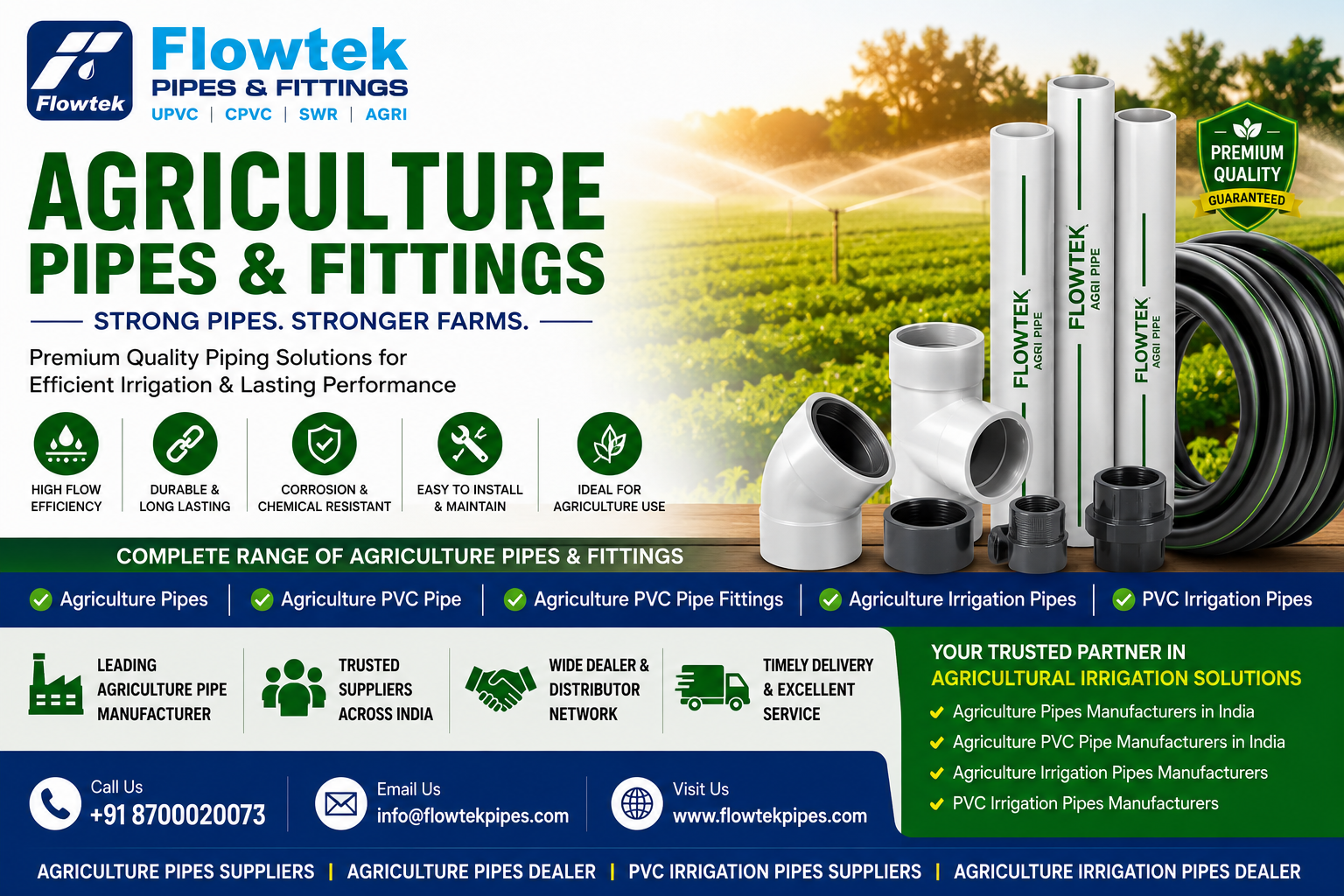
A field line fails after installation, and suddenly the cheapest quote does not look cheap anymore.
For B2B buyers, Agriculture Pipes And Fittings are not just plastic pipes moving water from one point to another. They decide pressure stability, field coverage, water loss, repair calls, dealer complaints, and repeat orders. A wrong diameter, weak fitting match, or unclear pressure rating can disturb the full irrigation layout.
Most buyers compare rates first. That is the first mistake.
In agricultural irrigation, the purchase order should begin with pipe size, pressure need, soil condition, water source, jointing method, and actual field use. Flowtek’s listed UPVC agriculture pipe specification includes a 20–400 mm diameter range, pressure rating up to 6.5 bar, 6m/12m pipe lengths, 0–60°C temperature resistance, 2–10 mm wall thickness, and solvent-weld or push-fit jointing. These details matter because irrigation pipelines face pressure variation, outdoor exposure, handling during transport, and uneven installation conditions.
Specification of Agriculture Pipes And Fittings
The Spec Detail Most Buyers Skip
Wall thickness is not a small line in the quotation.
Flowtek’s UPVC agriculture pipe specification mentions 2 mm to 10 mm wall thickness. That range changes how the pipe behaves under field pressure, handling stress, and buried or semi-exposed installation. If a buyer only asks for “PVC agriculture pipe 4 inch price,” the supplier may quote a product that matches size but not application.
That is where disputes begin.
A proper enquiry for Agriculture Pipes, Agriculture PVC Pipe, and Agriculture PVC Pipe Fittings should mention diameter, pressure requirement, jointing method, length preference, application, and quantity. For irrigation use, the listed application is water transmission and irrigation, with solvent weld and push-fit jointing options.
Technical Points Buyers Should Confirm
The basic specification should be checked before sampling approval:
- Diameter range: 20–400 mm
- Pressure rating: up to 6.5 bar
- Length: 6m/12m
- Temperature resistance: 0–60°C
- Material: Unplasticized Polyvinyl Chloride
- Wall thickness: 2 mm to 10 mm
- Jointing method: solvent weld or push fit
- Application: irrigation and water transmission
Nobody tells you this during a rushed purchase call, but fitting compatibility can create more site complaints than the pipe itself. A pipe may pass visual inspection, but if elbows, tees, couplings, or adapters are not aligned with the selected pipe size and jointing method, installation teams will blame the material.
Sometimes they are right.
How Buyers Should Evaluate Agriculture Pipe Suppliers
Five Checks Before Releasing a Purchase Order
A buyer selecting an Agriculture Pipe Manufacturer or Agriculture Irrigation Pipes Manufacturers should not rely only on catalogue language. The objective is simple: reduce risk before the order moves into production or dispatch.
First, ask for specification compliance. A good answer mentions pipe diameter, pressure class, length, wall thickness, material, and jointing method. A bad answer sounds like, “Sir, standard maal hai, tension mat lo.”
Second, verify certificate validity. Flowtek’s certificate page states ISO 9001:2015 certification validity from January 2024 to January 2027 for CPVC, UPVC, AGRI and SWR pipes and fittings. If a supplier sends a blurred certificate without validity dates, do not treat it as compliance.
Third, check sampling approval. For bulk supply, one sample must represent the production batch. Weak procurement teams approve one sample and then forget to match the dispatched material against it.
Fourth, discuss MOQ clearly. MOQ is not only a sales condition. It affects production planning, freight cost, packaging method, and delivery scheduling.
Fifth, ask how the supplier handles mismatch. A supplier who says “we will see later” does not have a process. That is a problem waiting for unloading day.
Most delays do not begin on the production floor. They begin when specifications remain unclear until sampling is already underway.
Benefits of Using the Right Agriculture Pipes and Fittings
Less Water Loss Means Fewer Field Complaints
Smooth internal flow and correct jointing help reduce leakage points in irrigation layouts. For dealers and contractors, fewer leakage complaints protect margin because replacement trips, labour calls, and transport cost quietly eat profit.
Correct Pressure Rating Protects the Order
Flowtek’s listed UPVC agriculture pipe pressure rating is up to 6.5 bar. That number should be matched with pump output, field distance, elevation, and irrigation layout. If pressure is ignored, the pipe may be blamed for a design mistake.
And yet buyers still ask only for the lowest rate.
Better Fitting Match Saves Installation Time
Agriculture PVC Pipe Fittings such as tees, elbows, couplings, and adapters must match the pipe system. Correct fitting selection reduces cutting errors, joint failure, and installation delays. For B2B buyers, that means fewer complaints from farmers, contractors, and field teams.
Standard Pipe Length Helps Freight Planning
6m/12m pipe lengths affect loading pattern, truck selection, and site storage. This sounds basic, but it is one of those things that creates friction when the order is urgent. A buyer should confirm pipe length before final dispatch planning.
Specification Clarity Protects Dealer Reputation
For PVC Irrigation Pipes and Agriculture Irrigation Pipes, repeat business depends on field performance. Dealers lose credibility when one batch performs differently from the last. Batch-wise QC inspection, sample matching, and clear dispatch documentation reduce that risk.
ISO-Certified Process Adds Procurement Confidence
ISO certification does not magically make every order perfect. It does mean the buyer can ask for process discipline, documentation, and traceability. Flowtek’s ISO 9001:2015 certificate validity from January 2024 to January 2027 gives buyers a clear compliance reference to check before order finalization.
Availability in Kundli, Sonipat and Nearby Supply Markets
Why Location Is a Supply Chain Decision, Not Just an Address
Flowtek Pipes & Fittings is located in Kundli, Sonipat, Haryana – 131028. For buyers sourcing in North India, this location can help with movement toward Delhi NCR, Haryana, Punjab, Uttar Pradesh, Rajasthan, and nearby agricultural markets.
Location matters because pipes are bulky.
For Agriculture Pipes Suppliers, freight planning is not a side topic. A 6m or 12m pipe order needs proper loading, bundling, and route planning. If the supplier quotes material but ignores transport handling, transit damage becomes the buyer’s headache.
A local or regional supply base can also help dealers manage urgent replenishment better. Still, buyers should not assume immediate dispatch for every size. Availability depends on diameter, pressure requirement, quantity, current stock, and production batch planning.
That trade-off should be discussed before PO release.
What We Check Before Material Moves Out
We manufacture pipes and fittings for agricultural, domestic, and industrial applications, with our base at Kundli, Sonipat, Haryana. Our product range includes Agriculture Pipes & Fittings, SWR Pipes & Fittings, UPVC Pipes & Fittings, CPVC Pipes & Fittings, and Column Pipes.
We are ISO 9001:2015 certified for CPVC, UPVC, AGRI and SWR pipes and fittings, with the certification validity stated from January 2024 to January 2027.
Our work does not stop at making the pipe. We have to look at the product category, required size, pressure need, jointing method, and dispatch condition before the order is moved. One operational detail buyers often miss is this: pipe dispatch is not like carton dispatch. Length, bundling, loading angle, and fitting packing all affect how the material reaches the buyer.
We prefer clear specifications before quotation because vague enquiries create weak orders.
Send These Details Before Asking for the Final Rate
If you are planning to source Agriculture Pipes And Fittings, send us your requirement with pipe diameter, pressure rating, length preference, quantity, application, delivery location, fitting list, and expected dispatch schedule.
Also mention your MOQ expectation.
For dealers, wholesalers, procurement managers, and project buyers, we can check the requirement against available sizes, production batch status, packaging needs, and freight planning. Response time depends on whether the required size is available in stock or needs production scheduling. A fast quote without checking specifications is not useful; it only creates trouble later.
Send the enquiry with complete details, and we will respond with the correct product direction, MOQ clarity, and supply discussion.
Conclusion
Agriculture Pipes And Fittings should be purchased with specification clarity, not just price comparison. The right pipe size, pressure rating, wall thickness, fitting match, and dispatch planning can reduce field complaints and protect buyer margins. Flowtek’s agriculture pipe range gives buyers clear specification points to start the sourcing discussion. As irrigation demand grows, procurement teams that buy with technical discipline will stay ahead of last-minute failures.
FAQs
1.Agriculture Pipes And Fittings are used for?
They can be used for irrigation, water transmission, water main distribution, sprinkler field layout, drip irrigation support, and rural water movement. Correct use is dependent on diameter, pressure, fitting type and field lay-out. Don’t choose the pipe just on the basis of its size.
2. What are the ways in which buyers should compare Agriculture Pipes Suppliers?
Check out the specifications before comparing. Inquire for the diameter, pressure rating, wall thickness, length, type of joining, certificate validity, minimum order quantity (MOQ), packing method, and dispatch time. If the quotation from the Agriculture Pipes Suppliers is merely “standard quality” then repeat the question.
3. Do Agriculture PVC Pipes Suppliers accept bulk orders?
Certain, however, the purchaser must ensure that the seller has declared the MOQ, stock, and manufacturing batch planning before giving any assurance to the dealers for the delivery. The catch is that not all the diameter and pressure classes are necessarily waiting for immediate shipment. More needs to be done to plan bulk orders.
4. What should I ask my Agriculture Pipes Dealer before ordering?
Query the Agriculture Pipes Dealer regarding the pipe size, pressure rating, availability of fittings, delivery time, packing method, replacement process in case of damage in transit or mismatch in specification. If a dealer doesn’t know the answers to these questions, he or she might cause trouble after the goods are delivered.
5.How PVC Irrigation Pipes Manufacturers aid improvements in irrigation performance?
PVC Irrigation Pipes Manufacturers help deliver irrigation performance with water transmission, pressure handling and field installation pipe systems. However, the final outcome will be affected by pump pressure, the design of the layout, the quality of the joints, and the type of fittings used.
6. Do I have the ability to purchase from a PVC Irrigation Pipes Dealer for emergency?
While buying is possible, urgent buying has its limits. A PVC Irrigation Pipes Dealer might have in stock, but the size, length, wall thickness and the matching fitting needs to be confirmed. In cases when the material is not the same as the field requirement, fast supply is of little or no value.
7. Why do Agriculture PVC Pipe Manufacturers in India stand out as trustworthy B2B suppliers?
Reliable Agriculture PVC Pipe Manufacturers in India provide transparent terms and conditions, documented compliance, MOQ support, sampling support, batch consistency, and dispatch clarity. That’s more important than blingy sales talk for B2B buyers.