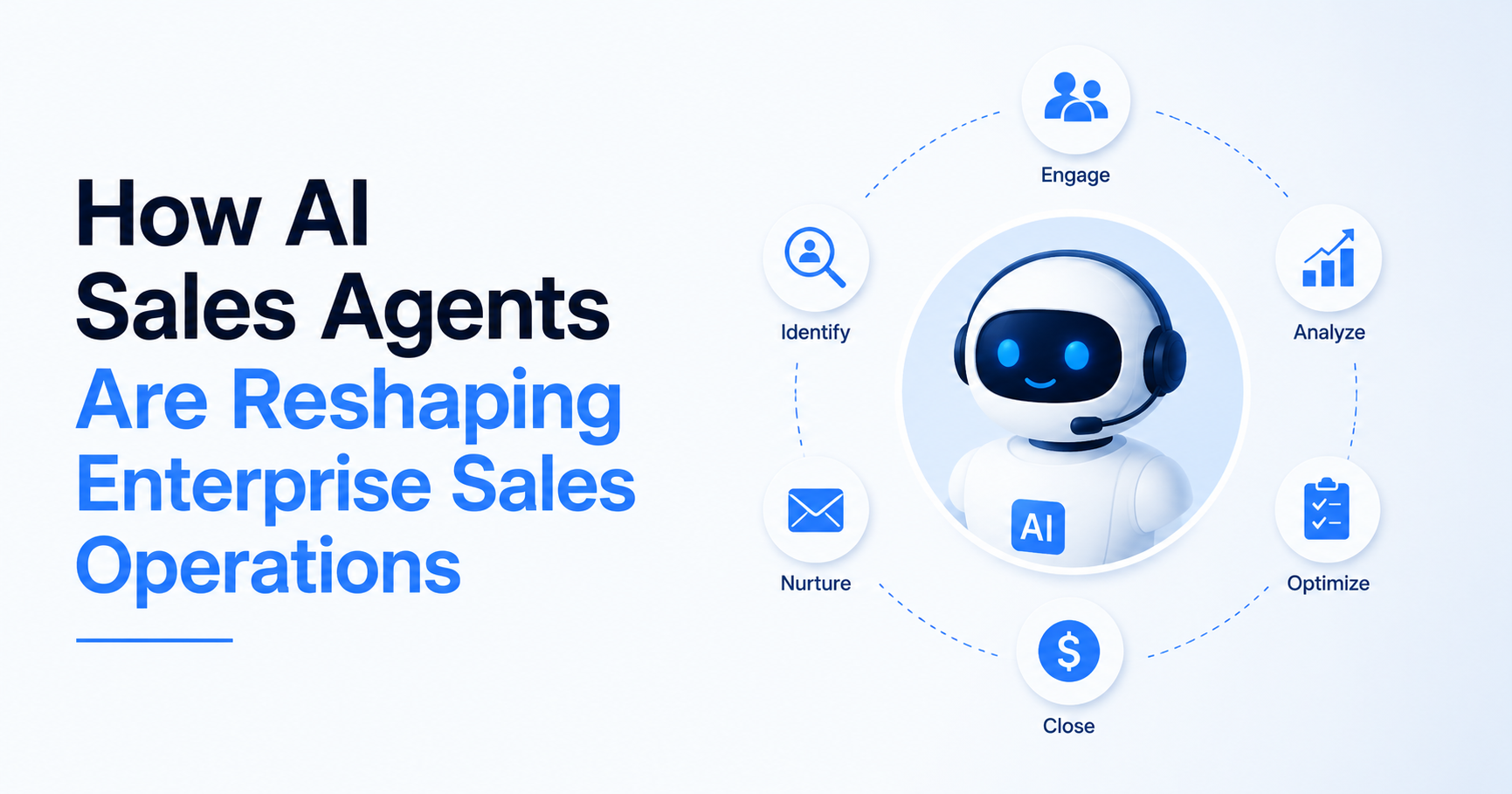
Sales organizations have invested heavily in CRM platforms, automation tools, and analytics over the past decade. Despite these investments, many enterprise sales teams continue to face the same operational challenge: representatives spend too much time managing systems instead of engaging customers.
Internal meetings, CRM updates, proposal creation, pipeline reviews, account research, and follow-up emails consume a significant portion of a seller’s workday. As organizations grow across regions and product lines, these administrative tasks increase faster than revenue-generating activities. AI sales agents are emerging as a practical response to this challenge—not by replacing sales professionals, but by reducing operational overhead and improving how sales teams interact with enterprise data.
Industry adoption reflects this shift. According to Gartner, generative AI will influence a significant percentage of B2B sales activities before the end of the decade as organizations integrate AI into customer engagement and sales execution. McKinsey & Company estimates that generative AI could contribute between $800 billion and $1.2 trillion annually across sales and marketing functions by improving productivity and supporting commercial decision-making. At the same time, Salesforce’s State of Sales Report indicates that sales organizations increasingly view AI as a practical tool for improving forecasting, pipeline management, and seller productivity rather than as a standalone innovation.
The conversation has therefore shifted from whether AI belongs in enterprise sales to where it delivers measurable business value.
From Sales Automation to Intelligent Sales Execution
Sales automation is not new. Enterprises have relied on workflow automation for years to assign leads, trigger approval processes, and send scheduled communications. Those systems perform predefined actions based on business rules, but they cannot interpret customer context or support decision-making.
AI sales agents introduce a different operating model.
Rather than executing static workflows, they continuously evaluate structured and unstructured enterprise information—including CRM records, meeting transcripts, product documentation, support history, pricing policies, and previous customer interactions—to generate recommendations or complete specific business tasks.
This capability changes the role of AI within enterprise sales. Instead of functioning as another automation layer, AI becomes an operational assistant that works alongside sales representatives throughout the customer lifecycle.
The Operational Problems AI Sales Agents Address
Enterprise sales operations become increasingly complex as businesses expand. Multiple regional teams, larger product portfolios, hybrid buying journeys, and growing customer datasets create operational friction that traditional CRM workflows struggle to manage.
Several recurring issues emerge.
Sales representatives often spend considerable time preparing for customer meetings by searching across multiple systems for account information. Pipeline reviews depend heavily on manual CRM updates, resulting in inconsistent forecasts. Managers frequently discover that opportunity stages differ between regions because individual teams adapt processes over time. Customer conversations become fragmented when sales, marketing, and customer success teams work from incomplete or outdated information.
These challenges rarely indicate weaknesses in the CRM platform itself. More often, they expose gaps in how organizations manage information across their technology ecosystem.
AI sales agents help reduce these operational inefficiencies by acting as an intelligent layer above existing enterprise systems.
AI Becomes Part of Daily Sales Operations
The most valuable AI implementations rarely involve dramatic changes to existing sales processes. Instead, they remove repetitive work from everyday activities.
Consider account preparation before a customer meeting.
Instead of manually reviewing CRM records, email history, support cases, and previous proposals, a sales representative can receive an automatically generated account briefing containing recent interactions, active opportunities, renewal risks, open support issues, and recommended discussion topics.
Similarly, after a customer meeting concludes, AI can generate structured meeting summaries, identify action items, update CRM records, and recommend follow-up activities without requiring representatives to perform repetitive administrative work.
These improvements may appear incremental individually, but collectively they recover hours of productive selling time each week.
Better Decisions Depend on Better Context
Modern enterprise sales involve far more information than individual representatives can realistically process.
Customer intent signals originate from marketing platforms. Product usage data resides in customer success applications. Pricing approvals move through ERP systems. Technical documentation lives inside knowledge repositories. Commercial conversations occur across email, collaboration platforms, and virtual meetings.
Without connected intelligence, sellers constantly switch between systems to gather information before making decisions.
AI sales agents reduce this fragmentation by retrieving relevant business context from multiple enterprise sources and presenting it within existing workflows.
The result is not simply faster information retrieval. Sales representatives gain access to more complete business context when evaluating opportunities, identifying risks, or preparing executive conversations.
CRM Quality Improves When AI Reduces Administrative Work
One of the persistent challenges in enterprise CRM adoption is data quality.
Sales professionals generally prioritize customer engagement over administrative tasks. Opportunity updates, activity logging, and account maintenance often occur days after customer interactions—or not at all.
Incomplete CRM data creates downstream problems for forecasting, territory planning, revenue operations, and executive reporting.
AI sales agents address this issue by capturing business activities automatically. Meeting summaries, customer emails, call transcripts, and follow-up tasks can populate CRM records with minimal manual effort.
Rather than asking representatives to become better data entry operators, organizations reduce the amount of manual work required to maintain accurate customer records.
Improved CRM quality benefits every department that depends on customer data, including finance, marketing, customer success, and executive leadership.
Enterprise AI Requires More Than Large Language Models
Many discussions about AI focus almost exclusively on language models. In enterprise environments, however, the language model represents only one component of a much larger architecture.
An enterprise-grade AI sales agent typically combines:
- CRM data
- Enterprise identity management
- Retrieval-Augmented Generation (RAG)
- Knowledge repositories
- Workflow orchestration
- API integrations
- Security controls
- Audit logging
- Business rules
Together, these components allow AI systems to retrieve accurate organizational information while respecting governance policies.
Without this supporting architecture, even advanced language models cannot provide reliable business recommendations.
Why Salesforce Organizations Are Investing in Agentforce
Organizations using Salesforce increasingly view AI as an extension of their existing CRM environment rather than as an independent application.
Salesforce’s Agentforce introduces autonomous AI agents capable of performing business tasks using enterprise data, CRM records, and organizational knowledge while operating inside Salesforce’s governance framework.
This architectural approach allows enterprises to integrate AI into existing sales workflows without introducing disconnected systems or duplicate customer information.
Implementing these capabilities often requires expertise beyond standard CRM administration. An experienced Agentforce Sales consultant helps organizations define AI use cases, integrate enterprise data sources, establish governance policies, and configure workflows that align with existing sales operations.
The objective is not simply enabling AI features but ensuring that AI decisions remain accurate, secure, and consistent with business processes.
Enterprise Example: IBM’s AI-Driven Sales Operations
IBM has incorporated AI into multiple customer-facing operations through its enterprise AI initiatives. Sales teams use AI-assisted tools to retrieve technical knowledge, summarize customer interactions, recommend relevant product information, and accelerate proposal preparation.
Rather than replacing account executives, these capabilities reduce the time required to locate information across complex enterprise environments. This allows technical sales specialists to focus on solution design, customer consultation, and strategic account development instead of administrative activities.
IBM’s experience demonstrates an important principle: AI delivers the greatest value when it complements experienced professionals rather than attempting to automate every customer interaction.
Measuring Business Value Beyond Productivity
Organizations often begin AI initiatives by measuring hours saved. While productivity remains important, enterprise leaders increasingly evaluate broader operational outcomes.
Key performance indicators include forecast accuracy, CRM data completeness, average sales cycle duration, lead response time, opportunity conversion rates, and seller capacity.
Revenue operations teams also monitor CRM adoption levels, pipeline health, and customer engagement quality after introducing AI-assisted workflows.
These measurements provide a clearer understanding of how AI contributes to business performance than productivity metrics alone.
The Road Ahead
AI sales agents are becoming part of enterprise sales infrastructure rather than standalone productivity tools. As CRM platforms, knowledge systems, analytics, and communication channels become more interconnected, AI agents will coordinate information across these environments and support increasingly sophisticated sales workflows.
However, technology alone does not determine success. Organizations need high-quality data, well-defined governance, secure integrations, and clearly documented business processes before AI can produce reliable outcomes.
For Salesforce users, an experienced Agentforce Sales consultant plays an important role in designing AI-enabled sales operations that align with enterprise architecture, compliance requirements, and long-term business objectives. Enterprises that treat AI as an extension of their operational framework—not simply another software feature—will be better positioned to improve decision-making, reduce operational friction, and support sustainable revenue growth.