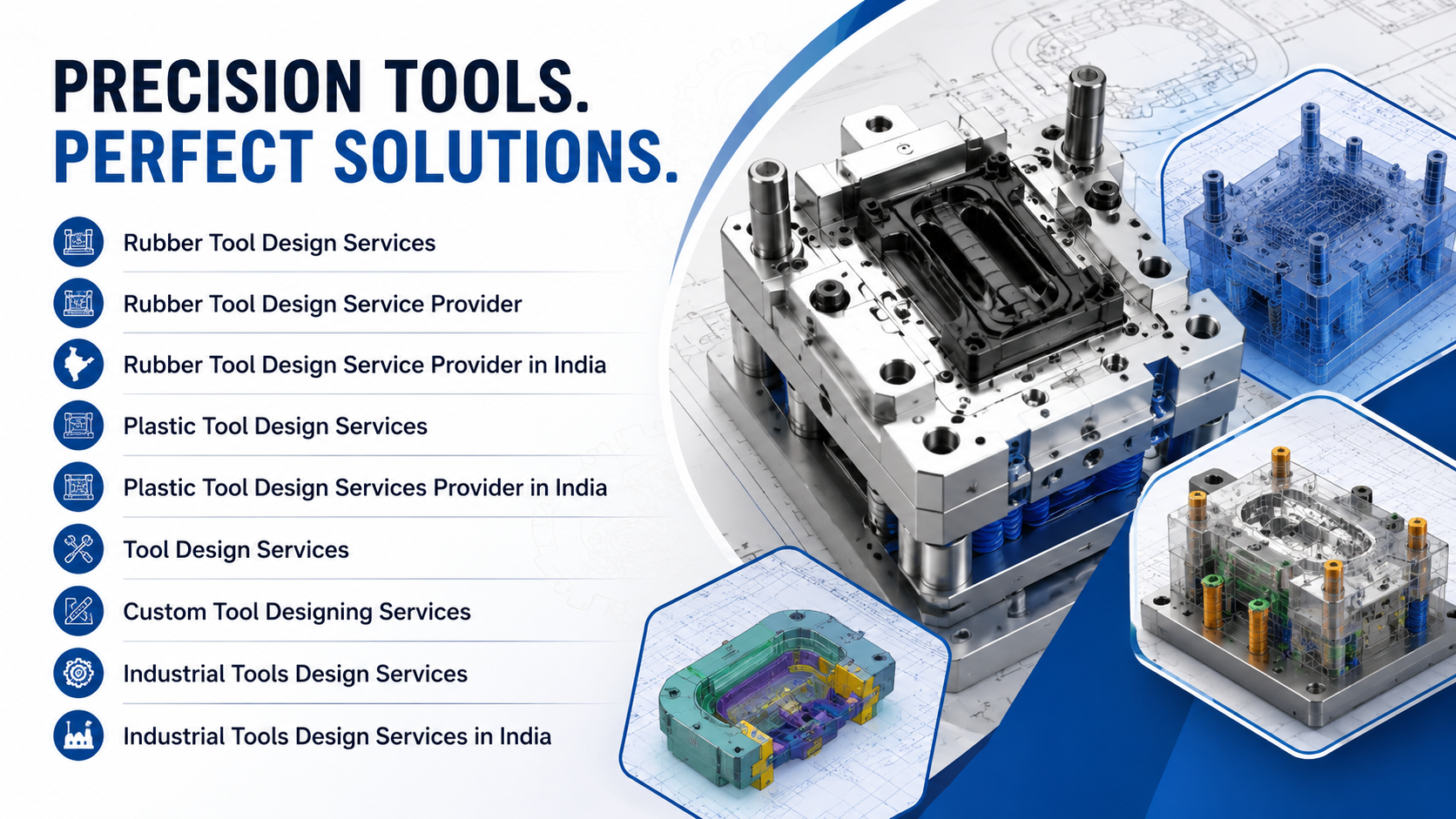
A buyer sends a 3D model, asks for quick costing, and expects the supplier to “manage” the production reality later. That is where Rubber Tool Design Services, Plastic Tool Design Services, and Tool Design Services become serious commercial decisions, not just engineering support. India’s revised IIP recorded 4.9% industrial growth in April 2026, with manufacturing growing 6.2%, so factories are not waiting politely for weak tooling to catch up.
Bad tool design does not only create defects. It eats margins quietly through longer cycle time, excess flash removal, rework, delayed dispatch, and arguments nobody priced into the purchase order.
That’s the part many buyers underestimate.
The Tool Details That Decide Production Behaviour
Rubber Tool Design Services Need More Than a Cavity Shape
Rubber tooling must control flow, cure, venting, parting line, flash, shrinkage, and removal from the mould. Integrated Solutions’ rubber tool work supports compression moulds, transfer moulds, and rubber injection moulds, which are commonly used for seals, gaskets, bushings, vibration dampers, insulation parts, and medical silicone components.
Here’s the overlooked detail: venting is not a small drawing note. A blocked or badly placed vent can create trapped air, incomplete curing, and surface defects that only show clearly after heat and pressure expose the weakness. Many buyers check cavity dimensions but ignore vent depth, parting-line position, and compound behaviour. That is expensive laziness.
Rubber compounds do not behave like metal or rigid plastic. They stretch, rebound, shrink, and cure differently based on formulation and temperature.
Plastic Tool Design Services Depend on Flow, Cooling, and Ejection
Plastic tooling is built around the cavity, core, gating system, cooling channel layout, slides, lifters, and ejection mechanism. Integrated Solutions lists injection moulding, blow moulding, compression moulding, and thermoforming among the plastic processes where tool design matters.
Most buyers focus on the mould price first. Wrong order.
Cooling can decide cycle time. Gate location can decide warpage. Ejection can decide whether a part comes out clean or carries stress marks. In high-volume production, even a few seconds of avoidable cycle time becomes a margin leak across thousands of shots. The HSBC India Manufacturing PMI stood at 55.0 in May 2026, which signals expansion; in an active production market, slow tools become a competitive disadvantage.
Tool Design Services Also Cover Jigs, Fixtures, Dies, and Cutting Tools
Tool Design Services are not limited to moulds. Integrated Solutions also works around moulds, dies, jigs, fixtures, and cutting tools for industrial production requirements.
Which means buyers should not treat every tool requirement as a drawing-to-price exercise. A fixture that does not hold repeatability will damage inspection consistency. A jig that looks fine on CAD but slows the operator at loading time will fail on the shop floor. A die that ignores maintenance access will punish production after approval.
5 Checks Before You Trust a Tool Design Supplier
- Design input discipline: A good supplier asks for 2D drawings, 3D CAD files, material grade, tolerance needs, expected production volume, process route, and defect history. A bad answer sounds like, “Send the sample, we will manage.” That is not engineering. That is guessing.
- Process knowledge: A serious Rubber Tool Design Service Provider explains compression, transfer, or injection mould choice based on part geometry and compound behaviour. A bad supplier talks only about mould steel and ignores curing, venting, and flash control.
- Simulation and review practice: For Plastic Tool Design Services, the supplier should discuss flow, cooling, shrinkage, gate location, and ejection. A bad answer is, “Trial mein pata chal jayega.” Trials are for validation, not basic discovery.
- Documentation quality: Industrial Tools Design Services should include CAD models, assembly structure, drawings, and revision control. ISO 9001:2015 Clause 8.3 focuses on design and development planning, review, verification, validation, and design-change control; a supplier who cannot track revisions will eventually create confusion.
- Commercial clarity: A proper supplier explains lead time, design scope, number of revisions, file formats, and what happens after the tool trial. A bad answer avoids responsibility with phrases like “defects will be handled case by case.” That means you will fight later, usually after money is already stuck.
Where Custom Tool Designing Services Protect Buyer Margins
1. Lower Rejection Risk Before Production Starts
Custom Tool Designing Services reduce risk by checking part geometry, material flow, shrinkage, venting, and release behaviour before tool manufacturing begins. For rubber parts, this helps reduce flash, air traps, short filling, and uneven curing. For plastic parts, it helps control warpage, sink marks, underfilling, and ejection damage.
Nobody tells you this early enough: rejection is not always a production-team failure. Sometimes production is blamed for a tool design mistake made three weeks earlier.
2. Better Cycle Time Control
A tool that cools properly, fills properly, and releases properly saves time at every cycle. This matters because factory cost is not only raw material. It is machine hour, operator time, power use, inspection time, and dispatch pressure.
The May 2026 HSBC/S&P Global survey noted that purchasing prices rose at one of the strongest rates in nearly four years, so buyers cannot afford tooling that wastes material or machine capacity.
3. Stronger Repeatability in Batch Production
Good Tool Design Services protect repeatability. That means the 1st piece and the 5,001st piece should not feel like two different production stories.
And yet, many buyers approve a sample without asking how the same result will be repeated in actual batch conditions. That mistake is common in rubber bushes, plastic housings, seals, clips, and precision industrial parts. One good sample does not prove a stable tool.
4. Fewer Disputes Between Buyer and Supplier
Custom documentation reduces blame games. If the drawing, tolerance, material, gate, vent, cooling, and ejection approach are documented, both sides know what was agreed.
Without that, every defect becomes a negotiation.
5. Better Tool Life and Maintenance Planning
Industrial Tools Design Services should consider wear points, insert strategy, accessibility, and maintenance load. A tool that is hard to clean, repair, or inspect will cost more after installation. For buyers running repeat orders, tool life is not a technical luxury. It is inventory security.
6. Faster New Product Development
Integrated Solutions uses CAD platforms and engineering simulations for tool development. That allows design problems to be caught before manufacturing starts. The result is not magic speed. It is fewer avoidable loops between design, tool room, trial, correction, and approval.
Tool Design Services Across India’s Manufacturing Supply Chain
India’s manufacturing growth has made supplier selection more sensitive. MoSPI’s new IIP series uses 2022–23 as the base year, which better reflects current industrial structure, and manufacturing posted 6.2% growth in April 2026. That tells buyers one thing clearly: industrial capacity is moving, and sourcing delays now have a real opportunity cost.
Integrated Solutions supports buyers looking for Rubber Tool Design Services in India, Plastic Tool Design Services Provider in India, Rubber Tool Design Service Provider in India, Custom Tool Designing Services, and Industrial Tools Design Services for production-focused requirements.
Location matters more than many procurement teams admit. A buyer in Delhi NCR, Haryana, Rajasthan, Punjab, Gujarat, Maharashtra, Telangana, Tamil Nadu, or Karnataka may all ask for the same CAD file, but the supply chain pressure is different. Automotive clusters want speed and repeatability. Medical and electrical buyers want clean tolerances and documentation. General machinery buyers often need reverse engineering because the original drawing is missing.
A Rubber Tool Design Service Provider who understands Indian manufacturing geography can reduce coordination delays between design, tool room, trial, correction, and production approval.
About Us: Integrated Solutions
At Integrated Solutions, we work on engineering, reverse engineering, product design, Tool Design Services, and manufacturing support for industrial buyers in India. We use CAD modelling, measurement inputs, and practical tool-room understanding to help buyers move from part requirement to production-ready design.
We do not treat rubber and plastic tooling as the same problem with different material names. On rubber jobs, we check flow, curing, venting, flash risk, and shrinkage behaviour. On plastic jobs, we look closely at gating, cooling, ejection, wall thickness, and part stability.
We respond within 24 hours, because waiting three days just to confirm whether a drawing was received is not how serious industrial work should run.
One thing we have learned from real tool discussions: the smallest unclear radius on a buyer’s drawing can become the longest argument during trial approval.
At Integrated Solutions, we can review your requirement and guide you on the right tool design approach.
Send us your 2D drawing, 3D CAD file, sample photos, material grade, expected production quantity, tolerance requirement, and current rejection issue if the part is already in production. Our response time is within 24 hours.
MOQ: for design review, we can start with 1 part drawing or 1 tool requirement. For production or tool-room work, MOQ depends on the part size, process, material, and trial scope, so we will confirm it after reviewing your files.
Contact Integrated Solutions if you need Rubber Tool Design Services, Plastic Tool Design Services, Custom Tool Designing Services, or Industrial Tools Design Services with practical engineering review before manufacturing starts.
Conclusion
Custom Tool Designing Services are no longer optional for buyers who want stable production, controlled rejection, and protected margins. Tool Design Services decide how a part behaves under pressure, heat, flow, cooling, curing, and repeat production. The better the design discussion, the fewer surprises appear during trial. The next advantage in manufacturing will belong to buyers who fix tool risk before placing production pressure on the shop floor.
FAQs
1. What should I check before choosing a Rubber Tool Design Service Provider?
Ask how they handle venting, curing, shrinkage, flash control, parting line, and material behaviour. If the answer stays limited to mould cost and delivery time, be careful. A Rubber Tool Design Service Provider should be able to explain why your part needs compression, transfer, or injection moulding.
2. Do Plastic Tool Design Services really reduce production cost?
Yes, mainly through better cycle time, lower rejection, less material waste, and fewer correction loops. The caveat is that savings depend on accurate design inputs. If the buyer shares incomplete drawings or keeps changing material after design starts, even good Plastic Tool Design Services will need revision time.
3. Are Custom Tool Designing Services useful for low-volume production?
They can be, but the scope should match the commercial value of the part. For low-volume jobs, the design may focus more on function, repeatability, and manageable tool cost. For high-volume jobs, cooling efficiency, tool life, inserts, maintenance access, and cycle time become much more important.
4. What makes Industrial Tools Design Services different from normal fabrication support?
Industrial Tools Design Services focus on production behaviour before fabrication begins. That includes tool structure, holding method, movement, loading ease, operator handling, maintenance access, and repeat accuracy. Normal fabrication often starts after the design is already fixed.
5. Can Integrated Solutions support both rubber and plastic tool requirements?
Yes. We support Rubber Tool Design Services and Plastic Tool Design Services for industrial applications. The approach is different for each material, so we review part geometry, material behaviour, production process, and tolerance expectations before suggesting the tool structure.
6. Is Integrated Solutions a Plastic Tool Design Services Provider in India?
Yes, Integrated Solutions works as a Plastic Tool Design Services Provider in India for buyers needing mould design support for injection moulding, blow moulding, compression moulding, and thermoforming-related applications. We will still need the part file and production details before giving a responsible design direction.
7. How do I know if I need a Rubber Tool Design Service Provider in India or a general tool designer?
Choose a Rubber Tool Design Service Provider in India if your part involves elastomers, silicone, seals, gaskets, bushes, dampers, or rubber-to-metal behaviour. A general tool designer may manage basic geometry, but rubber needs specific attention to curing, flash, venting, shrinkage, and release from the mould. The honest caveat: if your compound data is missing, the first review will be partly diagnostic.