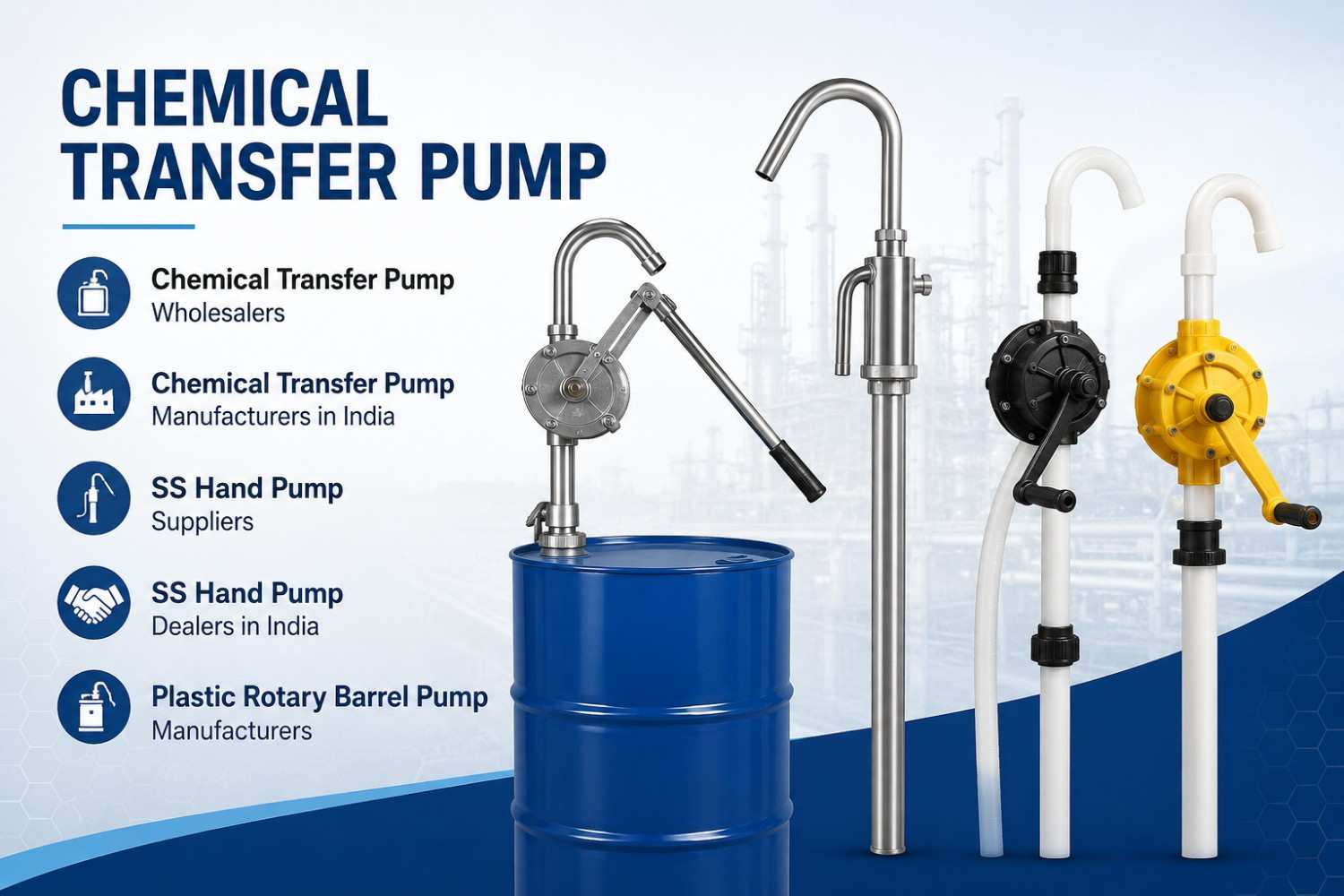
A drum is waiting on the shop floor, the operator is in a hurry, and the liquid inside is not as forgiving as water. That is usually where a Chemical Transfer Pump stops being a small purchase and starts becoming a safety decision. In India’s manufacturing sector, even small handling errors can affect batch quality, worker safety, and delivery timing. Manufacturing activity grew 6.2% in April 2026 under India’s revised IIP series, which means more factories are moving more liquids, more often.
That’s where the wrong pump starts costing money.
Most buyers focus only on price. Bad move. A pump that leaks during acid transfer, reacts with the chemical, or gives uneven discharge can turn a simple transfer job into rework, wastage, and a blame game between purchase, production, and maintenance teams. For flammable liquid movement, even static electricity is not a small issue; OSHA notes that Class I flammable liquids need proper bonding and grounding during transfer to reduce spark risk.
The Spec Detail Most Buyers Skip Before Ordering a Chemical Transfer Pump
Material Is Not a Formaility
For chemical, oil, solvent, and industrial fluid transfer, material selection is the first filter. Giza Pumps lists stainless steel, polypropylene, SS 304, SS 316, cast iron, PP, and PVDF across its industrial pump range, with applications covering oils, fuels, lubricants, acids, solvents, and corrosive liquids.
Here’s the simple buying logic. SS 304 or SS 316 works better where strength, corrosion resistance, and long working life matter. PP and PVDF are better choices where acids, alkalis, solvents, or highly reactive chemicals are involved. Cast iron has its place in rugged oil and fuel transfer, but pushing it into aggressive chemical duty just because it is cheaper is poor procurement.
Nobody tells you compatibility is boring until it becomes a rejected batch.
Pump Types Buyers Should Compare
A Chemical Transfer Pump is generally selected for acids, alkalis, solvents, mild corrosive liquids, and process chemicals. A SS Hand Pump is often preferred for controlled manual discharge of oils, solvents, and non-corrosive industrial fluids where electricity is not required. A Plastic Rotary Barrel Pump works well where the liquid needs a non-reactive body and lighter handling, especially in laboratories, chemical plants, and process units. Giza’s Plastic Rotary Barrel Pump page specifically mentions acidic, corrosive, solvent-based, and chemical liquid handling.
And yet, many buyers still ask only, “Rate kya hai?” Rate matters, yes. But pump tube length, seal quality, viscosity range, chemical compatibility, drum mouth fitting, discharge volume, and operating environment matter more.
Five Supplier Checks That Save You From a Bad Purchase
- Ask for material compatibility, not just material name.
A good answer mentions SS 304, SS 316, PP, PVDF, or cast iron based on your liquid. A bad answer sounds like, “Sir, yeh sab chemical mein chal jayega.” That is not technical advice. That is a future complaint. - Ask how the pump is tested before dispatch.
A serious supplier talks about leak testing, flow checking, and mechanical stability. A bad supplier says, “Problem hua toh replace kar denge.” A replacement after leakage does not recover your lost chemical or your operator’s trust. - Ask whether they understand bulk supply.
For Chemical Transfer Pump Wholesalers, stock regularity matters because distributors cannot wait 12 days every time a client asks for 8 pieces. Giza mentions wholesale supply, consistent inventory, and timely delivery for chemical transfer pumps. - Ask for industry use cases.
A reliable supplier should understand chemical plants, workshops, manufacturing units, automotive service, petroleum, lubricants, and pharma-type handling. A bad answer is only a product photo with no application clarity. - Ask who handles after-sales clarification.
ISO 9001:2015 is still one of the world’s most used quality management standards, with more than one million certificates issued in 189 countries, so documentation and process discipline are not small things in industrial buying. A weak supplier avoids written details. A serious one gives model, material, usage limit, and dispatch confirmation clearly.
How the Right Pump Protects Margin, Not Just Fluid
- Less leakage means less invisible loss.
A few drops per transfer may look minor, but in chemicals, solvents, and oils, repeated leakage becomes monthly wastage. A better Chemical Transfer Pump protects both material cost and housekeeping discipline. - Correct material reduces replacement cycles.
PP or PVDF for aggressive liquids and SS 316 for demanding chemical exposure can save buyers from early corrosion. Giza lists PP, PVDF, SS 304, SS 316, and cast iron as construction options across its rotary barrel pump range. - Manual control prevents over-discharge.
A SS Hand Pump is useful where operators need controlled flow rather than fast emptying. That matters in smaller batch mixing, lab-linked production, workshop dispensing, and controlled chemical use. - Safer handling lowers incident risk.
OSHA’s guidance says static charge can develop when liquids move through pipes or transfer systems, and this is why grounding and bonding cannot be ignored in flammable liquid transfer. Which means pump selection is not only a purchase job; it is also a safety-control decision. - Better repeatability improves production planning.
If one operator needs 12 minutes today and 19 minutes tomorrow for the same drum, your process is already unstable. Smooth rotation, suitable suction, and stable discharge help reduce that gap. - Bulk availability protects resale margin.
For dealers and distributors, delayed supply kills confidence. That is why buyers searching for Plastic Rotary Barrel Pump Manufacturers or Chemical Transfer Pump Wholesalers should look beyond single-piece pricing and check supply consistency.
India-Wide Availability Is a Supply Chain Advantage
Giza Pumps operates from Shapar, Rajkot, Gujarat, and lists 118 total market areas across Indian states and industrial cities, including Delhi, Gujarat, Maharashtra, Haryana, Rajasthan, Tamil Nadu, Telangana, Uttar Pradesh, and West Bengal.
This matters more than people think. Rajkot and Gujarat have a strong industrial supply ecosystem, while nearby industrial corridors like Ahmedabad, Vadodara, Ankleshwar, Dahej, Vapi, and Bharuch create practical movement for chemical and engineering buyers. For buyers searching Chemical Transfer Pump Manufacturers in India, supplier location is not just an address. It affects dispatch planning, transport coordination, urgent replacement, and wholesale supply cycles.
Most buyers in Delhi, Noida, Faridabad, Gurugram, Bhiwadi, Pune, Mumbai, Chennai, Hyderabad, and Kolkata want the same thing: a pump that reaches on time and performs without drama. That is also why SS Hand Pump Dealers in India need to be judged on stock, technical clarity, and dispatch discipline, not just catalogue size.
About Giza Pumps: What We Actually Pay Attention To
We work with industrial buyers who do not have time for vague answers. Our product line covers rotary barrel pumps, drum pumps, electric drum pumps, siphon pumps, SS rotary barrel pumps, SS Hand Pump, Plastic Rotary Barrel Pump, and Chemical Transfer Pump models for different fluid-handling needs. Giza’s website lists 1999 as the establishment year, 27+ years of experience, 25+ team members, over 90% repeat orders, and less than 48-hour response time.
Here’s one thing we have learned in this business: two liquids may look similar in a drum, but they may behave completely differently once they touch the pump body, seal, tube, or rotor.
We do not treat “chemical” as one category. We ask what liquid you are transferring, how often you use it, what drum size you handle, whether the liquid is corrosive, whether it is flammable, and whether the operator needs manual or motorized transfer. That small discussion saves bigger trouble later.
We reply in less than 48 hours for enquiries, and buyers can contact Giza Pumps at Website.
For faster quotation, send us these details:
- Liquid name or chemical type
- Approximate viscosity, if available
- Drum or barrel size
- Required pump type: manual, electric, pneumatic, SS, PP, or PVDF
- Required quantity
- Delivery location
- Whether you need dealer, distributor, or wholesale pricing
MOQ: one unit can be discussed for standard model selection; dealer and bulk pricing depend on model, material, and quantity.
Tell us the actual working condition, not just the product name. We will help you choose the right Chemical Transfer Pump, SS Hand Pump, or Plastic Rotary Barrel Pump from Giza Pumps based on usage, safety, and supply requirement.
Why Modern Manufacturing Needs Better Pump Selection
A Chemical Transfer Pump is not a side item when chemicals, oils, solvents, or corrosive liquids are moving every day. It affects safety, wastage, repeatability, and buyer confidence. The factories that grow cleaner and faster over the next few years will be the ones that stop treating fluid transfer as a low-priority purchase.
FAQs
1. Which Chemical Transfer Pump is suitable for acids and solvents?
For corrosive solvents, alkalis, and acids, you can use PP or PVDF. For certain applications, we can consider using SS 316, but a compatibility test is required before shipment. Giza provides PP, PVDF, SS 304, SS 316 and cast iron options in their pump range.
2. Do Chemical Transfer Pump Wholesalers support bulk orders?
Yes, Chemical Transfer Pump Wholesalers generally support distributors, retailers, and industrial buyers with repeated quantity needs. The caveat is simple: bulk price depends on model, material, and order size. A PP pump and SS 316 pump cannot be priced the same way.
3. Are SS Hand Pump Suppliers better for manual industrial use?
When factories require manual discharge that doesn’t depend on electricity, “SS Hand Pump Suppliers” come in handy. “SS Hand pumps” are often selected to pump oils, solvents, mild chemicals, and industrial fluids that are non-corrosive to metals. For chemicals that are highly reactive, check to make sure they are compatible first.
4. Why choose Plastic Rotary Barrel Pump Manufacturers for corrosive liquids?
Plastic Rotary Barrel Pump Manufacturers are often preferred for corrosive or acidic liquid transfer because plastic polymers like PP can reduce reaction risk with many chemicals. Still, not every plastic pump suits every chemical. Share the liquid name before ordering.
5. Can SS Hand Pump Dealers in India supply for factories outside Gujarat?
Yes. Giza lists market areas across 118 locations in India, including major industrial states and cities. Buyers looking for SS Hand Pump Dealers in India should confirm dispatch time, transport mode, and packaging before final approval.
6. How do I compare Chemical Transfer Pump Manufacturers in India?
Compare material options, testing process, application knowledge, dispatch support, and after-sales response. Chemical Transfer Pump Manufacturers in India who avoid compatibility discussion should not be your first choice. Low price is not useful if the pump fails in the first working cycle.
7. Are Plastic Rotary Barrel Pump Manufacturers suitable for distributors?
Yes, Plastic Rotary Barrel Pump Manufacturers can support distributors when stock, packaging, and repeat supply are clear. Chemical Transfer Pump Wholesalers and SS Hand Pump Suppliers should also provide model-wise details so dealers can answer buyer questions without guessing.