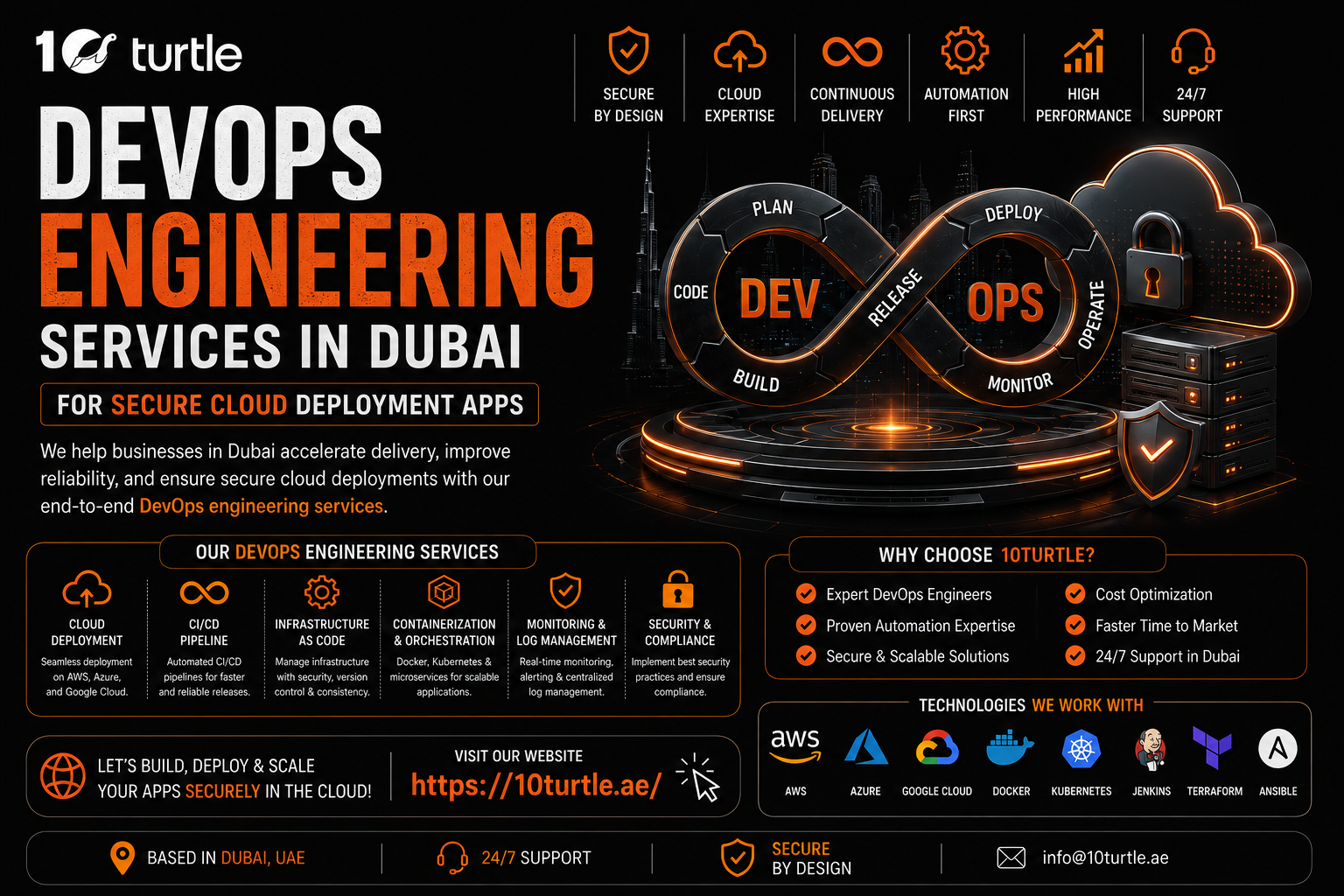
Dubai’s businesses are moving fast, and their infrastructure needs to move just as fast without breaking. That’s where cloud deployment solutions for growing enterprises come into the picture. From fintech startups in DIFC to logistics firms near Jebel Ali, companies across the UAE are adopting DevOps practices to ship software faster, cut downtime, and keep customer data locked down tight. This guide walks through what modern DevOps engineering looks like in the region, why security can’t be an afterthought, and how local businesses are getting it right in 2026.
Why DevOps Engineering Services Matters More Than Ever in the UAE
The UAE’s digital economy is expanding at a pace few regions can match. Government initiatives like the Dubai Digital Strategy and the broader UAE Vision push both public and private sectors toward cloud-first operations. But rapid digital transformation brings a real challenge: how do you release features quickly while still meeting the UAE’s data protection expectations under the Personal Data Protection Law (PDPL)?
This is where automated infrastructure management becomes essential rather than optional. DevOps isn’t just about writing scripts to deploy code it’s a culture shift that blends development and operations teams around shared goals: speed, reliability, and security. Companies that skip this shift often end up with fragile systems, slow release cycles, and compliance headaches down the line.
Core Services Under the DevOps Engineering Services Umbrella
A capable DevOps Engineering Services in Dubai typically covers a wide spread of technical ground:
- CI/CD pipeline setup — automating build, test, and release stages so code moves from a developer’s laptop to production without manual bottlenecks.
- Infrastructure as Code (IaC) — using tools like Terraform or Pulumi to provision cloud resources consistently, avoiding the classic “it worked on my machine” problem.
- Container orchestration — Kubernetes and Docker-based deployments that scale horizontally as demand grows, useful for e-commerce spikes during events like the Dubai Shopping Festival.
- Cloud migration support — moving legacy on-premise systems to AWS, Microsoft Azure, or Google Cloud, all of which now operate dedicated regions inside the UAE.
- Monitoring and observability — real-time dashboards and alerting so issues are caught before customers notice.
- DevSecOps integration — embedding security scans directly into the pipeline instead of bolting them on at the end.
Secure Cloud Deployment: The UAE Angle
Security in the Gulf region carries its own set of rules and expectations. The UAE’s data residency requirements mean many organizations, particularly in banking, healthcare, and government-adjacent sectors, must keep sensitive workloads within regional data centers. Providers such as AWS Middle East (Bahrain), Microsoft Azure UAE North and UAE Central, and G42 Cloud have built local infrastructure specifically to address this.
A well-structured secure cloud architecture typically layers in:
- Zero Trust network design — no implicit trust between services, even inside the same virtual network.
- Encryption at rest and in transit — mandatory for anything touching customer financial or health records.
- Identity and Access Management (IAM) governance — tightly scoped permissions instead of broad admin access.
- Automated compliance auditing — mapped against frameworks like ISO 27001, NESA (UAE Information Assurance Standards), and Dubai’s own DESC (Dubai Electronic Security Center) guidelines.
- Disaster recovery planning — multi-region failover so a single data center outage doesn’t take down operations.
Free zones like Dubai Internet City, DIFC, and Dubai Silicon Oasis have become hubs where tech companies actively seek out cloud infrastructure consulting to meet both growth targets and regulatory obligations simultaneously.
What’s New: The Shift Toward AI-Assisted DevOps Engineering Services in Dubai
One trend gaining real traction across UAE tech hubs is AI-augmented operations sometimes called AIOps. Rather than engineers manually sifting through logs, machine learning models now flag anomalies, predict capacity needs, and even suggest rollback actions automatically. Dubai-based startups and enterprise IT teams alike are piloting these tools to reduce mean time to resolution (MTTR) on incidents. Combined with the UAE’s National AI Strategy 2031, this positions the emirate as a genuine testing ground for intelligent cloud operations, not just a follower of trends set elsewhere.
Another local development worth noting: several UAE free zones now offer streamlined licensing for cloud and SaaS companies, which has encouraged more regional DevOps consultancies to set up shop rather than relying solely on providers based in Europe or the US. This means faster response times, better understanding of Arabic-language documentation needs, and support that actually aligns with UAE business hours and holidays.
Choosing the Right Partner
When evaluating a managed DevOps Engineering Services provider, look beyond flashy dashboards. Ask about their track record with UAE-specific compliance, whether they have engineers physically based in the region for faster incident response, and how they handle post-deployment support. A good partner treats security scanning, cost optimization, and uptime monitoring as ongoing responsibilities, not one-time setup tasks.
Conclusion
Dubai’s ambition to become a global tech and finance hub depends heavily on the strength of the digital infrastructure underneath it. Businesses that invest in reliable, well-architected DevOps practices position themselves to scale confidently while staying compliant with regional data laws. Whether it’s automating deployments, hardening cloud environments, or adopting AI-driven monitoring, the fundamentals remain the same: build fast, but build safely.
Frequently Asked Questions
1. What does a DevOps Engineering Services actually include?
It typically covers automation of software delivery (CI/CD), infrastructure provisioning, monitoring, and security integration essentially everything needed to move code from development to a live, stable production environment.
2. Is cloud data required to stay physically inside the UAE?
For certain sectors like banking, healthcare, and government services, yes data residency rules often require storage within UAE-based data centers. Other industries have more flexibility but should still review PDPL requirements carefully.
3. How long does a typical cloud migration take for a mid-sized company?
This varies widely, but most mid-sized migrations in Dubai take anywhere from six to twelve weeks, depending on system complexity and how much refactoring legacy applications need.
4. What’s the difference between DevOps and DevSecOps?
DevOps focuses on speeding up development and deployment cycles. DevSecOps adds security checks directly into that pipeline, so vulnerabilities get caught during development rather than after release.
5. Do small businesses in the UAE actually need DevOps Engineering Services, or is this only for large enterprises?
Small and mid-sized businesses benefit just as much, if not more, since automation reduces the need for large in-house IT teams while still keeping systems reliable and secure.