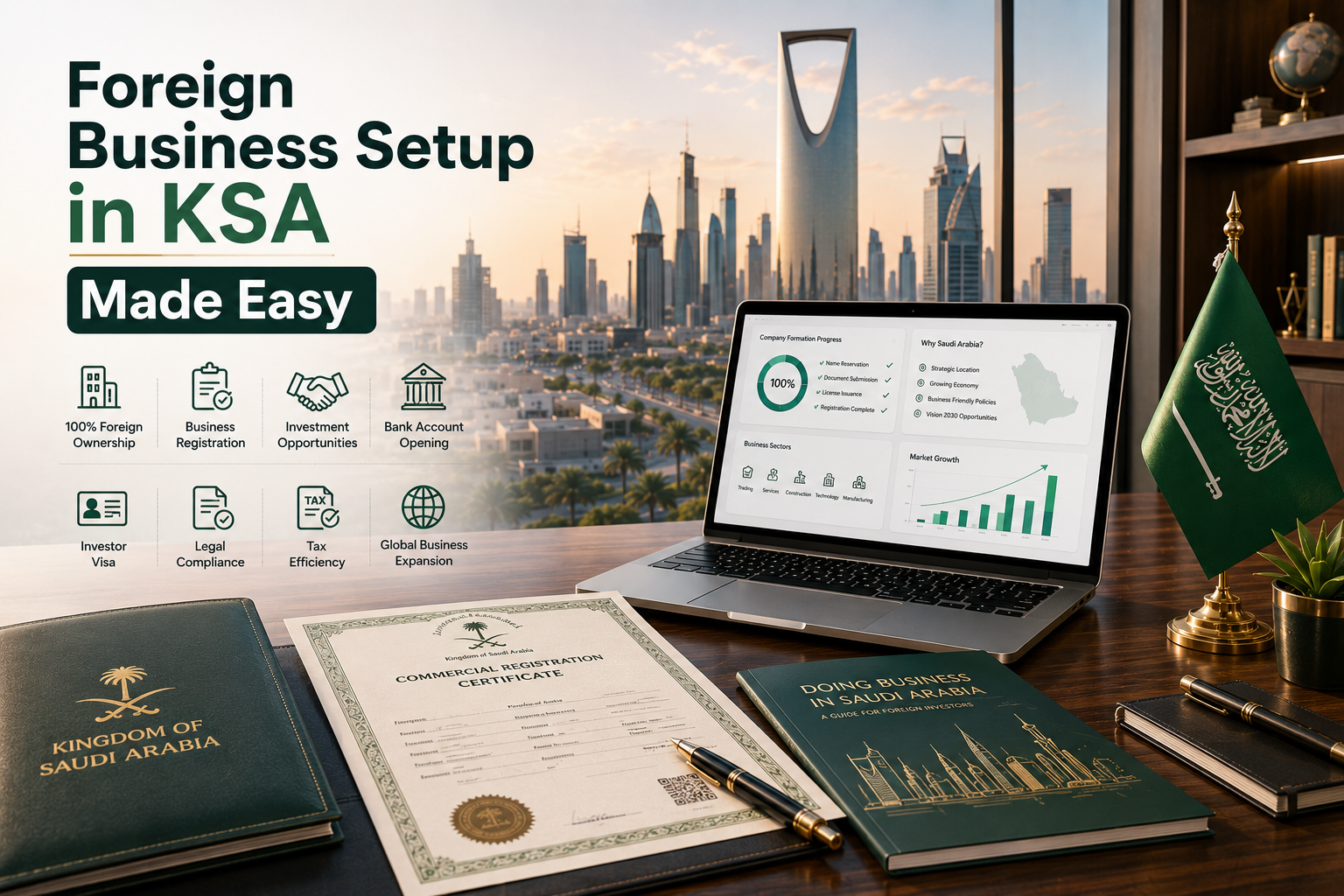
If your mental image of setting up a foreign business in Saudi Arabia involves months of stalled paperwork and a mandatory local sponsor, it’s worth updating. A new Investment Law took effect in February 2025, and the practical experience for foreign investors has shifted noticeably since — faster processing, fewer mandatory local partnerships, and a system that’s moved almost entirely online. None of this means there’s nothing to plan for. It means the plan looks different than it used to, and founders who understand the current shape of the process tend to move through it far more smoothly than those working off outdated advice.
Start By Confirming You Don’t Need a Local Partner
Foreign Business Setup in KSA old rule find a Saudi partner to hold a stake in your company simply doesn’t apply to most businesses anymore. In the large majority of sectors, including consulting, technology, retail, and manufacturing, foreign investors can now hold 100% ownership with no mandatory local sponsor at all. A smaller set of regulated activities, like banking, insurance, and certain real estate near Makkah and Madinah, still carries additional requirements or restrictions, so it’s worth confirming your specific activity classification before you assume either outcome. For most founders reading this, though, the honest answer is that full ownership is simply available, and no longer something you need to negotiate.
The One Gate You Can’t Skip: MISA
Every foreign investor has to pass through the Ministry of Investment of Saudi Arabia, known as MISA, before doing anything else. Saudi citizens register directly with the Ministry of Commerce; foreign investors don’t get that shortcut and need MISA’s approval first. The good news is that this gate has gotten considerably easier to pass through — many straightforward applications are now processed in as little as three to five business days, a dramatic change from the multi-week waits that used to be standard. Choosing the right license type here matters: service licenses suit consulting and IT businesses, commercial licenses fit retail and trading, and industrial licenses — which involve extra regulatory sign-off — typically take longer regardless of how quickly MISA itself moves.
Where the Real Time Actually Goes
Here’s the part that surprises a lot of first-time founders: MISA’s own processing has gotten fast, but the document preparation leading up to it hasn’t gotten any shorter. Every document connected to your parent company — commercial registration, financial statements, Articles of Association — has to be notarized in your home country, legalized by the Saudi Embassy, and then translated into Arabic by an approved local translator. This sequence, not the government review itself, is consistently what determines your actual timeline. Founders who start gathering and processing these documents weeks before they plan to submit anything tend to sail through the online application; those who start from scratch after deciding to expand often find the paperwork, not the bureaucracy, is what slows them down.
After MISA: Three More Registrations, Not Optional
Getting your MISA approval feels like the finish line, but it’s really comply globally the halfway point. From there, you register with the Ministry of Commerce for your Commercial Registration, which gives your business its official legal identity and CR number. After that comes ZATCA, the tax authority, for tax and VAT registration, and GOSI for social insurance if you plan to hire employees. You’ll also need a registered commercial lease through the Ejar platform to establish an official National Address — a virtual office alone doesn’t satisfy this requirement, something that trips up founders trying to move fast before securing real space.
Plan Around Hiring Early, Not Later
One detail that’s easy to miss until it directly affects you: Saudi Arabia’s Nitaqat system sets Saudization quotas that govern how many Saudi nationals your company needs to employ as it grows. It won’t stop your initial business setup, but it shapes your hiring plan from day one, and companies that ignore it until they’re actively recruiting often find themselves scrambling to adjust. Building this into your workforce planning early, alongside your registration timeline, avoids a genuinely avoidable headache later.
What “Easy” Really Means Here
Foreign business setup in Saudi Arabia genuinely has gotten easier — full ownership in most sectors, fast MISA processing, and an entirely digital application system. What hasn’t changed is that the process still rewards founders who prepare their documentation early and understand the full sequence, from MISA through Commercial Registration, tax enrollment, and Ejar. Approach it in that order, with your paperwork ready before you need it, and Saudi Arabia’s current system genuinely delivers on the “made easy” promise more honestly than it would have just a few years ago.