When the armies of Europe mobilized in the hot summer of 1914, the German Imperial Army marched toward the front lines in a striking blend of 19th-century military pageantry and modern industrial utility. The conflict that followed forced rapid, bloody adaptations in military strategy, which were directly reflected in the evolution of world war 1 german uniforms.
From the iconic spiked helmets of the opening campaigns to the cold, utilitarian steel armor of the late-war trenches, the garments worn by the German soldier underwent a massive transformation.
The Birth of Feldgrau (Field Gray)
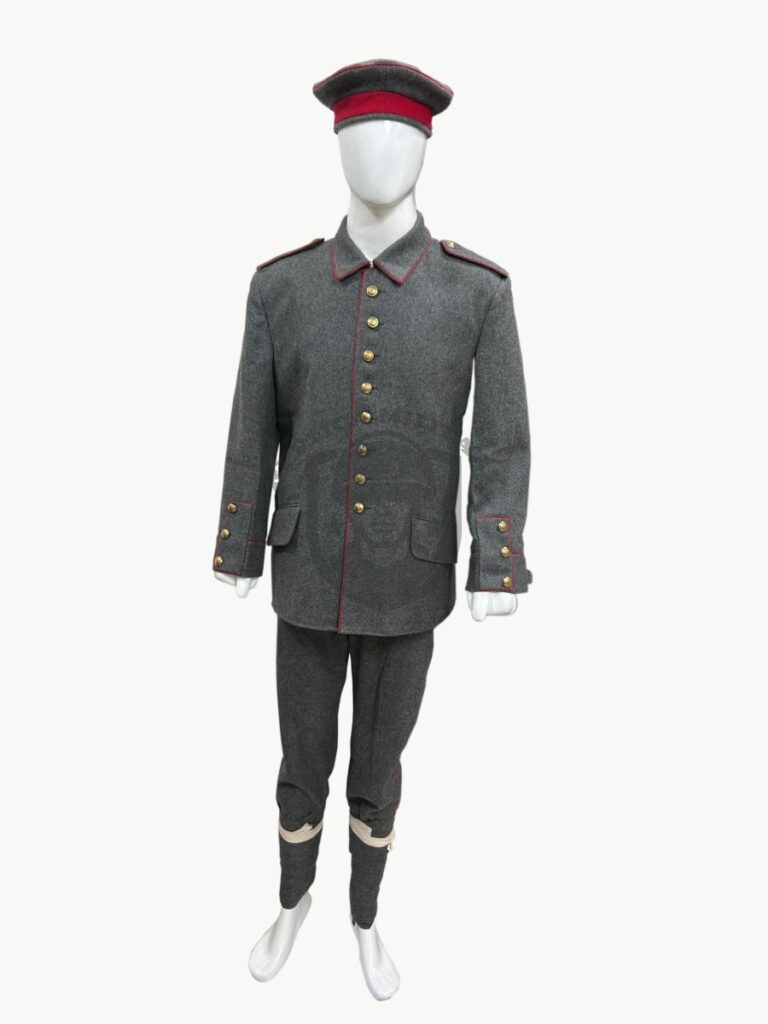
Prior to the war, European battlefields were dominated by bright blues, reds, and dark greens. However, recognizing the lethality of modern, long-range smokeless rifles, the German military introduced the M1910 uniform. This design replaced traditional Prussian blue with Feldgrau—a nuanced, greenish-gray hue engineered to blend into the misty, industrialized landscapes of Northern Europe.
The core of the early-war uniform consisted of:
- The M1910 Tunic: A heavy wool jacket featuring a turn-down collar, contrast piping along the cuffs and closure (colored according to the soldier’s kingdom or regiment), and internal brass belt hooks to support heavy leather gear.
- The Pickelhaube: The most recognizable piece of German headgear, this helmet was made of hardened leather, trimmed in brass, and topped with a distinctive metal spike. While visually striking, it offered zero protection against shrapnel and its glossy finish inadvertently gave away sniper positions.
Trench Warfare Adaptations: The M1915 and the Stahlhelm
As the war ground to a bloody, static halt in the trenches, the ornate details of the M1910 uniform proved completely impractical. In 1915, the high command introduced the simplified M1915 Bluse. This tunic hid the shiny brass buttons behind a fabric fly flap, removed the colorful regimental piping, and featured a simpler, universal green collar to ease mass production.
The most radical change came in 1916 with the retirement of the leather Pickelhaube. To combat devastating head injuries caused by overhead shrapnel bursts, Germany introduced the Stahlhelm (Steel Helmet). Designed by Dr. Friedrich Schwerd, its deep, coal-scuttle shape provided unparalleled protection for the soldier’s neck and ears. This silhouette became the definitive face of the German infantryman for the remainder of the war.
Recreating History with Replicamilitary
For living historians, museum curators, and film productions, capturing the exact texture, weight, and specific greenish-gray tone of historic German wool is an immense challenge. Finding an authentic look requires incredible attention to historical patterns.
If you are looking to assemble a historically accurate impression, Replicamilitary specializes in providing museum-grade reproductions of Great War uniforms and field gear. From the heavy wool weave of the M1915 Bluse to the precise leather construction of early-war ammunition pouches, Replicamilitary ensures that every stitch, seam, and button placement accurately honors the historical record, helping bring the complex history of the Great War to life.