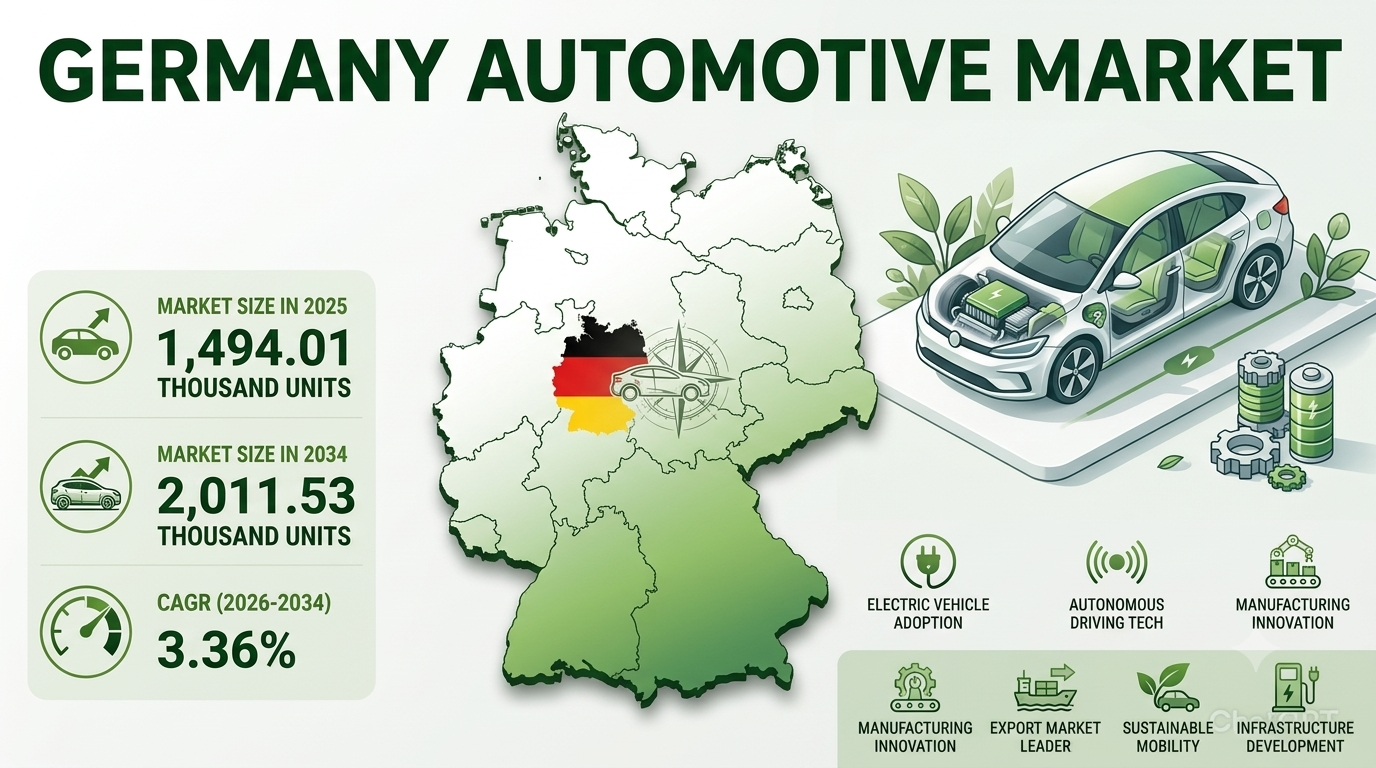
The Germany automotive market is witnessing steady growth driven by the country’s accelerating transition toward sustainable mobility, expanding electric vehicle adoption, and robust investment in autonomous driving and connected vehicle technologies. The market size reached 1,494.01 Thousand Units in 2025 and is projected to reach 2,011.53 Thousand Units by 2034, exhibiting a compound annual growth rate (CAGR) of 3.36% during 2026-2034. Germany remains Europe’s largest vehicle market, accounting for approximately a quarter of all new passenger car registrations in the European Union. The market recorded approximately 2.86 million new passenger car registrations in 2025, representing a modest recovery from prior years. Stringent EU emission regulations, expanding EV charging infrastructure, and robust investment in autonomous driving and connected vehicle technologies are reshaping the competitive landscape. Major German manufacturers are accelerating electrification strategies, launching affordable electric models, and enhancing digital integration across vehicle platforms, strengthening Germany’s automotive market share. This market is strategically important to Germany’s economy as the automotive sector accounts for approximately 5% of total value added in Germany, while providing 3% of employment and generating the largest revenue compared to other sectors. German auto exports totaled €262 billion (USD 307.8 billion) in 2024, making up 17% of the country’s total exports.
The Germany automotive market is poised for sustained expansion, driven by accelerating electric vehicle adoption, government support for sustainable mobility, and technological innovation in autonomous driving and connectivity. With a projected CAGR of 3.36% through 2034, the market presents significant opportunities for established manufacturers and new entrants focused on electrification and digital mobility solutions.
GERMANY AUTOMOTIVE MARKET SUMMARY
The Germany automotive market encompasses a wide range of vehicles designed for personal and commercial mobility, including passenger vehicles and commercial vehicles across diverse propulsion types. The ecosystem includes global automotive manufacturers (Volkswagen, BMW, Mercedes-Benz), suppliers, dealership networks, and end-use consumers. Major segments identified in the market include propulsion type (internal combustion engine, electric, hybrid, others), vehicle type (passenger vehicles, commercial vehicles, others), and region. Internal combustion (ICE) vehicles dominate the market with a share of 81% in 2025, driven by consumer familiarity, well-established fueling infrastructure, and ongoing demand for conventional powertrains across passenger and commercial vehicle segments. Passenger vehicles lead the vehicle type segment with a share of 76% in 2025, reflecting strong consumer preference for personal mobility solutions, diverse model availability from premium and mass-market brands, and robust urban commuting demand. The electric vehicle segment is the fastest-growing category, with the Germany electric vehicle market projected to exhibit a CAGR of 22.44% during 2026-2034, reaching USD 259.1 Billion by 2034.
PORTER’S FIVE FORCES ANALYSIS — GERMANY AUTOMOTIVE MARKET
The competitive dynamics of the Germany automotive market can be analyzed using Porter’s Five Forces framework.
- Competitive Rivalry: The German automotive market features intense competition among established domestic manufacturers (Volkswagen, BMW, Mercedes-Benz) and growing international challengers, particularly Chinese EV makers like BYD. Together, Volkswagen, BMW and Mercedes achieved a combined market share of 39.9% of new cars sold across Europe in 2025. However, Chinese competitors are rapidly gaining ground, with BYD tripling its market share in Europe and SAIC holding 1.9%. German automakers face declining profits, with Mercedes-Benz profits dropping 56% and Porsche’s operating profit plunging 91% in the first half of 2025. Business implication: Manufacturers must differentiate through electrification leadership, digital innovation, and cost competitiveness to maintain market position.
- Supplier Power (Component Suppliers): The automotive supply chain in Germany faces significant strain as the shift to EVs demands capital-intensive operations. Major suppliers like Bosch have announced plans to lay off 13,000 more workers by 2030. However, German manufacturers maintain strong bargaining power with suppliers due to their scale and engineering expertise. Business implication: Automakers must develop resilient supply chains and strategic partnerships, particularly for battery and semiconductor components.
- Buyer Power (Consumers): Private consumers and companies are increasingly reluctant to buy new cars due to economic struggles, with many concerned about losing income or jobs. The high prices of new cars, driven partly by regulatory requirements, are deterring buyers. Consumers are demanding more affordable electric models and digital features. Business implication: Manufacturers must offer compelling value propositions, competitive pricing, and flexible mobility solutions to attract price-sensitive consumers.
- Threat of Substitutes: Alternative mobility solutions including public transportation, car-sharing, ride-hailing services, and micromobility options pose substitution threats, particularly in urban areas. The rise of “Mobility as a Service” (MaaS) platforms is reshaping consumer transportation choices. Business implication: Automakers must evolve beyond traditional manufacturing toward integrated mobility service offerings.
- Threat of New Entrants: While high barriers to entry exist for traditional automotive manufacturing (capital intensity, engineering expertise, brand equity), lower barriers exist for EV startups and technology companies entering the mobility space. Chinese manufacturers like BYD and SAIC have successfully entered the European market. Tesla’s market share in Europe collapsed from 2.3% to 1.4% in 2025, indicating that even established disruptors face competitive pressures. Business implication: Incumbents should build defensible positions through brand strength, technological leadership, and scale advantages while embracing new mobility paradigms.
Competitive Rivalry — High
- Multi-tier competition spans domestic giants (Volkswagen Group, BMW, Mercedes-Benz), international players, and emerging Chinese EV manufacturers. In the January-September 2025 period, BYD’s sales in Europe rose 248.1%, while SAIC Motors recorded a 37.3% increase.
- German manufacturers are defending their position, expanding their combined EU market share to 39.9% in 2025, up 1.2 percentage points from the previous year. However, the industry faces significant headwinds: automobile production in Germany has fallen sharply from 5.6 million units in 2017 to around 3.4 million in 2024, with the sector cutting more than 51,000 jobs over the past year.
Request for Sample Report: https://www.imarcgroup.com/germany-automotive-market/requestsample
MARKET GROWTH DRIVERS:
Accelerating Electric Vehicle Adoption and Market Penetration
Germany is experiencing a rapid shift toward electric mobility as a wider range of electric models becomes available and affordability improves for everyday consumers. Battery-electric vehicle registrations surged by over 43% in 2025 to reach 545,000 units. Electric vehicles accounted for 19.1% of the German car market in 2025 versus 13.5% in 2024 and 18.4% in 2023. Electric car production in Germany surged to 1.67 million cars in 2025, an increase of 15% on 2024, making Germany the world’s second largest producer of electric cars. This transition is being shaped by stricter environmental regulations, changing buyer expectations, and increasing competitive intensity across the automotive landscape. Growing acceptance of electric vehicles reflects rising confidence in performance, driving range, and overall usability.
Advancement of Autonomous Driving and AI-Powered Mobility Solutions
Germany is emerging as a key testing ground for autonomous driving technologies, with both domestic and international companies investing in research and development. The federal government established a comprehensive framework to support innovation in this space. Key trends driving innovation include electric and autonomous vehicles, connected car technologies, and advancements in manufacturing processes. The future outlook for the Germany automotive innovation market appears promising, driven by a strong emphasis on sustainability, digitalization, and autonomous driving technologies.
Government Support and Policy Framework
Germany’s automotive sector benefits from government policies combining financial incentives, environmental regulations, and industrial strategies. The government allocated €3.4 billion in EV subsidies, with €2.1 billion for 2023 and €1.3 billion for 2024, stimulating consumer demand and boosting production. In October 2025, Chancellor Merz announced that the government would extend the vehicle tax exemption for electric cars beyond 2030 by an additional five years and provide €3 billion to support lower- and middle-income individuals transitioning to climate-friendly mobility. The government is also actively promoting hydrogen fuel cells as an alternative to combustion engines, with the Federal Ministry for Digital and Transport investing €259 million in R&D and €285 million for market activation under the National Innovation Programme for Hydrogen and Fuel Cell Technology.
Infrastructure Development and Charging Network Expansion
With the Master Plan for Charging Infrastructure 2030 and the expansion of the Deutschlandnetz, Germany is enabling comprehensive coverage with charging stations. The government also supports the development of a high-performance battery ecosystem and research, particularly in battery cells, while working on secure raw material supply. Together with ongoing improvements in charging networks and vehicle technologies, these factors are reinforcing the momentum of electrification and supporting the long-term transformation of the country’s automotive ecosystem.
GERMANY AUTOMOTIVE MARKET SEGMENTATION
Segmentation analysis provides a detailed view of the Germany automotive market by category:
- Propulsion Type Insights: Internal Combustion Engine (81% market share in 2025), Electric, Hybrid, Others.
- Vehicle Type Insights: Passenger Vehicles (76% market share in 2025), Commercial Vehicles, Others.
- Regional Insights: Germany’s automotive regions show significant variation. Eastern German states lead in electric car production, with nearly two-thirds (60%) of all cars produced in eastern Germany being electric in 2025, compared with 35.1% in western Germany and 40.2% for the country as a whole. North Rhine-Westphalia accounts for the largest BEV population with 454,783 registered units. Baden-Württemberg, home to Mercedes and Porsche, faces economic slowdown as the automotive sector undergoes structural change.
COMPETITIVE LANDSCAPE
The Germany automotive market exhibits a highly competitive landscape, with established domestic manufacturers leveraging decades of engineering expertise alongside growing international challengers. Companies are intensifying investments in electrification, autonomous driving, and digital connectivity to maintain market positioning and capture emerging mobility opportunities. Key companies operating in the market include:
- Volkswagen Group — dominates the German electric car market with a market share of approximately 46% in the first half of 2025. Together with BMW and Mercedes, VW achieved a European market share of 39.9% in 2025.
- BMW Group — remains the world’s leading premium carmaker in 2025. BMW’s profits declined by one-third in the second quarter of 2025.
- Mercedes-Benz — remains the second largest premium carmaker in 2025, though profits dropped by 56% in the first half of 2025.
- Audi — remains the third largest premium carmaker in 2025.
- Chinese Competitors (BYD, SAIC) — BYD’s sales in Europe rose 248.1% in the January-September 2025 period. BYD now has a market share of 1.2% in Europe, while SAIC holds 1.9%.
Strategic developments are shaping the competitive arena, notably the Automobile Dialogue at the Federal Chancellery in October 2025, where Chancellor Merz met with auto industry representatives to discuss strengthening competitiveness and innovation. The government committed to supporting the industry in advancing technologies beyond electromobility to compete globally. German car manufacturers also face significant headwinds from high U.S. tariffs and eroding market share in China, where local rivals like BYD and Xiaomi are now dominating with cheaper, high-tech electric vehicles. German carmakers’ collective sales in China fell by a quarter over five years to 3.9 million vehicles in 2025.
REGIONAL ANALYSIS
Regional dynamics within the Germany automotive market are shaped by varying levels of industrial concentration and electrification adoption:
- Eastern Germany emerges as a critical electric vehicle production hub, with nearly 60% of all cars produced being electric, driven by Tesla’s Gigafactory in Brandenburg and Volkswagen’s all-electric factory in Zwickau, Saxony. Well over 200,000 people work for automotive companies and their suppliers in east German states.
- Baden-Württemberg, Germany’s top exporting state and home to Mercedes and Porsche, is facing an economic slowdown as the automotive sector undergoes structural change. Falling demand in the auto supply chain is squeezing hundreds of smaller manufacturers and threatening job security.
- North Rhine-Westphalia accounts for the largest BEV population with 454,783 registered units.
- Bavaria sees BMW achieving 40.3% of its German new registrations, while Audi achieves 37.0%.
RECENT INDUSTRY DEVELOPMENTS
October 2025: Chancellor Merz convened the Automobile Dialogue at the Federal Chancellery with auto industry representatives, unions, and politicians to strengthen competitiveness and innovation. The government committed to extending EV tax exemptions beyond 2030 by five years and providing €3 billion to support lower-income individuals transitioning to climate-friendly mobility.
October 2025: Germany hosted an auto industry summit to discuss ways to boost competitiveness amid rising competition from the US and China. The summit focused on finding common solutions to position the auto industry for future technologies while securing jobs and achieving climate targets.
September 2025: Chancellor Merz opened the IAA Mobility 2025 in Munich, stating that the automotive industry remains by far the most significant industrial sector in Germany by revenue.
2025: The German automotive market recorded approximately 2.86 million new passenger car registrations, representing a 1% increase year-on-year. Battery-electric vehicle registrations surged by over 43% to reach 545,000 units. Electric car production reached 1.67 million vehicles, up 15% from 2024, making Germany the world’s second largest producer of electric cars.
2025: German automakers Volkswagen, BMW and Mercedes expanded their combined EU market share to 39.9%, up 1.2 percentage points from the previous year. However, all three reported steep profit declines in the first half of 2025, citing U.S. tariffs and weak demand.
Key Aspects Required for the Germany Automotive Market
- Market Performance: 1,494.01 Thousand Units in 2025, with a projected trajectory to 2,011.53 Thousand Units by 2034.
- Market Outlook: A 3.36% CAGR through 2034 indicates steady growth across passenger and commercial vehicle segments.
- Growth Drivers: Accelerating electric vehicle adoption (22.44% CAGR for EV segment through 2034); €3.4 billion government EV subsidies; €3 billion additional support for low- and middle-income EV buyers; autonomous driving and connected vehicle technology investments; expansion of charging infrastructure through Master Plan 2030.
- Competitive Landscape: A highly competitive market with established domestic manufacturers (Volkswagen Group, BMW, Mercedes-Benz) leveraging engineering expertise alongside growing international challengers, particularly Chinese EV makers. Combined EU market share of top three German manufacturers reached 39.9% in 2025.
- Value Chain Analysis: From automotive manufacturing and component supply through dealership networks, aftermarket services, and end-use consumers to vehicle exports.
- Industry Trends: Rapid electrification with BEV registrations up 43% in 2025; autonomous driving and AI-powered mobility solutions; China’s rise reshaping competitive landscape; industry job cuts exceeding 51,000; government policy support for technology-neutral approaches and climate goals.
- Strategic Recommendations: Focus on electric vehicle innovation and affordability; invest in autonomous driving and connected vehicle technologies; develop resilient supply chains for batteries and semiconductors; expand charging infrastructure partnerships; strengthen brand differentiation in premium segments; adapt to changing consumer preferences toward sustainable mobility.
Note: If you need any specific information that is not covered currently within the scope of the report, we will provide the same as a part of customization.
Request Customization: https://www.imarcgroup.com/request?type=report&id=23723&flag=E
Write this before about us —
- Report Format, Delivery, and Customization Details
- Report Format Mode: PPT, PDF, and Excel
- Report Delivery Mode: Online Delivery, Physical Delivery
- Report Delivery Time: Report Delivered Over Email within 24 to 48 hours. If requested by the client, a physical copy will be delivered within three to ten days.
- Report Confirmation Mode: Yes via Email
- Report Customization Mode: Yes via Email / Call
- Report Table of Content: Yes
- Report List of Figures: Yes
- Report Methodology Mode: Yes
- Request For Sample Report: Yes