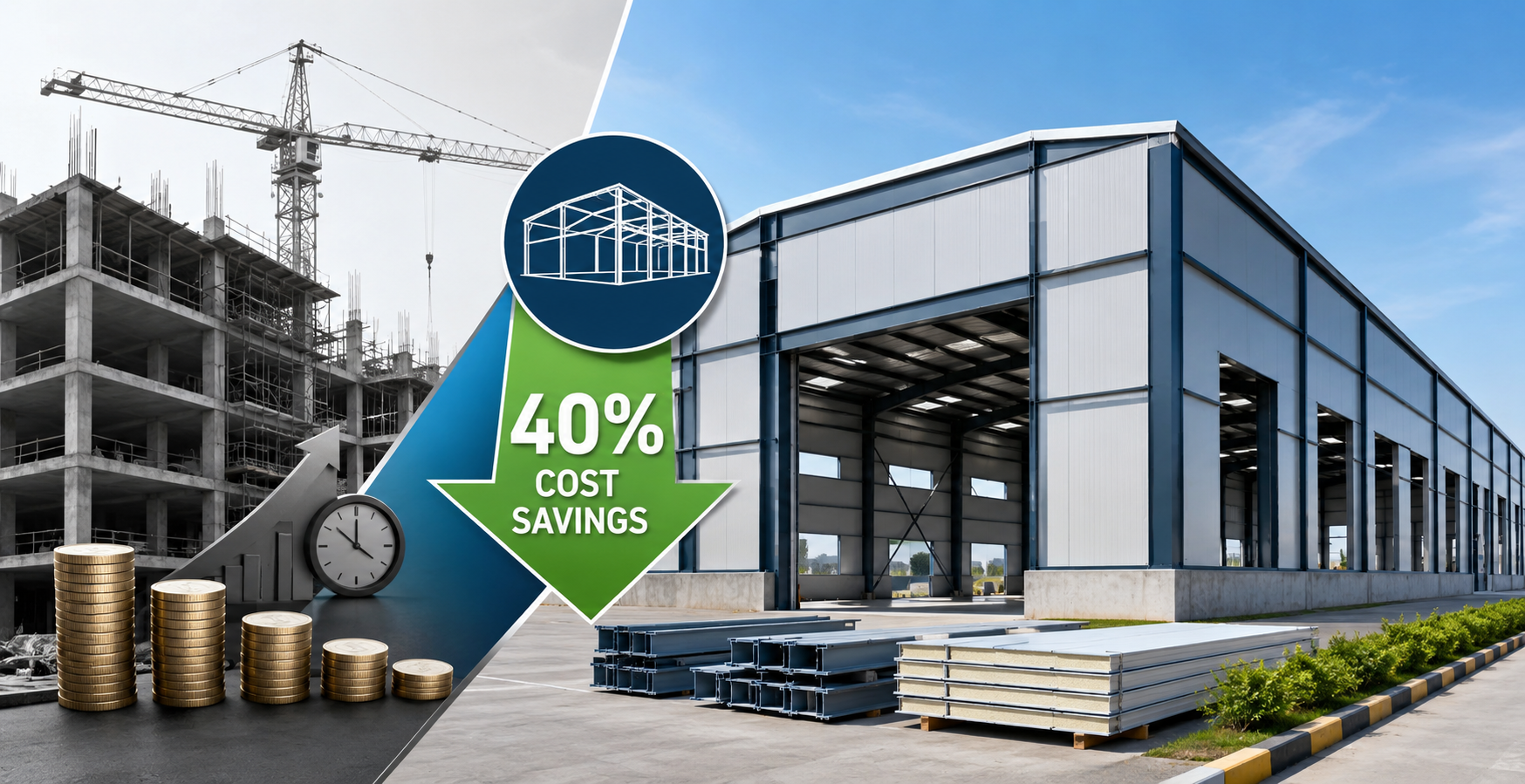
Picture this: you’ve finally decided to build that warehouse, office space, or industrial unit you’ve been planning for years. You call a traditional contractor, get a quote, and your jaw drops. Then you factor in delays, weather setbacks, labor shortages, and material price hikes — and suddenly your budget looks more like a rough guess than a plan.
If this sounds familiar, you’re not alone. Thousands of business owners and homeowners across India face the same frustration every year. The good news? There’s a smarter, faster, and far more cost-effective way to build — and it starts with working with the right Pre Fabricated Building Manufacturer.
At Invogue Building Systems, we’ve helped countless clients slash their construction budgets without compromising on quality or durability. In this blog, we’ll break down exactly how prefabricated construction works, why it can reduce your costs by up to 40%, and how to choose the right manufacturer for your project.
What is a Pre Fabricated Building Manufacturer?
A Pre Fabricated Building Manufacturer is a company that designs, engineers, and produces building components — walls, roofing, frames, and panels — in a controlled factory environment, rather than building everything from scratch on-site. Once these components are ready, they’re transported to your location and assembled quickly, almost like putting together a giant, precise puzzle.
Unlike traditional construction, where materials are cut, measured, and built on-site (often with errors, waste, and weather delays), prefabrication moves most of the heavy lifting into a factory. This shift alone is what drives most of the cost and time savings.
Why Does This Save So Much Money?
Traditional construction is unpredictable. Rain delays pouring concrete. Labor shortages stall timelines. Material wastage adds up. Prefabrication removes most of these variables because everything is planned, measured, and produced in advance under factory conditions — with far less room for error or delay.
Traditional Construction vs Pre Fabricated Construction
| Factor | Traditional Construction | Pre Fabricated Construction |
| Construction Time | 6–12 months (or longer) | 6–10 weeks on average |
| Material Wastage | High (10–15%) | Low (2–5%) |
| Weather Dependency | High — frequent delays | Minimal — factory-controlled |
| Labor Requirement | Large on-site workforce | Smaller assembly team |
| Cost Predictability | Often exceeds budget | Fixed, predictable pricing |
| Overall Cost Savings | Baseline | Up to 40% lower |
Note: Savings and timelines vary based on project size, design complexity, and location, but the overall trend consistently favors prefabricated construction.
Key Benefits of Choosing a Pre Fabricated Building Manufacturer
Beyond just cost savings, working with an experienced manufacturer like Invogue Building Systems brings a range of practical advantages:
- Faster project delivery: Since components are manufactured off-site while foundation work happens simultaneously, total project time drops significantly.
- Consistent quality: Factory production means tighter quality control compared to on-site manual work.
- Reduced labor dependency: Fewer workers are needed on-site, which also reduces safety risks.
- Eco-friendly construction: Less material waste and lower carbon footprint compared to conventional building methods.
- Design flexibility: Modern prefab systems can be customized for warehouses, offices, homes, schools, and industrial units.
- Easy scalability: Need to expand later? Prefabricated structures can often be extended or modified with minimal disruption.
Where Do the 40% Cost Savings Actually Come From?
| Cost Factor | Why It Matters |
| Bulk Material Procurement | Manufacturers buy raw materials in bulk, reducing per-unit costs significantly. |
| Reduced Construction Time | Shorter timelines mean lower labor costs and reduced site overheads. |
| Minimal Material Wastage | Precision manufacturing means less scrap and rework compared to on-site cutting. |
| Lower Labor Dependency | Fewer on-site workers required, cutting daily wage expenses. |
| Predictable Pricing | Fixed quotes avoid the “surprise cost overruns” common in traditional construction. |
This table highlights the core cost drivers — each one contributes to the overall savings you see with prefabricated construction.
Step-by-Step: How the Prefabrication Process Works
Many first-time buyers assume prefab construction is complicated or “less reliable.” In reality, it follows a clear, structured process:
Pre Fabricated Building Process Overview
| Step | What Happens |
| 1. Consultation & Design | Your requirements, budget, and land details are discussed to create a custom design plan. |
| 2. Engineering & Approval | Structural drawings are finalized and approved before manufacturing begins. |
| 3. Factory Manufacturing | Wall panels, steel frames, and roofing components are produced in a controlled facility. |
| 4. Site Preparation | Foundation work happens simultaneously, saving weeks of otherwise sequential time. |
| 5. Transport & Assembly | Components are delivered to site and assembled by a trained installation team. |
| 6. Final Inspection & Handover | Quality checks are completed, and the building is handed over ready for use. |
This is the typical workflow followed by Invogue Building Systems for most residential, commercial, and industrial projects.
Tips for Maximizing Your Cost Savings
- Plan early: Finalizing your design early avoids costly mid-project changes.
- Choose standard designs where possible: Highly customized layouts can reduce some cost benefits.
- Ask for a detailed quote breakdown: Transparency helps you compare manufacturers fairly.
- Check material specifications: Cheaper isn’t always better — ensure the steel and panel grades match your climate and usage needs.
- Work with an experienced manufacturer: Experience reduces the risk of design errors and delays.
Common Mistakes to Avoid
Do’s and Don’ts When Choosing a Pre Fabricated Building Manufacturer
| Do’s | Don’ts |
| Verify the manufacturer’s past project portfolio | Don’t choose based on price alone |
| Ask about warranty and after-sales support | Don’t skip site inspection before finalizing design |
| Confirm material quality certifications | Don’t ignore local building codes and approvals |
| Get a clear project timeline in writing | Don’t assume all prefab structures are the same quality |
Avoiding these common mistakes can save you from unexpected delays or hidden costs down the line.
Quick Reference: Is Pre Fabricated Construction Right for You?
| Your Situation | Is Prefab a Good Fit? |
| Need a warehouse or industrial shed quickly | Yes — ideal use case |
| Building in a remote or weather-prone area | Yes — reduces weather-related delays |
| Working with a tight, fixed budget | Yes — predictable pricing helps |
| Need a highly unconventional architectural design | Possible, but may require custom engineering |
| Building a small residential extension | Yes — fast and cost-effective |
Use this quick checklist to see how well prefabricated construction aligns with your specific project needs.
Frequently Asked Questions
1. Is prefabricated construction as durable as traditional buildings?
Yes. When built with quality steel and certified materials, prefabricated structures can be just as strong and long-lasting as conventional buildings — often with better weather resistance.
2. How much can I really save with a Pre Fabricated Building Manufacturer?
Savings typically range between 20% to 40%, depending on project size, design complexity, and location. Larger, simpler structures tend to see the highest savings.
3. How long does a prefabricated building take to construct?
Most projects are completed within 6 to 10 weeks, compared to several months for traditional construction, though timelines vary by scale.
4. Can prefabricated buildings be customized?
Absolutely. From layout to finishes, most manufacturers offer flexible design options to match your functional and aesthetic requirements.
5. Are prefabricated buildings suitable for both residential and commercial use?
Yes. They’re widely used for warehouses, factories, offices, schools, hospitals, and even residential homes.
6. Is maintenance different for prefabricated structures?
Not significantly. With proper installation and quality materials, maintenance needs are similar to, or lower than, traditional buildings.
Final Thoughts
Choosing the right Pre Fabricated Building Manufacturer isn’t just about saving money — it’s about building smarter. Faster timelines, predictable costs, reduced wastage, and consistent quality make prefabrication one of the most practical construction solutions available today.
At Invogue Building Systems, we combine engineering precision with real-world experience to help you build exactly what you need — on time, within budget, and built to last.
If you’re planning a construction project and want to explore how much you could save, reach out to our team at Invogue Building Systems for a free consultation and project estimate.