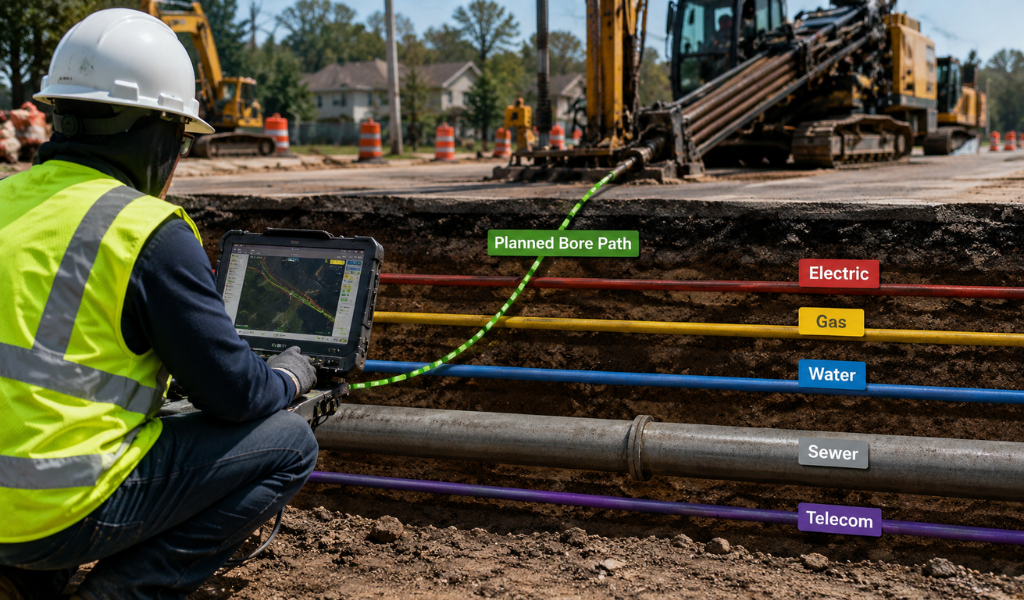
One of the most expensive and preventable problems with horizontal directional drilling (HDD) projects in the United States is utility damage. Service disruptions, safety hazards, and costly project delays are typically caused by poor planning, incomplete underground utility records, and slow performance. That is why bore path planning utility strikes are essential in this situation.
When bore path planning is done correctly, teams can clearly identify underground utilities and soil behavior and plan accurate drilling routes before any work starts. For HDD contractors and utility companies, it is more than just a planning stage. It is essential to control high risks and keep the project efficient and cost-effective.
This blog explores how effective bore path planning reduces strikes and prevents costly delays today.
Why Bore Path Planning Is The Backbone Of Safe HDD Projects
Borepath planning is the process of designing a precise underground drilling route before any horizontal directional drilling begins. It determines depth, entry, and exit angles and safe clearance from existing utilities.
For HDD contractors, this stage is where most risks are either eliminated or created.
A well-planned bore path:
-
- Prevents unexpected utility conflicts
-
- Reduces rework and drilling corrections
-
- Improves drilling accuracy in complex soil conditions
-
- Helps meet safety requirements and standards
Without proper planning, even advanced drilling equipment cannot prevent utility damage. Most project delays in trenchless operations start with poor subsurface visibility, not equipment failure.
How Poor Planning Leads To Utility Strikes
Utility strikes are rarely random. They are usually the result of incomplete or inaccurate planning data.
Common causes include:
-
- Outdated utility maps
-
- Missing underground infrastructure records
-
- Inadequate site investigation
-
- Lack of verification before drilling
Modern contractors, therefore, use techniques such as GPR utility locating in West Palm Beach for their pre-bore planning, as this enables the most efficient plan for boring to be formulated using the latest detection and planning techniques.
By not knowing where underground lines run before the bore path has been determined, the chances of drilling into water, gas, or telephone lines, causing financial and safety concerns and delays in operations, rise substantially.
Role Of Utility Verification Before Bore Execution
Before any directional drilling begins, contractors must validate underground conditions through physical and non-destructive methods.
One of the most effective practices is utility potholing before directional boring, which exposes the exact locations of utilities using vacuum excavation.
This step:
-
- Confirms utility depth and alignment
-
- Reduces dependency on outdated records
-
- Improves bore path accuracy
-
- Prevents last-minute redirection.
When potholing is skipped, even the best bore path design becomes unreliable. Verification ensures that planning aligns with real-world underground conditions.
Advanced Planning With HDD Expertise
Modern HDD projects require more than basic mapping; they need engineering-level precision.
Services like HDD Services Orlando provide structured planning and execution support that includes
-
- Bore path optimization
-
- Soil condition analysis
-
- Entry/exit point calibration
-
- Real-time drilling adjustments
These services help contractors reduce uncertainty in complex urban and infrastructure-heavy environments.
Integration With Directional Drilling Strategy
Bore path planning is not separate from execution; it directly influences directional drilling success.
In directional drilling, even minor miscalculations in angle or depth can result in:
-
- Utility conflicts
-
- Surface heaving
-
- Bore failure
-
- Costly re-drilling
A precise bore path ensures smooth navigation beneath obstacles while maintaining the structural integrity of surrounding utilities.
Contractors who invest in detailed planning consistently report fewer corrections and faster project completion times.
Importance Of Back Reaming In Project Completion
After the pilot bore is completed, the back reaming process, directional drilling are essential for safely widening the borehole.
If the initial bore path is inaccurate, back reaming can
-
- Damage nearby utilities
-
- Collapse unstable bore sections
-
- Increase torque and equipment wear
However, when bore path planning is accurate from the start, back reaming becomes controlled and predictable, improving overall installation efficiency.
This step reinforces why planning accuracy is not optional; it directly impacts every stage of HDD execution.
Reducing Risk Through Data-Driven Bore Path Design
The future of trenchless drilling is data-driven decision-making. Contractors are increasingly using digital modeling, subsurface scanning, and predictive routing to design safer bore paths.
Essential advantages include:
-
- Reduced utility strike probability
-
- Faster project approvals
-
- Improved cost forecasting
-
- Better stakeholder confidence
When all subsurface data is integrated into the planning process, HDD teams gain full visibility before drilling begins.
This eliminates guesswork and replaces it with engineering precision.
Essential Takeaways
Here are some essential takeaways you should need to know:
-
- Bore path planning is the foundation of safe and accurate HDD execution.
-
- Most utility strikes happen due to poor planning or missing underground data.
-
- Verified utility locating and potholing greatly reduce drilling risks.
-
- Accurate bore design improves efficiency, safety, and project timelines.
-
- Every HDD stage depends on a well-planned bore path from the start.
-
- Good planning keeps work smooth, fast, and cost-effective.
FAQs
1. What is bore path planning in HDD?
It is the process of designing a safe and precise underground drilling route before directional drilling begins.
2. How does bore path planning prevent utility strikes?
It identifies existing underground utilities and helps avoid them during drilling.
3. Why is utility potholing important?
It confirms exact utility locations and depths, reducing the risk of damage.
4. What role does GPR play in bore planning?
GPR helps detect hidden utilities and improves accuracy in subsurface mapping.
5. How does poor planning cause project delays?
Incorrect bore paths can lead to strikes, rework, and stoppages during drilling.
6. Is bore path planning required for all HDD projects?
Yes, it is essential for safe, efficient, and compliant trenchless operations.
Final Thoughts
Bore path planning is the foundation of safe and efficient HDD operations. When combined with accurate utility locating, potholing, and disciplined drilling execution, it reduces utility strikes and costly project delays. Contractors who prioritize planning over reaction consistently achieve safer job sites, better productivity, and stronger client trust across every trenchless project they deliver.
Get Expert Trenchless Drilling Solutions For Safer Bore Planning
Improve accuracy and reduce utility strike risks with professional trenchless expertise. Visit Trenchless Drilling, LLC, for advanced HDD planning, execution support, and reliable underground drilling solutions designed for modern infrastructure projects across the USA.