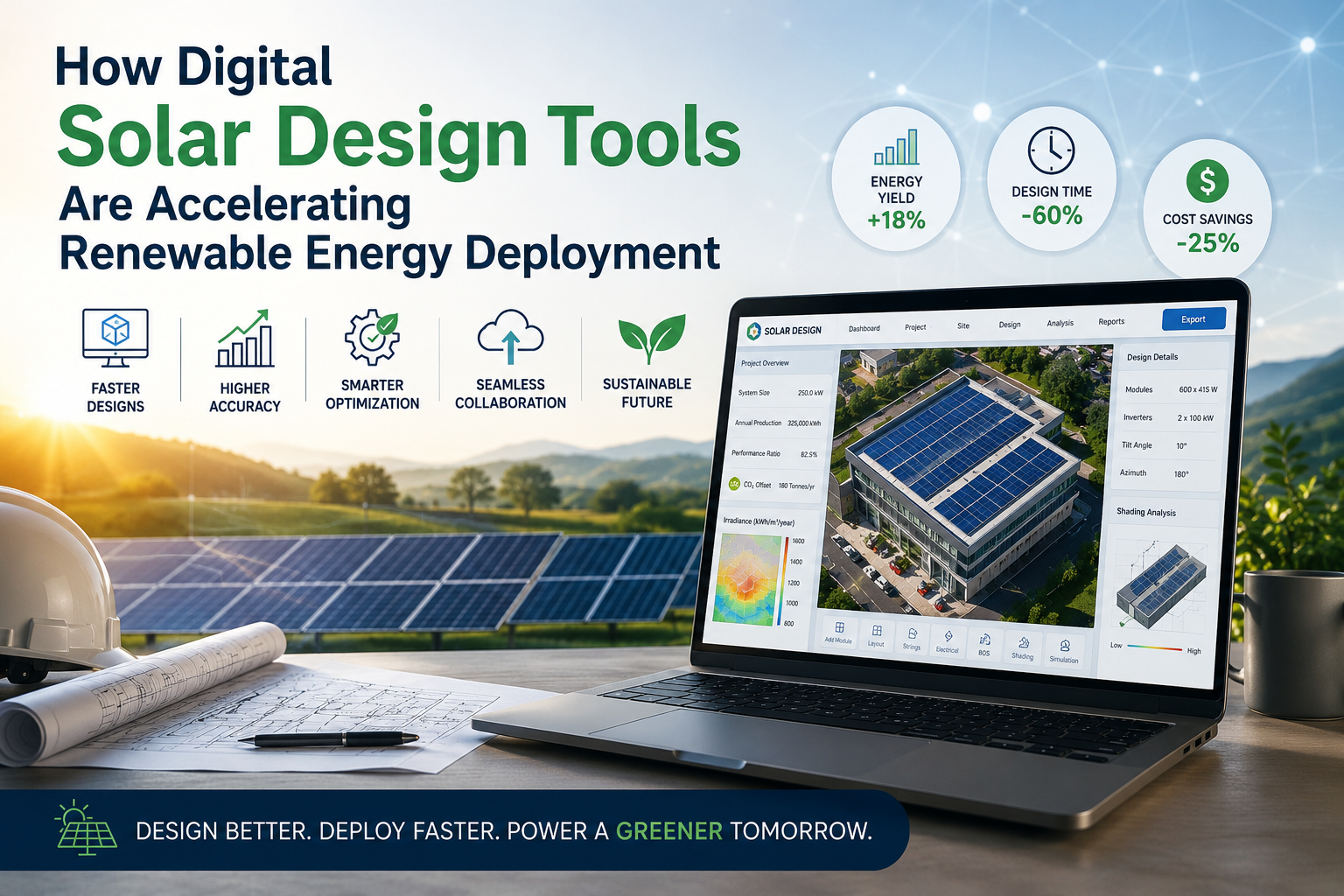
The global shift toward renewable energy is happening faster than ever before, and solar power is at the center of this transformation. As governments, businesses, and homeowners invest heavily in clean energy, one major factor is quietly accelerating the entire industry: digital solar design tools.
These advanced platforms are changing how solar projects are planned, engineered, and deployed — making the process faster, more accurate, and significantly more scalable.
☀️ From Manual Design to Digital Precision
In the past, solar system design was a time-consuming process that relied heavily on manual calculations, spreadsheets, and basic layout software. Engineers had to estimate shading, panel placement, and energy output with limited tools, which often led to inefficiencies and redesigns later in the project lifecycle.
Today, digital solar design tools eliminate much of this guesswork. Using advanced modeling and simulation, engineers can now create highly accurate system layouts in minutes rather than days.
These tools consider real-world conditions such as:
- Sun path and seasonal irradiation
- Roof geometry and tilt angles
- Shading from nearby buildings or trees
- Local weather data and environmental factors
This level of precision ensures that solar systems are optimized before installation even begins.
📊 Faster Project Turnaround Times
One of the biggest advantages of digital solar design tools is speed. What once took weeks of back-and-forth planning can now be completed in a fraction of the time.
Automated design features allow engineers to:
- Generate optimized panel layouts instantly
- Test multiple design scenarios quickly
- Identify performance issues early
- Reduce revision cycles between stakeholders
This acceleration directly impacts the renewable energy industry by allowing more projects to move from concept to construction without delays.
🌐 Improving Collaboration Across Teams
Solar projects typically involve multiple stakeholders — engineers, developers, installers, and clients. In traditional workflows, communication gaps between these groups often led to delays and inconsistencies.
Modern digital platforms solve this by enabling real-time collaboration. Teams can access the same design data simultaneously, leave feedback directly on system models, and track updates instantly.
This level of coordination reduces miscommunication and ensures that everyone is aligned throughout the project lifecycle.
⚡ Enhancing Energy Efficiency and ROI
Beyond speed and collaboration, digital solar design tools also significantly improve system performance. By simulating energy production under different conditions, engineers can optimize every aspect of a solar installation.
This leads to:
- Higher energy output per system
- Better return on investment for clients
- Reduced installation errors and rework
- More efficient use of available space
Even small design improvements can translate into substantial long-term gains in energy production and cost savings.
🏗️ Supporting Large-Scale Renewable Deployment
As solar energy expands globally, scalability has become a critical challenge. Utility-scale solar farms require precise planning across thousands of panels and complex infrastructure systems.
Digital design tools make this level of complexity manageable. They allow engineers to:
- Model large-scale solar arrays efficiently
- Integrate electrical and structural components
- Coordinate with grid requirements
- Optimize land usage for maximum output
Without these tools, many of today’s large renewable energy projects would be significantly slower and more expensive to develop.
🔮 The Future of Solar Design Is Fully Digital
The next phase of solar innovation will push digital design tools even further. Artificial intelligence, machine learning, and automation are already beginning to enhance system design by recommending optimal layouts and predicting performance outcomes with even greater accuracy.
As these technologies mature, solar deployment will become even faster, more affordable, and more accessible worldwide.
In this evolving landscape, digital solar design tools are not just improving workflows — they are actively accelerating the global transition to clean energy.
More Articles – Solar Permit Design Outsourcing Helps Installers Scale Without Slowing Down