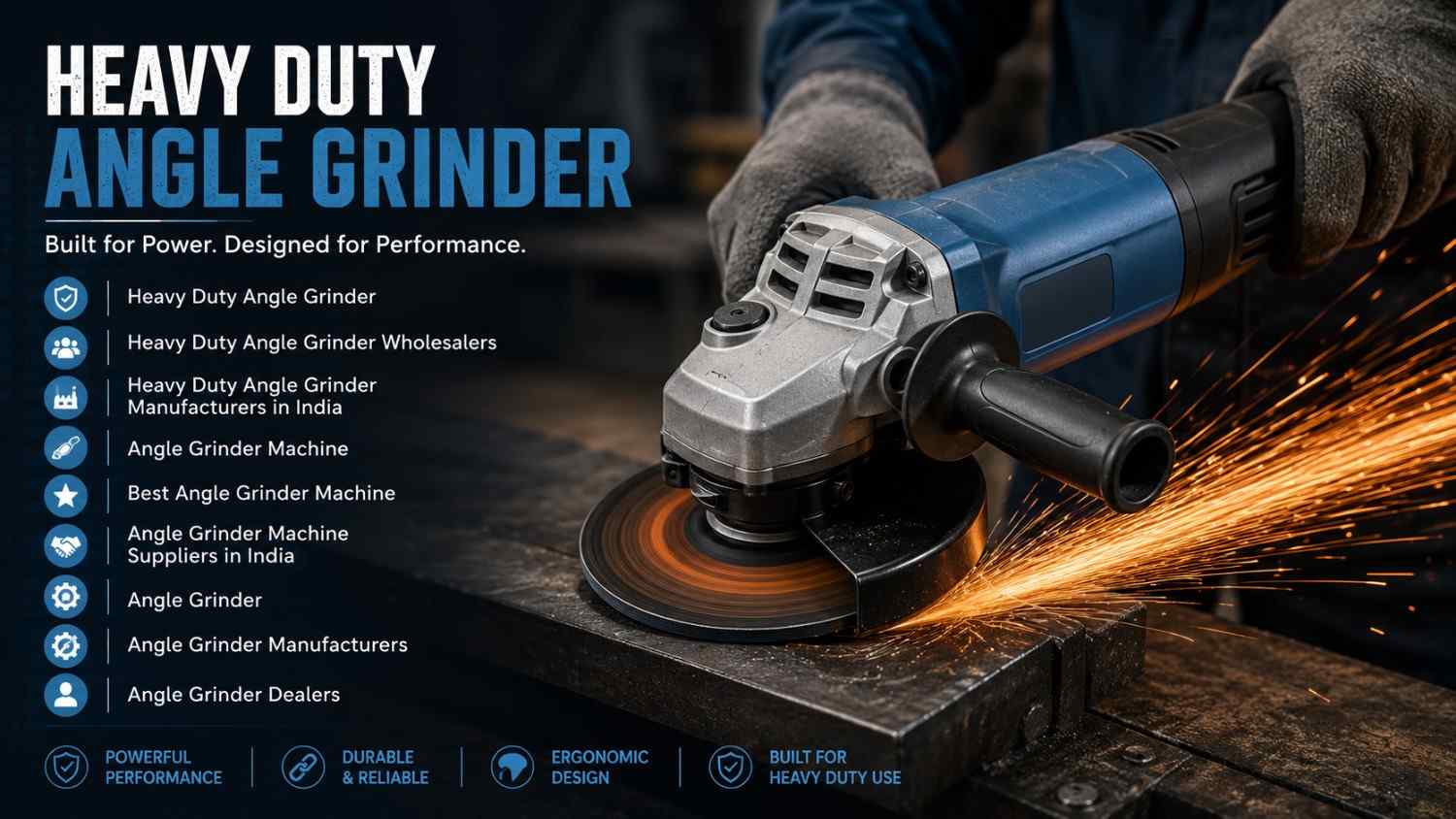
A workshop does not stop because one tool fails beautifully on paper.
It stops because the Heavy Duty Angle Grinder bought for daily cutting cannot hold speed under load, the spare disc is wrong, and the supplier suddenly stops taking calls after dispatch. India’s factory activity is moving fast: industrial output grew 4.9% in April 2026, manufacturing grew 6.2%, and capital goods output rose 16% year-on-year. That tells you one thing clearly: industrial buyers are not buying grinders for occasional use anymore. They are buying for pressure, deadlines, and repeated work.
Most buyers still compare only price. That is a mistake.
A low-priced Angle Grinder Machine that heats up after repeated cutting does not save money. It quietly eats margin through operator delay, finish rejection, repair follow-ups, and replacement disputes.
The Rating Plate Tells You More Than the Price Sheet
The Spec Detail Most Buyers Skip
A serious Angle Grinder purchase should begin with wattage, RPM, wheel size, spindle thread, insulation, and usage type. Ultra Touch lists its angle grinder specification as 220 V / 50 Hz, 1050 W input power, 11,000 RPM no-load speed, 100 mm wheel diameter, M10 spindle thread, slide switch, heavy-duty copper motor, double insulation, and industrial/professional usage.
Here’s where buyers go wrong. They ask, “1050 W hai?” but they do not ask how the motor behaves during repeated cuts.
That matters more.
Why Wattage Alone Is Not Enough
Ultra Touch’s heavy-duty grinder range also references 670 W, 1050 W, and 1200 W variants for different work intensity levels. Lower wattage may suit controlled grinding or finishing. Higher wattage makes more sense for continuous cutting, fabrication, and site work.
Most buyers treat all grinders like the same machine with a different sticker.
Nobody tells you the harder part: matching the grinder to the disc, material, operator habit, and daily usage cycle is more difficult than choosing the brand name.
Five Supplier Checks That Prevent Expensive Follow-Ups
India’s power tools market is projected to grow from USD 2.03 billion in FY2024 to USD 3.46 billion by FY2032, at a 6.90% CAGR. That growth brings more suppliers, but not every supplier is ready for industrial accountability.
- Check the exact model and technical sheet
A good supplier shares wattage, RPM, wheel size, spindle thread, motor type, and usage category before quoting. A bad answer sounds like, “Sir, sab same hai, bas rate dekh lo.” - Check stock commitment before payment
The right answer includes available quantity, dispatch time, packaging method, and invoice clarity. A bad supplier takes the order first and then starts arranging stock. - Check warranty and defect handling
A supplier who says “case by case dekh lenge” does not have a policy. That is a negotiation you will lose after the shipment lands. - Check application guidance
A good supplier asks whether the grinder will be used for metal cutting, surface grinding, polishing, stone work, or fabrication. A bad supplier pushes one model for every job. - Check bulk supply discipline
For wholesalers and dealers, one sample working well is not enough. The next 25, 50, or 100 pieces must be consistent too. And yet, many buyers approve bulk orders from one demo piece only.
How Better Grinder Manufacturing Protects Buyer Margin
Ultra Touch mentions 150+ cities covered pan-India, 75,000+ repeat orders fulfilled, 1995 as the year of establishment, and 4,500+ contractors and workshops served. These numbers matter because industrial tool buying depends on repeat supply, not one-time display value.
- Lower downtime risk
A properly matched Heavy Duty Angle Grinder helps workers keep cutting and grinding without constant stoppage. That protects production time. - Cleaner finish control
Stable RPM supports smoother grinding and more predictable cutting. Which means less rework on fabrication edges and surface preparation jobs. - Better operator comfort
Ultra Touch mentions balanced handling, reduced fatigue, and continuous-use performance as part of its tool design focus. Operator fatigue is not a small issue when the tool runs for hours. - Safer purchase decisions
Spindle lock, protective guards, double insulation, and correct disc compatibility reduce avoidable misuse. A buyer who ignores safety features is not saving money; he is shifting risk to the workshop floor. - More dependable bulk planning
Dealers and wholesalers need repeated stock movement. If supply breaks after the first order, the dealer loses trust with his own market. - Better long-term value
A slightly higher purchase cost can still be cheaper if the machine reduces repair calls, return pressure, and customer complaints.
Why Location Is a Supply Chain Decision, Not Just an Address
Ultra Touch lists its address as 330, Samuel Street, Vadgadi, Mumbai – 400003, Maharashtra, India, with contact number +91-9967960508 and email [email protected]. The brand also states pan-India delivery through an organized network for workshops, retailers, professionals, and industrial buyers.
Here’s the local SEO reality. Heavy Duty Angle Grinder Manufacturers in India are not judged only by factory address. They are judged by how quickly a dealer in New Delhi, a contractor in Mumbai, a fabricator in Howrah, or a retailer in Vadodara can get the right model without supply gaps.
India’s manufacturing PMI increased to 55.0 in May 2026 from 54.7 in April 2026, showing continued manufacturing expansion. More activity usually means tighter tool availability, especially for fast-moving power tools used in fabrication and construction.
That’s why Angle Grinder Machine Suppliers in India need stock discipline, secure packaging, and city-wise dealer support. Price matters, but availability decides whether the buyer can actually deliver work on time.
What We Build Around Before We Build the Tool
At Ultra Touch, we work with one clear understanding: a grinder is not bought for showroom display. It is bought for noise, dust, pressure, and daily use.
We have been associated with power tools since 1995, and our product range includes angle grinders, marble cutters, grinding wheels, cutting wheels, hammer drills, cordless drill machines, flap wheels, polishing wheels, saw blades, demolition hammers, hand saws, cordless impact wrenches, and power tools.
We pay attention to practical details because small issues travel fast in B2B markets. In 2024, after repeated handling marks appeared on grinder cartons during transit checks, we tightened carton inspection and model marking before dispatch. It sounds minor. It is not. A dealer receiving mixed or scuffed cartons has to explain that mistake to his customer.
We build for Indian working conditions, not catalog comfort.
At Ultra Touch, we respond to serious B2B enquiries within 24 working hours.
Send us the grinder model required, wattage preference, quantity, delivery city, GST details, and application type. Our MOQ is model-wise, so share your planned quantity first; for dealer, wholesaler, and industrial bulk orders, we will confirm the correct slab before billing.
We can support enquiries for Heavy Duty Angle Grinder Wholesalers, Angle Grinder Dealers, procurement teams, workshops, and industrial buyers across India.
For quotation, send your requirement to Ultra Touch through the website.
Conclusion
The Heavy Duty Angle Grinder market is moving with India’s manufacturing and construction needs, not against them. Buyers now need tested specs, steady supply, dealer support, and honest model guidance. A supplier who can only quote low rates will struggle as industrial demand becomes more technical. The next phase belongs to manufacturers who can prove performance before the buyer asks twice.
FAQs
1. What makes a Heavy Duty Angle Grinder different from a regular angle grinder?
A heavy-duty model is designed to handle more demanding tasks with more complex materials, and to function for longer, more continuous work cycles. Ultra Touch offers heavy-duty options in the 1050 W and 1200 W categories, while regular grinders are usually best for lighter and/or more infrequent use. The caveat is simple: buying heavy-duty only makes sense if your daily work actually needs that extra load capacity.
2. How do Heavy Duty Angle Grinder Wholesalers support industrial buyers?
They help buyers with bulk availability, dealer pricing, and faster repeat supply. For wholesalers, the real test is not one good sample. It is whether the 50th machine performs like the first one.
3. Are Angle Grinder Manufacturers better than local resellers?
Manufacturers usually give better clarity on specs, product range, and bulk supply planning. Resellers may still be useful for fast local buying. The caveat: a reseller without manufacturer support may struggle with warranty, spare guidance, and repeat model availability.
4. What should Angle Grinder Dealers ask before placing a bulk order?
They should ask for model-wise stock, carton packing, invoice details, warranty terms, and expected dispatch time. Dealers should also ask which models move better for fabrication, construction, polishing, or repair markets.
5. Can one Angle Grinder handle cutting, grinding, and polishing?
Yes, but only with the correct disc and safe usage method. Ultra Touch lists cutting, grinding, and polishing as applications for its angle grinder, with compatible accessories like grinding wheels, cutting wheels, and flap wheels. Do not use the wrong disc just because it “fits.” That is how tools, materials, and safety get compromised.