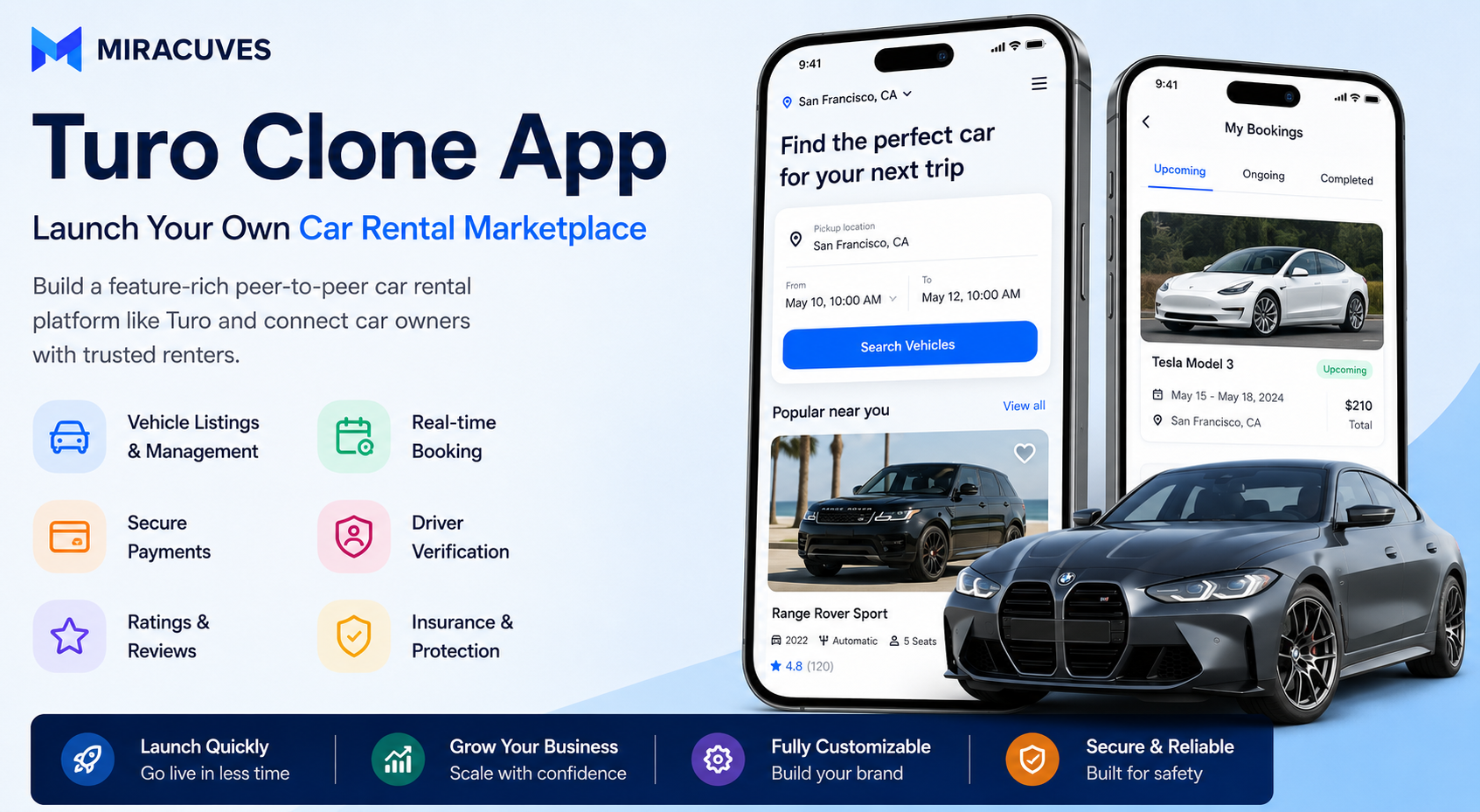
The way people access vehicles is changing. Instead of purchasing a car or relying entirely on traditional rental agencies, many customers now prefer flexible peer-to-peer car-sharing platforms that allow them to rent vehicles directly from local owners.
Turo has demonstrated how a digital marketplace can connect vehicle owners with renters while creating earning opportunities for hosts and convenient transportation options for customers. This model has encouraged mobility entrepreneurs to explore launching their own car-sharing businesses.
A Turo clone app provides the technology required to operate a similar peer-to-peer vehicle rental marketplace under your own brand. With the right features, monetization model, security systems, and operational strategy, founders can build a scalable mobility platform without developing every component from scratch.
What Is a Turo Clone App?
A Turo clone app is a customizable peer-to-peer car rental marketplace that connects vehicle owners with people looking to rent cars.
Vehicle owners can register, upload their vehicles, define rental availability, set pricing, and accept booking requests. Renters can search for available cars, compare options, verify their identity, make payments, and manage their trips through the platform.
Unlike traditional rental companies that own and maintain their own fleets, a Turo-like platform can operate as a marketplace. The platform facilitates transactions between hosts and renters while generating revenue through commissions, service fees, protection plans, subscriptions, and additional services.
A white-label solution can be customized with the startup’s:
- Business name and logo
- Brand colours and interface
- Rental policies
- Commission structure
- Payment methods
- Service locations
- Verification process
- Insurance workflows
- Vehicle categories
- Pricing rules
This allows entrepreneurs to build a unique car-sharing brand rather than simply reproducing Turo’s interface.
How Does a Turo-Like Car Rental Platform Work?
A Turo-style marketplace generally involves three participants: the renter, the vehicle owner, and the platform administrator.
Vehicle-owner process
The host creates an account and submits identity and vehicle documents for verification. Once approved, the owner can add a vehicle listing with information such as:
- Vehicle make and model
- Manufacturing year
- Rental price
- Pickup location
- Availability calendar
- Mileage limits
- Fuel policy
- Vehicle photographs
- Delivery options
- Cancellation terms
The owner receives booking requests, communicates with renters, manages vehicle availability, monitors trips, and tracks earnings through a dedicated dashboard.
Renter process
Renters register on the platform, complete identity verification, and search for vehicles based on location, date, price, category, transmission type, or other preferences.
After selecting a vehicle, the renter can review its details, choose available protection options, complete payment, contact the owner, and confirm the pickup instructions.
Following the trip, the renter can return the vehicle, complete the checkout process, and submit a review.
Administrator process
The administrator manages the entire marketplace through a centralized panel. Admin responsibilities may include:
- Approving users and vehicle listings
- Monitoring bookings
- Managing payments and payouts
- Setting platform commissions
- Handling disputes and refunds
- Reviewing submitted documents
- Managing promotions
- Tracking platform performance
- Controlling service locations
- Monitoring suspicious activities
A powerful admin dashboard helps founders maintain service quality while reducing manual operational work.
Essential Features of a Turo Clone App
A successful car-sharing marketplace must provide convenient booking tools while protecting both vehicle owners and renters.
User registration and verification
Users should be able to register using their email address, phone number, or supported social accounts. Identity, driving licence, age, and payment verification can help reduce fraudulent activity.
Location-based vehicle search
GPS and map integration allow renters to discover available vehicles near their current location, an airport, a hotel, or a selected destination.
Advanced search filters
Search filters help customers narrow down listings based on:
- Vehicle category
- Daily rental price
- Brand and model
- Seating capacity
- Transmission type
- Fuel type
- Electric vehicle availability
- Delivery options
- Instant booking
- Host rating
Vehicle listing management
Hosts require a simple interface for adding vehicle details, uploading images, setting booking rules, and updating availability.
Real-time availability calendar
An integrated calendar prevents double bookings and enables hosts to block dates when a vehicle is unavailable.
Instant and request-based booking
Some hosts may allow immediate booking, while others may prefer to review each request. Supporting both options gives vehicle owners greater control.
Secure payment gateway
The platform should support protected payments, deposits, refunds, cancellation charges, taxes, commissions, and host payouts.
Dynamic pricing
Dynamic pricing tools can adjust rental rates based on demand, location, season, vehicle category, weekends, events, and booking duration.
In-app communication
Secure messaging allows hosts and renters to discuss pickup arrangements without exposing personal contact information.
GPS and trip tracking
GPS integration can help monitor active rentals, verify pickup and return locations, identify late returns, and improve renter accountability.
Ratings and reviews
A two-way review system allows renters to evaluate vehicles and hosts while giving owners an opportunity to rate renters.
Push notifications
Users can receive notifications for booking requests, payment confirmation, trip reminders, cancellations, messages, returns, and payout updates.
Damage and dispute management
Hosts and renters should be able to upload pre-trip and post-trip photographs, submit incident reports, and provide documentation for disputes.
Advanced Features for a Competitive Car Rental App
Basic booking functionality may be sufficient for an initial launch, but advanced features can help a car-sharing marketplace compete more effectively.
Useful additions include:
- AI-powered vehicle recommendations
- Automated document verification
- Fraud and risk detection
- Smart dynamic pricing
- Keyless vehicle access
- Telematics integration
- Fuel-level monitoring
- Mileage-based billing
- Geofencing
- Vehicle health alerts
- Multilingual support
- Multiple currencies
- Loyalty rewards
- Referral programs
- Subscription plans
- Corporate rental accounts
- Airport vehicle delivery
- EV charging information
- Automated host payouts
These features should be prioritized according to the target audience, local market, launch budget, and operational model.
Different Business Models for a Turo Clone
A Turo clone platform does not need to serve every type of customer. Startups can improve their positioning by selecting a focused market.
Peer-to-peer car sharing
Individual vehicle owners list their cars and earn money from bookings. The platform manages discovery, payments, verification, and commissions.
Fleet-based rental marketplace
Professional rental companies and fleet operators list multiple vehicles through a centralized management dashboard.
Luxury car rental platform
The marketplace focuses on sports cars, premium sedans, wedding vehicles, and luxury SUVs.
Electric vehicle rental
An EV-focused platform can serve environmentally conscious customers and users who want to test electric vehicles before purchasing one.
Airport car rental marketplace
Vehicle delivery and pickup services can be offered near airports, railway stations, hotels, and tourism destinations.
Corporate mobility platform
Businesses can book vehicles for employees, clients, project teams, or long-term corporate transportation requirements.
Hourly car-sharing service
The platform can support short-term, hourly, daily, and weekly bookings for customers who do not need full-day rentals.
Selecting a niche can make customer acquisition, host onboarding, platform messaging, and geographic expansion more manageable.
How Does a Turo Clone Make Money?
A car-sharing platform can generate revenue through several channels.
Booking commission
The platform deducts a percentage from every completed reservation. This is usually the primary revenue source.
Renter service fee
An additional fee may be added to the renter’s total based on trip value, duration, demand, or risk level.
Host subscription plans
Vehicle owners or fleet operators can purchase premium plans that provide lower commission rates, better visibility, advanced analytics, or additional management tools.
Featured vehicle listings
Hosts can pay to promote selected vehicles at the top of search results.
Protection and insurance fees
The platform can offer different protection levels through approved insurance or protection partners, subject to local laws and business arrangements.
Vehicle delivery charges
Additional revenue can be generated by offering airport, hotel, home, or custom-location vehicle delivery.
Cancellation and late-return fees
The platform can retain part of applicable cancellation, late-return, additional mileage, cleaning, or refuelling charges.
Advertising partnerships
Car manufacturers, repair services, charging networks, dealerships, travel businesses, and vehicle accessory brands can advertise to relevant users.
Using more than one revenue stream can help founders reduce dependence on booking commissions alone.
Steps to Build a Turo Clone App
1. Select a target market
Identify the location and customer segment your platform will serve. Research vehicle demand, tourism patterns, local transportation gaps, competition, and host availability.
2. Choose the business model
Decide whether the platform will support peer-to-peer hosts, professional fleets, luxury vehicles, electric cars, corporate rentals, or multiple segments.
3. Define the minimum viable product
Start with the features required to complete a secure rental transaction. Avoid adding every advanced feature before confirming market demand.
An initial version generally requires:
- User registration
- Identity verification
- Vehicle listings
- Search and filters
- Availability management
- Booking system
- Secure payments
- Host payouts
- Messaging
- Reviews
- Notifications
- Admin dashboard
4. Establish rental policies
Define policies for deposits, cancellations, mileage, fuel, cleaning, late returns, prohibited use, age requirements, damages, and refunds.
5. Plan verification and protection workflows
Car rentals involve valuable physical assets. Driver verification, vehicle-document review, transaction monitoring, insurance coordination, and incident reporting should be planned carefully.
6. Customize the platform
Apply your own branding, pricing structure, vehicle categories, local payment methods, language, currency, and marketplace rules.
7. Test every booking scenario
Testing should cover registration, search, availability, booking, payment, cancellation, refund, payout, notifications, dispute reporting, and administrative controls.
8. Launch in a controlled region
A focused launch can make it easier to onboard hosts, provide support, monitor service quality, and improve marketplace liquidity.
9. Track marketplace performance
Important performance indicators include:
- Number of active vehicles
- Search-to-booking conversion rate
- Booking frequency
- Average booking value
- Vehicle utilization rate
- Host retention
- Renter retention
- Cancellation rate
- Customer acquisition cost
- Platform commission revenue
Turo Clone Development Cost
The cost of developing a Turo-like app depends on the number of user roles, mobile applications, admin capabilities, integrations, security requirements, design complexity, and custom functionality.
Building a completely custom platform may require a substantial development budget and an extended testing period. A white-label foundation can reduce the cost and time required to build standard marketplace modules.
The Miracuves Turo Clone page currently lists its ready-made solution at $3,699, with source code, white-label customization, app-publishing support, technical support, and platform updates among the stated deliverables. The page also advertises a six-day launch path for its ready-made package.
Final pricing may change when a project requires extensive custom development, third-party integrations, advanced insurance workflows, telematics, IoT systems, regional compliance changes, or a redesigned user experience.
Marketing Strategies for a Turo-Like Platform
A car-sharing marketplace must attract vehicle owners and renters at the same time. Without enough vehicles, renters will not find suitable options. Without sufficient booking demand, hosts may leave the platform.
Effective growth strategies include:
- Launching city by city
- Partnering with local vehicle owners
- Offering early-host commission incentives
- Creating renter referral programs
- Targeting airport and tourist searches
- Working with hotels and travel companies
- Promoting luxury or EV rental niches
- Publishing location-specific landing pages
- Running retargeting campaigns
- Building partnerships with dealerships
- Offering discounts for first bookings
- Rewarding hosts for adding more vehicles
Early marketing should focus on building sufficient vehicle supply in each launch location before expanding aggressively.
Security and Compliance Considerations
Launching a car rental marketplace involves operational, legal, and financial responsibilities.
Founders should consider:
- Identity and driving-licence verification
- Vehicle-registration validation
- Secure payment processing
- Data encryption
- User privacy controls
- Fraud monitoring
- Insurance requirements
- Tax management
- Local rental regulations
- Damage documentation
- Dispute-resolution procedures
- Emergency support processes
Legal requirements vary by country, state, and city. Founders should consult qualified legal, insurance, and financial professionals before launching services in a new market.
Why Choose Miracuves for Turo Clone Development?
Miracuves provides a customizable foundation for entrepreneurs who want to launch a branded peer-to-peer car rental marketplace without developing every feature from the beginning.
The Miracuves Turo Clone can be customized for peer-to-peer car sharing, fleet rentals, airport rentals, luxury vehicles, electric cars, and other mobility niches.
Businesses can benefit from:
- Complete white-label branding
- Full source-code ownership
- Android and iOS app support
- Vehicle-owner and renter workflows
- Centralized admin dashboard
- Booking and payment management
- Commission configuration
- Custom feature development
- Deployment and server setup
- App-store publishing assistance
- Technical support
- Scalable marketplace architecture
Instead of spending the initial development phase rebuilding standard booking and marketplace modules, founders can focus on local operations, host acquisition, customer experience, partnerships, and platform growth.
Conclusion
A Turo clone app gives mobility entrepreneurs an opportunity to build a flexible car-sharing marketplace that connects vehicle owners with renters.
However, technology alone does not guarantee marketplace success. Founders must also develop a strong host network, establish clear rental policies, protect users, provide reliable support, and create enough local demand to generate regular bookings.
Starting with a focused niche and a launch-ready platform can reduce early development risk. Once the marketplace gains traction, founders can introduce dynamic pricing, telematics, keyless access, subscriptions, corporate accounts, loyalty programs, and additional revenue streams.
With the right technology and market strategy, a Turo-like platform can grow from a local rental service into a scalable mobility business.
Frequently Asked Questions
What is a Turo clone app?
A Turo clone app is a customizable peer-to-peer car rental marketplace that allows vehicle owners to list their cars and renters to search, book, pay for, and manage rentals through a digital platform.
Can I launch a Turo clone under my own brand?
Yes. A white-label Turo clone can be customized with your business name, logo, colours, pricing, commission structure, rental policies, payment methods, and service locations.
How does a Turo-like platform generate revenue?
The platform can earn through booking commissions, renter service fees, host subscriptions, featured listings, protection plans, vehicle delivery fees, cancellation charges, and advertising partnerships.
What features should a Turo clone include?
Important features include user verification, vehicle listings, location search, availability calendars, booking management, secure payments, host payouts, messaging, notifications, reviews, GPS integration, and an admin dashboard.
Can a Turo clone support fleet rental companies?
Yes. The system can be customized to support individual hosts, professional fleet operators, traditional rental companies, luxury fleets, EV providers, and corporate mobility businesses.
Is GPS tracking necessary for a car rental app?
GPS tracking is highly useful for monitoring active trips, verifying pickup and return locations, reducing theft risk, identifying late returns, and supporting disputes. Advanced telematics can also provide mileage, fuel, ignition, and vehicle-health data.
How much does a Turo clone app cost?
The final cost depends on the features, applications, integrations, design, security systems, and customization required. Miracuves currently lists its ready-made Turo Clone solution at $3,699 on the service page.