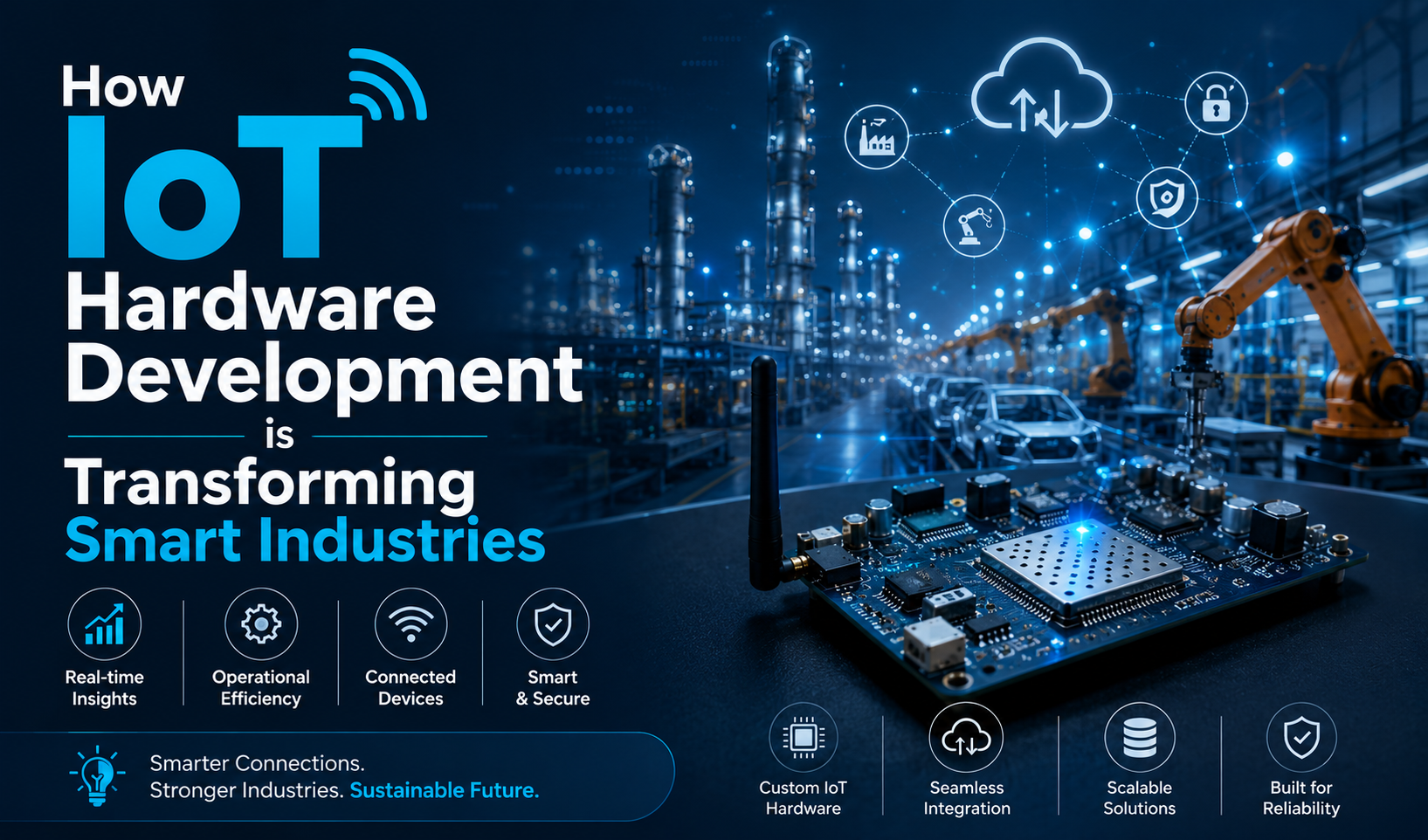
IoT hardware has become the physical foundation of modern digital transformation. Industries no longer depend only on software platforms or cloud analytics; they rely on connected physical devices that continuously sense, process, and transmit real-world data.
According to Statista, the number of connected IoT devices is expected to exceed 29 billion by 2030. IDC estimates that global IoT spending will cross $1 trillion, driven mainly by manufacturing, logistics, healthcare, and energy sectors. McKinsey further reports that IoT adoption in industrial environments can improve operational efficiency by up to 25% through predictive maintenance and real-time monitoring.
These numbers highlight a clear shift: industrial intelligence now begins at the hardware layer. Sensors, embedded systems, edge processors, and communication modules form the backbone of this transformation.
IoT Hardware as the Core of Smart Industry Systems
Smart industries depend on continuous data from physical environments. Machines, vehicles, and infrastructure systems generate massive volumes of operational signals every second. IoT hardware captures this data and converts it into structured digital inputs.
Unlike traditional systems that rely on periodic reporting, IoT-enabled environments operate on continuous sensing. This shift allows industries to move from reactive decision-making to real-time operational control.
The effectiveness of any IoT system is directly tied to hardware quality. If sensors are inaccurate or communication modules are unstable, the entire data pipeline becomes unreliable, regardless of software sophistication.
Hardware Innovation Driving Industrial Transformation
IoT hardware has evolved significantly in recent years. Early systems focused on basic data collection, but modern devices now include edge computing capabilities, energy optimization features, and built-in security layers.
Key advancements include:
- Edge-enabled microcontrollers for local processing
- Multi-sensor integration for complex environments
- Low-power wide-area communication technologies
- Industrial-grade durability for harsh conditions
- Hardware-based encryption for secure data transfer
This evolution has allowed IoT devices to move from passive data collectors to active decision-support nodes in industrial environments.
Impact Across Key Industries
Manufacturing
In manufacturing environments, IoT hardware is widely used for machine monitoring, predictive maintenance, and production optimization. Sensors track vibration, temperature, and pressure to identify early signs of equipment failure.
This helps manufacturers reduce downtime, improve product quality, and extend machine lifespan. Instead of reacting to breakdowns, organizations can now plan maintenance based on real-time equipment health data.
Logistics and Supply Chain
IoT hardware enables end-to-end visibility in logistics operations. Tracking devices monitor shipment location, environmental conditions, and transit behavior.
This is especially important for temperature-sensitive goods such as pharmaceuticals and food products. Real-time monitoring helps reduce losses and improve delivery accuracy across long supply chains.
Healthcare
In healthcare, IoT hardware supports remote patient monitoring and continuous health tracking. Wearable devices and embedded sensors collect vital signs and transmit them to healthcare systems.
This enables early detection of health issues and reduces dependency on hospital-based monitoring. It also improves patient care for individuals managing chronic conditions.
Energy and Utilities
Smart energy systems rely heavily on IoT hardware to monitor consumption patterns and grid performance. Smart meters and distributed sensors help utilities balance load demand and detect system faults quickly.
This leads to better energy efficiency and more stable grid operations, especially in renewable energy integration scenarios.
Importance of Hardware Design in IoT Systems
The success of any IoT deployment depends heavily on hardware design quality. Software can analyze data, but hardware determines whether the data itself is reliable.
Key design considerations include:
- Power efficiency for long-term deployment
- Environmental resistance in industrial conditions
- Sensor accuracy and calibration stability
- Communication reliability across networks
- Secure device-level architecture
Poor hardware design often leads to data inconsistency, increased maintenance costs, and system instability.
This is why many organizations rely on an experienced IoT Hardware Development Company to design systems that can perform reliably in real-world conditions.
Edge Computing and Local Intelligence
One of the most important developments in IoT hardware is the rise of edge computing. Instead of sending all data to the cloud, modern devices process critical information locally.
This reduces latency and improves responsiveness in time-sensitive applications such as industrial automation, autonomous systems, and predictive maintenance.
Edge processing also reduces network dependency, making systems more resilient in environments with unstable connectivity.
Security Challenges in IoT Hardware
Security is a major concern in IoT ecosystems because devices often operate in distributed and physically accessible environments.
Common risks include:
- Unauthorized device access
- Firmware tampering
- Data interception during transmission
- Device cloning or spoofing
To address these risks, modern IoT hardware incorporates secure boot systems, encrypted communication modules, and hardware-based authentication mechanisms.
Security must be built into the hardware layer rather than added later as a software feature.
Real-World Industrial Example
A large manufacturing company operating multiple production plants faced recurring issues with machine downtime and inconsistent sensor data across facilities.
The company initially used standard IoT sensors connected to cloud-based monitoring systems. However, delays in data transmission and variations in sensor accuracy led to missed early warning signals for equipment failure.
To resolve this, the organization upgraded its IoT infrastructure with industrial-grade hardware integrated with edge processing capabilities.
After implementation:
- Machine downtime is reduced due to earlier fault detection
- Sensor data consistency improved across all plants
- Maintenance became more predictive than reactive
- Operational visibility increased across production lines
The improvement was driven primarily by hardware redesign rather than software changes.
IoT Hardware Design Services in Scaling Systems
As IoT deployments expand, managing hardware complexity becomes increasingly difficult. Large-scale systems require consistent performance across thousands of connected devices.
This is where IoT hardware design services play an important role. These services help organizations with:
- Custom hardware development
- Sensor integration and calibration
- Embedded system design
- Connectivity architecture planning
- Industrial testing and validation
They ensure that IoT systems remain scalable, stable, and efficient across diverse environments.
ROI and Business Impact
The return on investment from IoT hardware is typically realized through operational improvements rather than direct revenue growth.
Key measurable benefits include:
- Reduced equipment downtime
- Lower maintenance costs
- Improved asset utilization
- Faster fault detection
- Reduced manual monitoring efforts
In industrial environments, even a small improvement in uptime can lead to significant financial savings due to continuous production cycles and high operational dependency on machinery.
Final Thoughts
IoT hardware development is reshaping smart industries by shifting intelligence closer to the physical world. Instead of relying solely on software systems, industries now depend on connected devices that continuously sense, analyze, and respond to real-time conditions.
The real value of IoT lies not only in connectivity but in the reliability of the hardware layer that supports it. As industries scale their digital transformation efforts, robust hardware design becomes essential for ensuring performance, accuracy, and long-term stability.
Organizations that invest in strong engineering practices and work with a reliable IoT Hardware Development Company and professional IoT hardware design services are better positioned to build scalable, efficient, and future-ready smart systems.