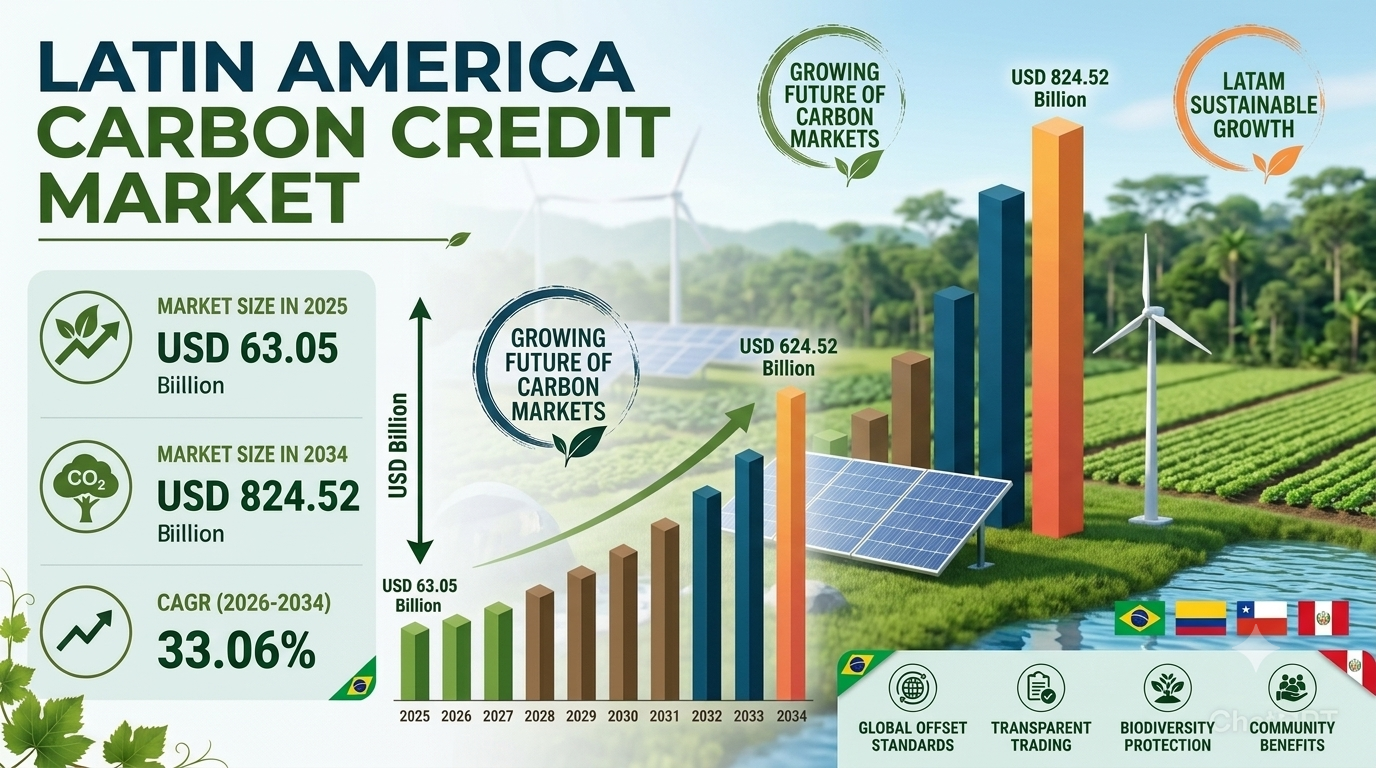
The Latin America carbon credit market encompasses a wide range of carbon offset products designed to enable organizations to compensate for their greenhouse gas emissions through verified emission reduction or removal projects. The ecosystem includes project developers, verification and certification bodies, carbon credit trading platforms, corporate buyers, and regulatory authorities across the region. Major segments identified in the market include type (voluntary and compliance), project type (avoidance/reduction projects, removal/sequestration projects), and end-use industry (power, industrial, transportation, aviation, residential, commercial, and others). The voluntary segment dominates the market with a share of 58% in 2025, owing to growing corporate sustainability commitments and the flexibility offered to organizations seeking to offset emissions beyond regulatory requirements.
Avoidance/reduction projects lead the market with a share of 52% in 2025, reflecting the region’s vast forest resources and cost-effective implementation of deforestation prevention initiatives. The Latin America carbon credit market size was valued at USD 63.05 Billion in 2025 and is projected to reach USD 824.52 Billion by 2034, growing at a compound annual growth rate of 33.06% from 2026-2034. The power sector represents the largest end-use segment with a market share of 20% in 2025, driven by electricity generators seeking to offset emissions from thermal power plants and transition towards cleaner energy portfolios while meeting regulatory compliance requirements.
Porter’s Five Forces Analysis — Latin America Carbon Credit Market
The competitive dynamics of the Latin America carbon credit market can be analyzed using Porter’s Five Forces framework.
- Competitive Rivalry: Moderate. Competition exists among project developers, verification bodies, and trading platforms, but the market remains fragmented with significant room for differentiation through project quality, verification methodologies, and geographic specialization. Rivalry is driven by the growing number of market participants and the increasing demand for high-integrity carbon credits. Business implication: Project developers must differentiate through robust verification standards, community engagement, and biodiversity co-benefits to command premium pricing.
- Supplier Power (Project Originators): Moderate to High. Landowners, forest managers, and project developers with access to high-quality nature-based carbon sequestration assets have increasing negotiating power. The scarcity of verified, high-integrity carbon credit projects in the region enables project originators to select buyers and negotiate favorable terms. Business implication: Buyers must establish long-term offtake agreements and strategic partnerships to secure access to premium carbon credit supply.
- Buyer Power (Corporate Offtakers): Increasing. Multinational corporations and technology companies are becoming sophisticated buyers, demanding transparency, third-party verification, and demonstrable climate impact. Large buyers can negotiate favorable pricing and contract terms. Business implication: Project developers must offer differentiated value propositions including biodiversity benefits, community development outcomes, and robust measurement, reporting, and verification (MRV) frameworks.
- Threat of Substitutes: Moderate. Alternative decarbonization strategies including direct emissions reductions, renewable energy investments, and internal carbon pricing pose substitution threats for corporate buyers. Additionally, carbon credits from other regions (Africa, Asia-Pacific) compete with Latin American offsets. Business implication: Latin American projects must emphasize their unique value proposition, including cost-effective nature-based solutions and significant biodiversity co-benefits.
- Threat of New Entrants: Moderate to High. Barriers to entry are relatively low for project development in the voluntary carbon market, attracting new domestic and international entrants. However, barriers are higher for establishing credibility, securing verification, and building buyer relationships. Business implication: Established players should build defensible positions through robust project portfolios, strong verification partnerships, and long-term buyer relationships.
Competitive Rivalry — Moderate
- Multi-tier competition spans specialized project developers (BTG Pactual Timberland Investment Group), international verification bodies (Verra, Gold Standard, SGS AG, Bureau Veritas), regional trading platforms, and corporate buyers establishing direct offtake agreements with project originators.
- In June 2024, BTG Pactual Timberland Investment Group committed to supply Microsoft with up to 8 million nature-based carbon reduction credits by 2043 through a USD 1 billion forestry and restoration program, representing the largest carbon dioxide elimination credit transaction to date. In September 2024, Meta agreed to purchase up to 3.9 million carbon offset credits from BTG Pactual’s forestry arm through 2038.
Request for Sample Report: https://www.imarcgroup.com/latin-america-carbon-credit-market/requestsample
MARKET GROWTH DRIVERS:
Several key factors are propelling the expansion of the Latin America carbon credit market. The strengthening regulatory frameworks and carbon pricing mechanisms serve as a powerful demand driver for compliance carbon credits. Countries across the region are implementing emissions trading systems and carbon taxes to meet climate commitments under the Paris Agreement. Article 6 of the Paris Agreement is creating new opportunities for international carbon credit trading, positioning Latin America as a strategic supplier in the global carbon market. Additionally, corporate sustainability commitments and ESG reporting requirements are accelerating demand for voluntary carbon offsets. Increasing environmental, social, and governance (ESG) reporting standards and stakeholder expectations are fueling expansion in the voluntary segment, as multinational companies pursue net-zero targets through verified carbon offset purchases.
MARKET GROWTH DRIVERS:
The Latin America carbon credit market is also benefiting from accelerating demand for nature-based solutions and evolving market dynamics. There is a significant shift towards multi-year, large-scale agreements between multinational corporations and regional project developers, with organizations entering long-term contracts emphasizing forestry and land restoration initiatives to secure verified credits. The region’s extensive forest ecosystems, particularly the Amazon rainforest, provide substantial capacity for carbon sequestration projects, making Latin America a global leader in nature-based carbon credit generation. Technology adoption and enhanced verification methodologies are strengthening market credibility, with investments in technology, transparency platforms, and community engagement. Furthermore, growing international investment is flowing into the region, with technology companies increasingly establishing long-term offset agreements, recognizing Latin America’s potential as a premium source of high-integrity carbon credits that deliver measurable climate impact alongside biodiversity and community benefits.
LATIN AMERICA CARBON CREDIT MARKET SEGMENTATION
Segmentation analysis provides a detailed view of the Latin America carbon credit market by category:
- Type Insights: Voluntary, Compliance.
- Project Type Insights: Avoidance/Reduction Projects (including REDD+, forest conservation), Removal/Sequestration Projects.
- End-Use Industry Insights: Power, Industrial, Transportation, Aviation, Residential, Commercial, Others.
- Regional Insights: Brazil, Mexico, Argentina, Colombia, Chile, Peru, Rest of Latin America.
COMPETITIVE LANDSCAPE
The Latin America carbon credit market features a fragmented competitive landscape, with participants spanning project developers, verification bodies, trading platforms, and corporate buyers. Key players operating in the market include:
- BTG Pactual Timberland Investment Group
- Verra (Verification Body)
- Gold Standard (Verification Body)
- SGS AG (Verification Body)
- Bureau Veritas SA (Verification Body)
- CarbonCheck (Verification Body)
- SustainCERT (Verification Body)
- TUV SUD (Verification Body)
- Mombak (Brazilian Carbon Removal Startup)
Strategic developments are shaping the competitive arena, notably BTG Pactual’s USD 1 billion forestry and restoration program with Microsoft for up to 8 million nature-based carbon reduction credits by 2043, and Meta’s agreement to purchase up to 3.9 million carbon offset credits from BTG Pactual’s forestry arm through 2038. Google has also struck its biggest carbon removal deal, agreeing to finance restoration of the Amazon rainforest with Brazilian startup Mombak.
REGIONAL ANALYSIS:
Regional dynamics within the Latin America carbon credit market are shaped by varying levels of forest resources, regulatory frameworks, and market maturity. Brazil emerges as the dominant regional market, comprising the largest share with 35% in 2025, reflecting its extensive Amazon rainforest resources, established regulatory frameworks, and position as a global leader in nature-based carbon credit generation and trading activities. The country is also developing a national carbon credit certifier—Ecora—to strengthen market integrity. Mexico, Argentina, Colombia, Chile, and Peru represent growing markets, each with distinct regulatory developments and project portfolios. Colombia and Peru are undergoing pivotal political transitions that raise important questions about the future of Article 6 engagement, domestic carbon pricing, and indigenous rights governance. The region’s diverse ecosystems—from the Amazon rainforest to Andean forests and agricultural lands—provide substantial capacity for both avoidance/reduction and removal/sequestration projects.
RECENT INDUSTRY DEVELOPMENTS
September 2024: Meta agreed to purchase up to 3.9 million carbon offset credits from Brazilian investment bank BTG Pactual’s forestry arm through 2038.
June 2024: BTG Pactual Timberland Investment Group committed to supply Microsoft with up to 8 million nature-based carbon reduction credits by 2043 through a USD 1 billion forestry and restoration program, representing the largest carbon dioxide elimination credit transaction to date.
November 2025: Brazil announced the creation of a national carbon credit certifier—Ecora—to strengthen market integrity and regulatory oversight.
November 2025: Google struck its biggest carbon removal deal, agreeing to finance restoration of the Amazon rainforest with Brazilian startup Mombak.
2025: Brazil’s Finance Ministry announced that the country will publish carbon market regulations by December 2026.
Key Aspects Required for the Latin America Carbon Credit Market
- Market Performance: USD 63.05 Billion in 2025, with a projected trajectory to USD 824.52 Billion by 2034.
- Market Outlook: A 33.06% CAGR through 2034 indicates robust growth across voluntary and compliance segments.
- Growth Drivers: Strengthening regulatory frameworks and carbon pricing mechanisms across the region; corporate sustainability commitments and ESG reporting requirements; growing demand for nature-based solutions and large-scale offset agreements; abundant forest ecosystems positioning Latin America as a global leader in carbon credit generation.
- Competitive Landscape: A fragmented structure with specialized project developers (BTG Pactual Timberland Investment Group, Mombak), international verification bodies (Verra, Gold Standard, SGS AG, Bureau Veritas), and corporate buyers establishing direct offtake agreements with project originators.
- Value Chain Analysis: From project development and verification through trading platforms and corporate offtake agreements to retirement and reporting.
- Industry Trends: Shift towards multi-year, large-scale nature-based offset agreements; technology adoption for enhanced measurement, reporting, and verification; growing international investment from technology companies; development of national carbon credit certification frameworks; increasing focus on biodiversity and community co-benefits.
- Strategic Recommendations: Focus on high-integrity nature-based carbon credit projects in Brazil and other forest-rich countries; develop differentiated capabilities in verification methodologies and community engagement; build strong relationships with multinational corporate buyers and technology companies; invest in technology platforms for transparency and measurement; establish long-term offtake agreements to secure premium pricing.
Note: If you need any specific information that is not covered currently within the scope of the report, we will provide the same as a part of customization.
Request Customization: https://www.imarcgroup.com/request?type=report&id=30138&flag=E
Write this before about us –
- Report Format, Delivery, and Customization Details
- Report Format Mode: PPT, PDF, and Excel
- Report Delivery Mode: Online Delivery, Physical Delivery
- Report Delivery Time: Report Delivered Over Email within 24 to 48 hours. If requested by the client, a physical copy will be delivered within three to ten days.
- Report Confirmation Mode: Yes via Email
- Report Customization Mode: Yes via Email / Call
- Report Table of Content: Yes
- Report List of Figures: Yes
- Report Methodology Mode: Yes
- Request For Sample Report: Yes