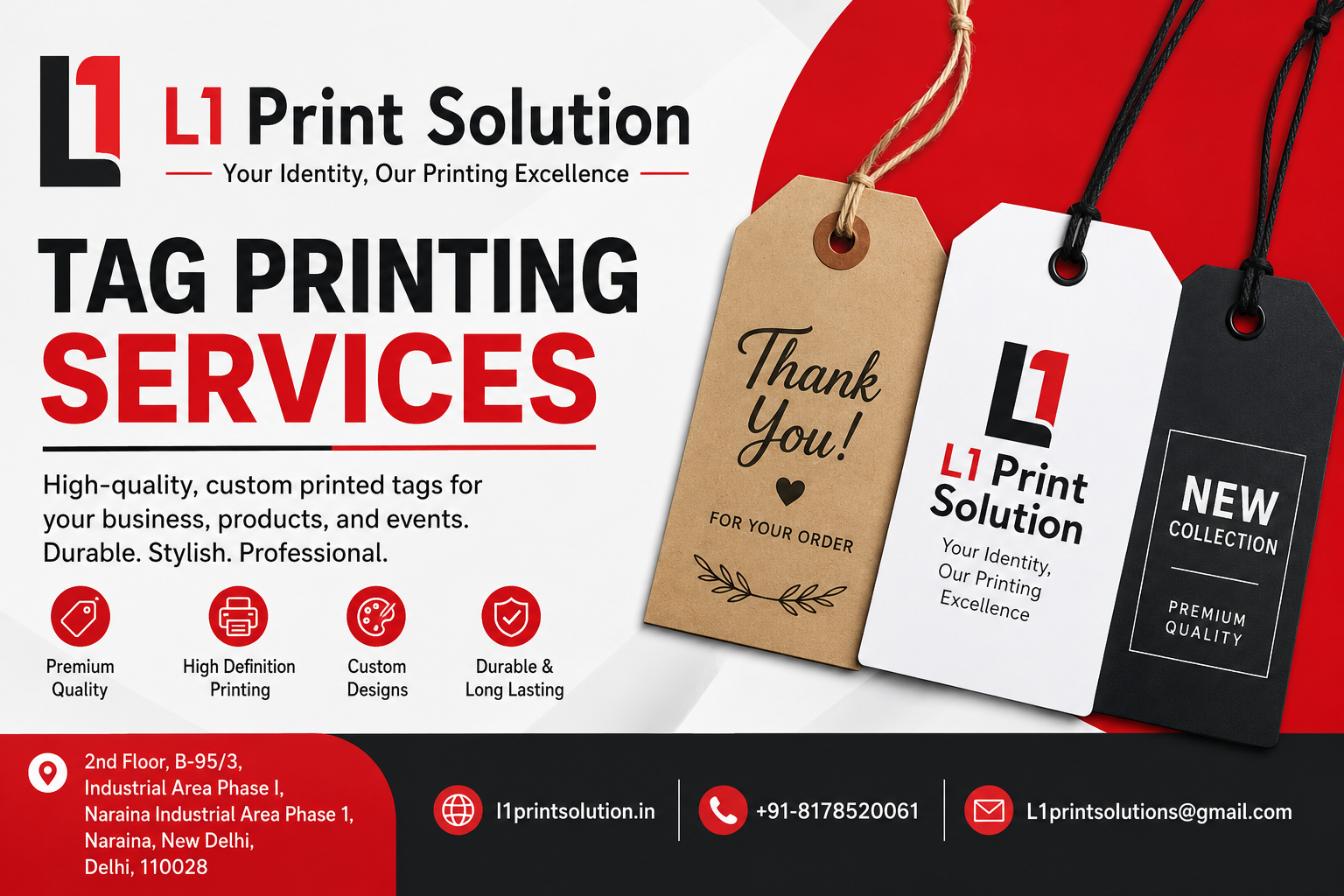
Walk into any store — a boutique, a supermarket, even a small local shop — and pick up almost any item. Chances are, the first thing your fingers touch isn’t the product itself. It’s the tag.
That tiny piece of paper or card hanging off a shirt, tied to a candle, or stapled to a gift box does more work than most business owners realize. It tells a story before the customer even reads a word of your website. It whispers “this brand is careful,” or, if it’s done poorly, it quietly says “this was an afterthought.”
That’s the real reason Tag Printing Services matter so much more than people assume. They’re not just about slapping a price on a product. They’re about branding, trust, and the tiny details that turn a casual browser into a loyal customer. In this guide, we’ll break down what professional tag printing really involves, why it matters for retail success, and how to choose the right approach for your business — in plain, simple language.
What Are Tag Printing Services, Really?
At the most basic level, tag printing services help businesses design, print, and finish product tags — the small cards or labels attached to clothing, accessories, packaging, gift items, and more. But calling it “just printing” undersells what’s actually happening.
A good tag printing partner thinks about paper stock, finish, size, color accuracy, string or fastener type, barcode placement, and how the tag will actually survive handling — being pulled, folded, scanned, and sometimes even washed with the item still attached. It’s a mix of design sense and practical engineering, on a tiny canvas.
Why It’s Not as Simple as “Print and Attach”
Think about a clothing brand that sells hundreds of units a week. Every tag needs to be consistent — same font, same color, same size — across thousands of pieces. A slight color shift or a flimsy tag that tears off in transit can quietly chip away at how premium the brand feels, even if the product itself is excellent. This is exactly where professional tag printing services earn their keep: consistency at scale, without sacrificing quality.
Types of Tags Used in Branding and Retail
Not all tags serve the same purpose. Understanding the different types helps you pick the right one for your product line.
Comparison of Common Tag Types
| Tag Type | Best Used For | Common Material |
| Hang Tags | Apparel, accessories, footwear | Cardstock, kraft paper |
| Price Tags | Retail shelves, in-store displays | Coated paper, plastic |
| Care Tags | Washing/handling instructions | Woven or satin fabric |
| Gift Tags | Hampers, festive packaging | Textured or specialty paper |
| Barcode/Inventory Tags | Warehousing, POS scanning | Durable synthetic paper |
Note: Many brands combine two or three tag types on a single product — for example, a hang tag with a barcode printed on the back.
Key Benefits of Professional Tag Printing Services
Here’s where it gets practical. Why should a growing brand invest in professional tag printing instead of doing it in-house with a basic printer?
- Brand Consistency: Every tag matches your brand colors, fonts, and logo — no matter how large the order.
- Durability: Professional-grade cardstock and finishes survive shipping, handling, and shelf time without curling or tearing.
- Better First Impressions: A well-designed tag signals quality before the customer even opens the packaging.
- Operational Efficiency: Barcodes and SKU details printed accurately reduce billing errors at checkout.
- Scalability: Bulk printing keeps per-unit costs low as your order volume grows.
- Customization Options: Foil stamping, embossing, die-cut shapes, and specialty finishes help you stand out on a crowded shelf.
Feature vs. Why It Matters
| Feature | Why It Matters |
| High-resolution printing | Keeps logos and text crisp, avoiding a blurry, cheap look |
| Colorfast inks | Prevents fading during storage or transit |
| Accurate barcode printing | Reduces scanning errors at checkout counters |
| Custom die-cutting | Gives tags a unique shape that reinforces brand identity |
| Eco-friendly paper options | Appeals to sustainability-conscious shoppers |
These small features add up to a tag that feels intentional rather than an afterthought.
Step-by-Step: How Tag Printing Services Actually Work
If you’ve never worked with a printing partner before, the process can feel a bit mysterious. Here’s what it typically looks like, from idea to finished product.
The Tag Printing Process
| Step | What Happens |
| 1. Design Consultation | You share your logo, brand colors, and tag purpose; the printer suggests layout options |
| 2. Material Selection | Choose paper weight, finish (matte/gloss), and fastener type |
| 3. Proofing | A sample proof is sent for your approval before bulk printing |
| 4. Printing | Tags are printed in bulk using offset or digital printing, depending on volume |
| 5. Finishing | Die-cutting, hole-punching, string or safety pin attachment, and quality checks |
| 6. Delivery | Finished tags are packed and shipped, ready for attachment to your products |
Most printing partners, including L1 Print Solution, can complete this entire cycle within a few business days for standard orders.
Tips and Best Practices for Getting Tags Right
- Keep it simple. A cluttered tag is harder to read at a glance. Stick to your logo, essential info, and one clear visual element.
- Match your packaging theme. Tags should feel like part of the same family as your boxes, bags, and labels.
- Test the material before bulk ordering. Request physical samples so you can feel the paper weight and finish in person.
- Double-check barcode scannability. A barcode that looks fine on screen can sometimes fail to scan when printed too small.
- Plan for durability. If your product will be handled a lot (like shoes or bags), choose thicker cardstock or laminated tags.
Common Mistakes to Avoid
Do’s and Don’ts of Tag Printing
| Do | Don’t |
| Order a physical proof first | Approve designs based only on a screen preview |
| Use brand-consistent colors (CMYK values) | Rely on RGB colors, which can shift when printed |
| Choose durable materials for high-handling products | Use flimsy paper for items that get scanned or pulled often |
| Plan quantities with some buffer stock | Order the exact number with zero margin for damage or reprints |
| Work with an experienced printing partner | Cut corners with low-cost, unverified printers for a “big” brand launch |
Small oversights in tag printing are cheap to fix early, but expensive once thousands of units are already printed.
Quick Reference: Choosing the Right Tag for Your Product
| Product Type | Recommended Tag | Finish Suggestion |
| Apparel | Hang tag + care tag | Matte with string fastener |
| Handmade goods | Kraft paper gift tag | Uncoated, rustic texture |
| Electronics accessories | Barcode/inventory tag | Glossy, tear-resistant |
| Gourmet/food packaging | Small string-tied tag | Textured, food-safe ink |
Use this table as a quick starting point, then fine-tune based on your specific brand style and budget.
Frequently Asked Questions
1. What is the difference between a hang tag and a price tag?
A hang tag usually carries branding elements like the logo and story, while a price tag focuses on pricing and SKU details. Many brands combine both on a single card.
2. How long does it take to get tags printed?
For standard orders, most tag printing services deliver within a few business days once the design is approved. Larger or highly customized orders may take longer.
3. Can tag printing services handle small business orders?
Yes. Most professional printers, including L1 Print Solution, offer flexible order sizes, so small businesses and startups don’t need to commit to massive quantities upfront.
4. What material is best for durable tags?
Thicker cardstock (around 300–400 GSM) with a matte or laminated finish tends to hold up well against handling, folding, and moisture.
5. Do tags need to include barcodes?
Not always, but for retail environments with POS scanning, a printed barcode significantly speeds up checkout and reduces manual entry errors.
6. Is it cheaper to print tags in-house?
It might seem cheaper initially, but in-house printing often costs more per unit at scale and lacks the consistency, durability, and finishing options a professional service provides.
Final Thoughts
Tags are small, but they carry a surprising amount of weight in how customers perceive a brand. A well-printed, thoughtfully designed tag can quietly reassure a shopper that they’re buying something worth the price. A poorly made one can undo hours of careful branding work elsewhere.
That’s why partnering with the right printing team matters. Professional tag printing services aren’t just about ink on paper — they’re about consistency, durability, and the kind of small detail that builds trust one product at a time.
If you’re planning a new product line, refreshing your packaging, or simply tired of tags that don’t hold up, it might be worth having a conversation with a team that handles this every day. At L1 Print Solution, that’s exactly the kind of detail we like to get right — one tag at a time.
Visit: https://l1printsolution.in/
Call: +91-8178520061
Email: [email protected]
Address: 2nd Floor, B-95/3, Industrial Area Phase I, Naraina Industrial Area Phase 1, Naraina, New Delhi, Delhi, 110028