
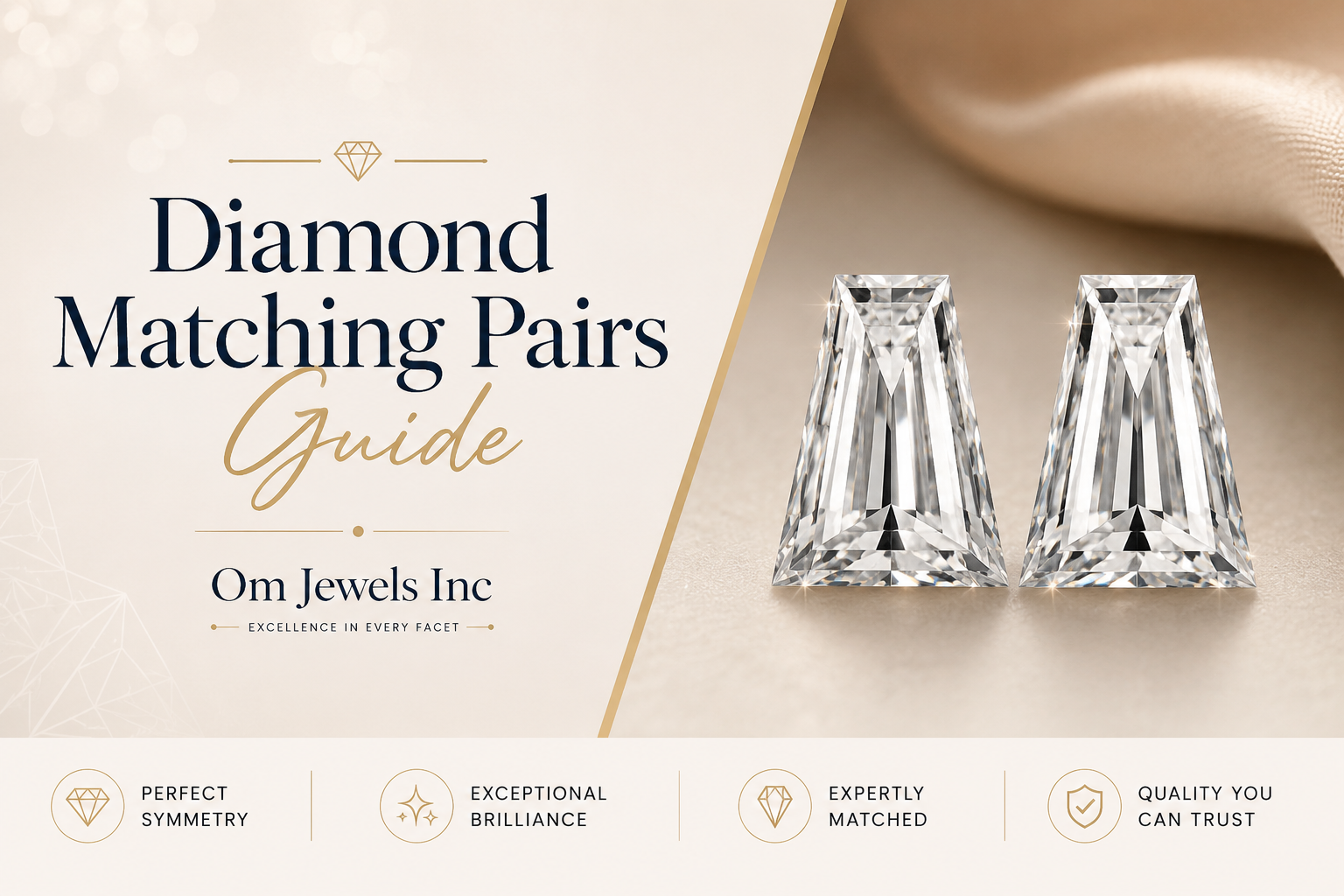
A single beautiful diamond is a discovery. A perfectly matched pair is an achievement.
Anyone who has shopped for diamond stud earrings, a pair of side stones for a three-stone ring, or symmetrical accents for a custom design knows the challenge: no two diamonds are ever truly identical. Each stone is a product of billions of years of geology, and nature does not repeat itself. That is precisely what makes a well-matched pair so remarkable – and so valuable.
At Om Jewels Inc, diamond matching pairs are one of the most demanding disciplines of our trade. Here is what goes into finding two diamonds that belong together.
What Makes a “Matching Pair”?
A matching pair is two diamonds selected to appear identical to the naked eye when worn or set together. True matching goes far beyond pulling two stones of the same carat weight from inventory. Our graders evaluate pairs across several dimensions:
Carat weight. The two stones should be within a very tight tolerance of each other – typically just a few points – so neither earring or side stone looks heavier than its twin.
Color. Diamonds are graded on a scale from D (colorless) down through Z. Even a single grade of difference can be visible when two stones sit side by side, especially in larger sizes. A well-matched pair sits in the same color grade, and ideally shows the same undertone within that grade.
Clarity and inclusion pattern. Two stones may share a clarity grade yet look different if one has a visible inclusion near the table and the other is eye-clean. We match not only the grade but the character and position of inclusions.
Cut, proportions, and faceting. This is where matching becomes an art. Table size, depth percentage, crown angle, and pavilion depth all influence how a diamond returns light. Two stones with different proportions will sparkle differently – and the eye notices. We match cut grade, measurements, and light performance so both stones dance the same way.
Fluorescence. A pair where one stone fluoresces strongly under UV light and the other does not can look mismatched in daylight. We pair stones with the same fluorescence behavior.
Shape and outline. For fancy shapes – ovals, pears, marquises, emerald cuts – matching becomes even harder. Length-to-width ratios, shoulder curves, and point symmetry must align so the two stones mirror each other perfectly.
Why Matched Pairs Command a Premium
If you have ever wondered why a matched pair costs more than two comparable single stones, the answer is scarcity of combination. A cutter may need to review dozens – sometimes hundreds – of diamonds to find two that align on every parameter above. For larger stones and fancy shapes, the search grows exponentially harder, because fewer candidates exist at each size.
That effort is reflected in the finished piece. A pair of studs that truly match reads as intentional, balanced, and luxurious. A pair that almost matches reads as a compromise.
Where Matching Pairs Shine
Diamond stud earrings. The classic application. Studs sit close to the face, at eye level, where any mismatch in size, brightness, or color is most noticeable.
Three-stone rings. The side stones flanking a center diamond must match each other precisely, and complement the center stone in color and cut style.
Toi et moi and bypass designs. Some two-stone designs deliberately contrast shapes, but when symmetry is the goal, the pairing must be flawless.
Earring drops and chandeliers. Multi-stone earrings often require matched pairs at several sizes within a single design.
Cufflinks and men’s jewelry. Precision matching gives these pieces their clean, tailored look.
How Om Jewels Inc Matches Pairs
Our process combines gemological instrumentation with the trained human eye:
- Certified grading first. We begin with independently certified stones so that color, clarity, cut, and fluorescence are established objectively.
- Measurement matching. Digital proportion analysis narrows candidates to stones with near-identical dimensions and ratios.
- Side-by-side visual review. Graders examine candidate pairs face-up under controlled lighting, exactly as the stones will be seen when worn.
- Light-performance comparison. We confirm both stones exhibit the same brilliance, fire, and scintillation pattern.
- Final approval. Only pairs that pass every stage are offered as matched pairs.
Tips for Buying a Matched Pair
- Prioritize cut and color matching over clarity. Slight clarity differences are often invisible; differences in brightness or tint rarely are.
- View pairs face-up, together. Certificates tell you the grades; your eyes tell you whether the stones truly belong together.
- For fancy shapes, check the ratios. Two ovals of equal weight can look very different if their length-to-width ratios diverge.
- Ask about fluorescence. Make sure both stones behave the same way.
- Buy the pair as a pair. Trying to find a “twin” for a stone you already own is far harder than selecting a matched pair from the start.
The Om Jewels Inc Promise
Every matched pair we offer represents hours of selection, comparison, and rejection – because a pair is only as good as its weakest twin. Whether you are sourcing studs for a milestone gift, side stones for a bespoke engagement ring, or calibrated pairs for your own designs, our team is ready to find the two diamonds that were meant to be together.
Explore our matched pair collection or speak with our diamond specialists today – and discover what perfect symmetry looks like.