
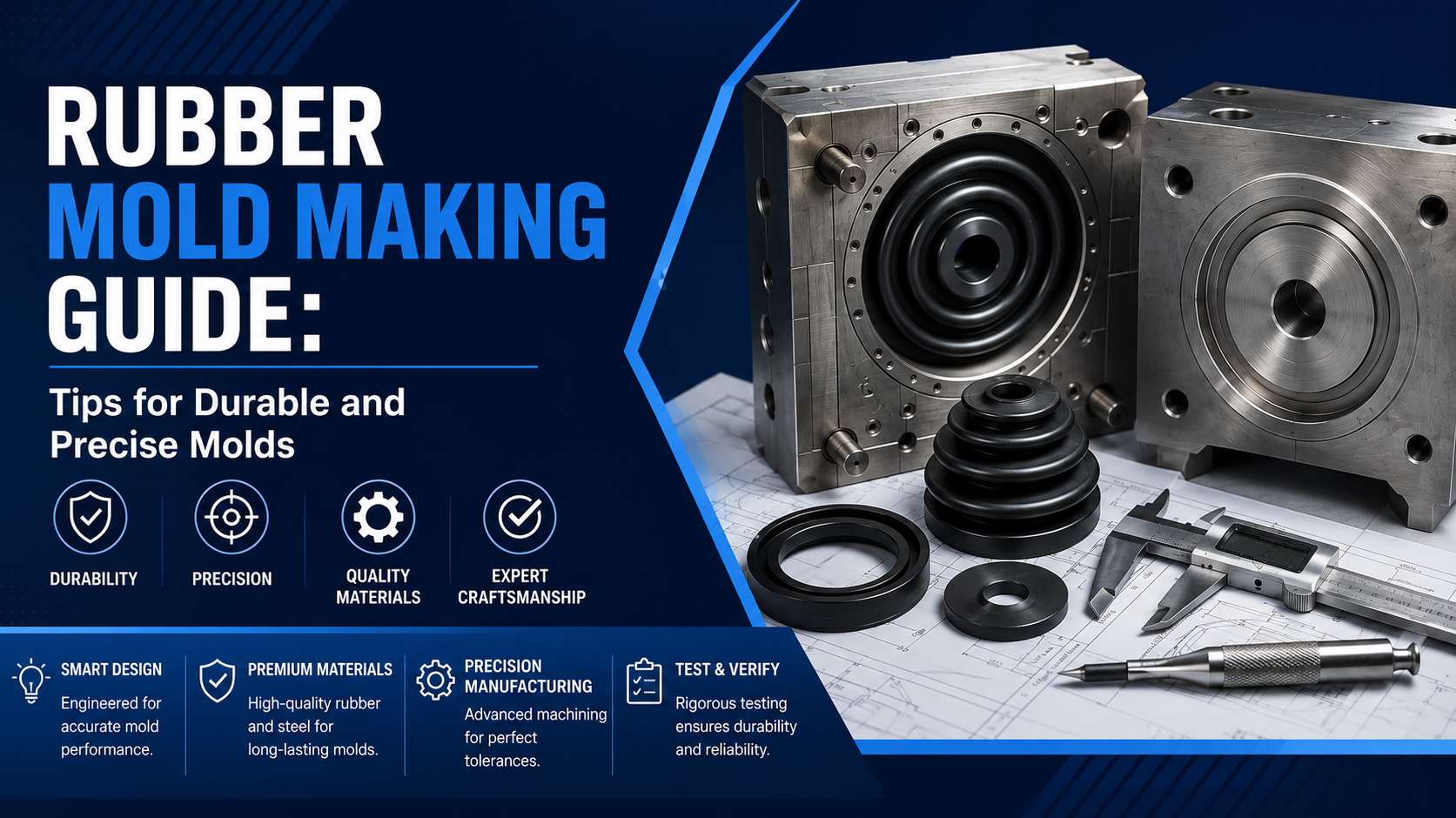
Most people notice a molding problem only after parts start coming off the press. Flash appears where it shouldn’t. Dimensions drift. Surface quality changes. Production slows while operators try to figure out what happened. The interesting part is that many of those issues did not start on the shop floor. They started much earlier, during tooling development.
That is why rubber mold making remains one of the most important parts of any molding project. A well-built PRODUCT can run consistently for years. A poorly planned one can create headaches from the first production run.
Why Rubber Mold Making Deserves More Attention
In manufacturing, tooling is often treated as a one-time purchase. Once the mold is approved, attention shifts to production.
Reality is usually less straightforward.
A mold affects material flow, curing behavior, part release, cycle time, and product consistency. Small decisions made during design can influence every part that follows.
Years ago, a supplier producing industrial seals struggled with recurring defects. The rubber compound was blamed first. Then machine settings. After several weeks of investigation, engineers discovered the real issue was uneven cavity filling caused by the mold design.
The lesson was simple: when production problems keep returning, tooling deserves a closer look.
Material Selection in Rubber Mold Making Matters
Not every project requires the same tooling approach.
A prototype mold intended for a few hundred parts has very different requirements from a mold expected to run for several years.
Aluminum is often used for development work because it machines quickly and keeps costs manageable. With increasing volumes of production and durability being a priority steel becomes a more attractive option. Experienced engineers usually look beyond the purchase price.
They ask practical questions:
- How many parts will be produced?
- What rubber compound is being used?
- How often will the mold run?
- What tolerances must be maintained?
Good rubber mold making starts with understanding those answers before any machining begins.
How Custom Rubber Molding Helps During Development
Product designs rarely remain unchanged. An engineer modifies a sealing surface. A customer requests a different geometry. Testing reveals a performance issue that was not obvious in CAD. Changes happen.
That is one reason many manufacturers rely on custom rubber molding during development programs. It allows teams to evaluate designs before investing in high-volume production tooling.
A manufacturer of protective equipment recently discovered that a housing component performed well at room temperature but showed sealing issues during thermal cycling. Because the design was still in development, adjustments could be made before the project moved into full production. Finding a problem early is almost always cheaper than fixing it later.
Design Details Affect Rubber Molded Parts
Some tooling decisions seem minor until production begins.
Vent locations, draft angles, gate placement, and cavity layout rarely attract much attention outside engineering meetings. Yet these details often determine whether production runs smoothly or requires constant adjustments.
This is well known to manufacturers of rubber molded parts.
A poorly vented cavity can trap air. Material may not fill evenly. Surface defects begin appearing. Operators compensate where they can, but eventually the root cause has to be addressed.
Good mold design reduces those risks before production starts.
It is not always about making the mold more complex. Often, it is about making it smarter.
Working With a Rubber Mold Company Early
One mistake manufacturers sometimes make is involving tooling suppliers too late.
By the time a mold builder reviews the design, key decisions have already been made.
An experienced rubber mold company often spots potential manufacturing challenges immediately. Features that look acceptable on a drawing may create release problems, increase cycle times, or accelerate wear.
Early collaboration usually leads to better results.
Discussions between product designers, production engineers, and tooling specialists often take place long before machining starts on many successful projects. Those discussions often prevent expensive redesigns down the road.
Common Rubber Mold Manufacturing Challenges
Even the best-designed molds experience issues from time to time.
Some of the more common ones are:
- Flash around parting lines
- Uneven curing
- Air entrapment
- Mold wear
- Surface imperfections
- Difficult part removal
Most of these problems become manageable if we catch them early.
Usually, the best approach is preventive, not reactive. Routine inspection, good maintenance, and careful engineering go a long way toward ensuring molds continue to perform as intended.
That is one reason experienced manufacturers view rubber mold making as an ongoing process rather than a finished task.
Producing Better Rubber Molded Parts Over Time
Tooling performance is not measured only by the first production run.
The real test comes later.
Can the mold maintain dimensional accuracy after thousands of cycles? What about the quality of parts? Maintenance requirements?
Manufacturers producing critical rubber molded parts often pay close attention to these questions because product performance depends on consistency.
A seal that varies slightly in size may still pass inspection. It may also create assembly issues months later. Good tooling helps prevent those situations before they become expensive problems.
Choosing the Right Rubber Mold Company
Finding the right supplier involves more than comparing quotations.
Technical experience matters. Communication matters. Industry knowledge matters.
A capable rubber mold company can contribute ideas that improve manufacturability and reduce production risk. That expertise often proves valuable long after the mold has been delivered. The strongest supplier relationships tend to be partnerships rather than simple transactions.
Conclusion
Good tooling rarely gets much credit when everything works. Yet custom silicone molds often plays a larger role than people realize.
Anyone who’s worked in manufacturing knows it’s seldom that easy. Small tooling choices impact everything from cycle times to product quality. An efficiently made mould typically saves significantly more time and money than people realize by helping to prevent manufacturing problems before they occur.
In general, it’s important to spend time getting the mould perfect, whether you’re testing a new design through custom silicone molds or preparing for full production.
FAQs
1. What is rubber molding?
Rubber moulding is the process of forming rubber into a final product by the use of a mould. The mould controls the final shape, size and features of the product, helping to ensure that each item is created consistently.
2. Why do companies opt for custom rubber moulding?
Not all applications can employ an off-the-shelf item. Custom rubber moulding allows producers to build parts that meet specific dimensional, performance, or design specifications.
3. Is an aluminium mould preferable to a steel mould?
Neither is inherently superior. Prototypes and smaller production runs commonly employ aluminium moulds because they are faster to produce. Typically , steel moulds are used for higher volume production since they will last for more cycles over time .
4. Why are there sometimes faults in moulded rubber parts?
There might be a number of reasons. This can be affected by issues like trapped air , uneven flow of material , wear on the mould , processing conditions , or part design . The cause of this is often not just one thing but a combination of things.
5. How do I find the best rubber mould manufacturer?
Don’t only look at the listed price. A excellent rubber mould company should have real manufacturing experience, great engineering knowledge and a history of solving production issues. Clear communication and technical assistance are often as important as the mould.
CTA
No two rubber moulding jobs are alike. Whether you are designing a new component or improving an old one, the correct tooling strategy can have a major impact on quality, cost and production efficiency. If you’d like to discuss your project, we’d love to help you explore the best strategy.