
The mud, the wire, and the relentless artillery of the Western Front defined the landscape of the Great War. Yet, amid the harsh realities of trench warfare, the visual identity of the British soldier became an enduring symbol of resilience. The distinctive khaki attire worn by the “Tommies” was more than just clothing—it was a highly engineered piece of tactical gear designed for a new era of industrialized combat.
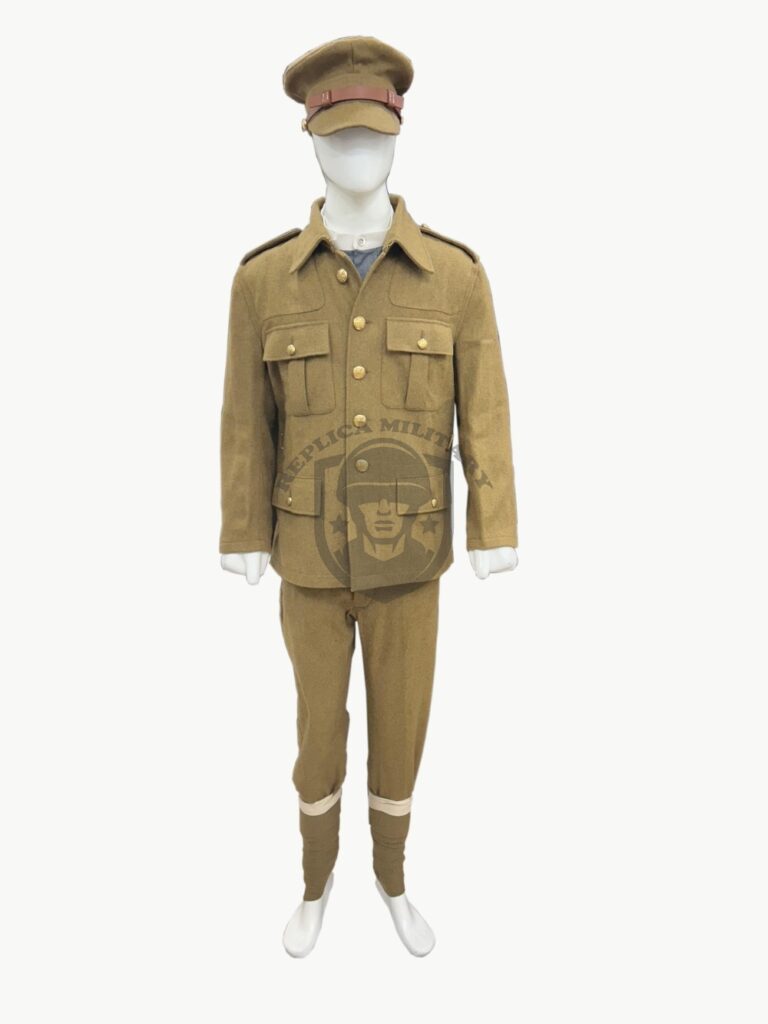
For modern living history groups, museum curators, and film productions, capturing this exact aesthetic requires a deep dive into the evolution of british uniforms of world war 1.
The Birth of the 1902 Pattern Service Dress
When Great Britain entered the war in August 1914, the British Expeditionary Force (BEF) marched to the front lines wearing the 1902 Pattern Service Dress. Unlike the bright red tunics of the 19th century, this uniform was born from lessons learned during the Boer Wars, where camouflage and utility became paramount.
+-----------------------------------------------------------------+
|               THE TOMMY'S TRENCH KIT (1914–1918)                |
+-----------------------------------------------------------------+
|  • Material: Heavy, 22-to-24 oz. coarse khaki-drab wool twill   |
|  • Tunic Features: 4 large pleated pockets, internal rifle pads |
|  • Trousers: High-waisted, loose-cut thigh for mobility         |
|  • Legwear: Woolen puttees wrapped from ankle to knee           |
+-----------------------------------------------------------------+
The uniform was constructed from a thick, coarse wool fabric that provided vital protection against the damp, biting European winters. The tunic featured four large front pockets for storing ammunition, rations, and personal items, alongside brass buttons bearing the regimental crest of the soldier’s unit.
Mud, Wool, and Puttees: Adaptations in the Field
As the conflict ground into a stalemate, the functional strengths and weaknesses of british uniforms of world war 1 quickly came to light. The heavy wool fabric, while excellent for warmth, became dangerously waterlogged in the flooded trenches of Flanders, often holding pounds of stagnant water and mud.
To protect the lower legs, soldiers wore puttees—long strips of woolen cloth wrapped meticulously from the ankle up to the knee. Puttees provided crucial ankle support over uneven terrain and prevented debris from entering the boots. However, wrapped too tightly, they could restrict circulation, worsening the dreaded condition known as “trench foot.”
By 1915, the soft service cap was frequently replaced on the front lines by the iconic Brodie helmet, a steel bowl designed to deflect flying shrapnel from air-bursting artillery shells.
Reliving History with Replicamilitary
Finding an original Great War uniform in wearable condition is nearly impossible today; surviving pieces are safely locked away in museum archives, far too fragile for the rigors of a reenactment field. This is where Replicamilitary steps in.
Dedicated to preserving living history with absolute fidelity, Replicamilitary specializes in crafting museum-grade reproductions of historical uniforms. Their artisans meticulously study original archival garments to replicate the exact coarse weave, tailored drape, and historic silhouette of the 1902 Pattern Service Dress. From the stiff collar lines to the precise stitching on the interior lining, Replicamilitary ensures that your impression stands up to the closest scrutiny, whether under the harsh lights of a movie set or in the mud of a tactical weekend.