A surgeon can be highly skilled, the OT team can be disciplined, and the procedure plan can still suffer because one clamp slips, one scissor loses bite, or one retractor feels slightly wrong in hand.
That’s why surgical instruments are not “basic hospital tools.” They are risk-control products. WHO notes that complications after inpatient operations may occur in up to 25% of patients, and at least half of surgery-related harm cases are considered preventable. That should make every buyer slightly more serious about instrument selection.
Most buyers ask price first.
That’s not buying. That’s gambling with procurement paperwork.
For wholesalers, procurement managers, and brand owners, the real question is simple: will these instruments perform consistently after repeated handling, sterilization, packing, dispatch, and real surgical use?
What Surgical Instruments Must Prove Before Purchase
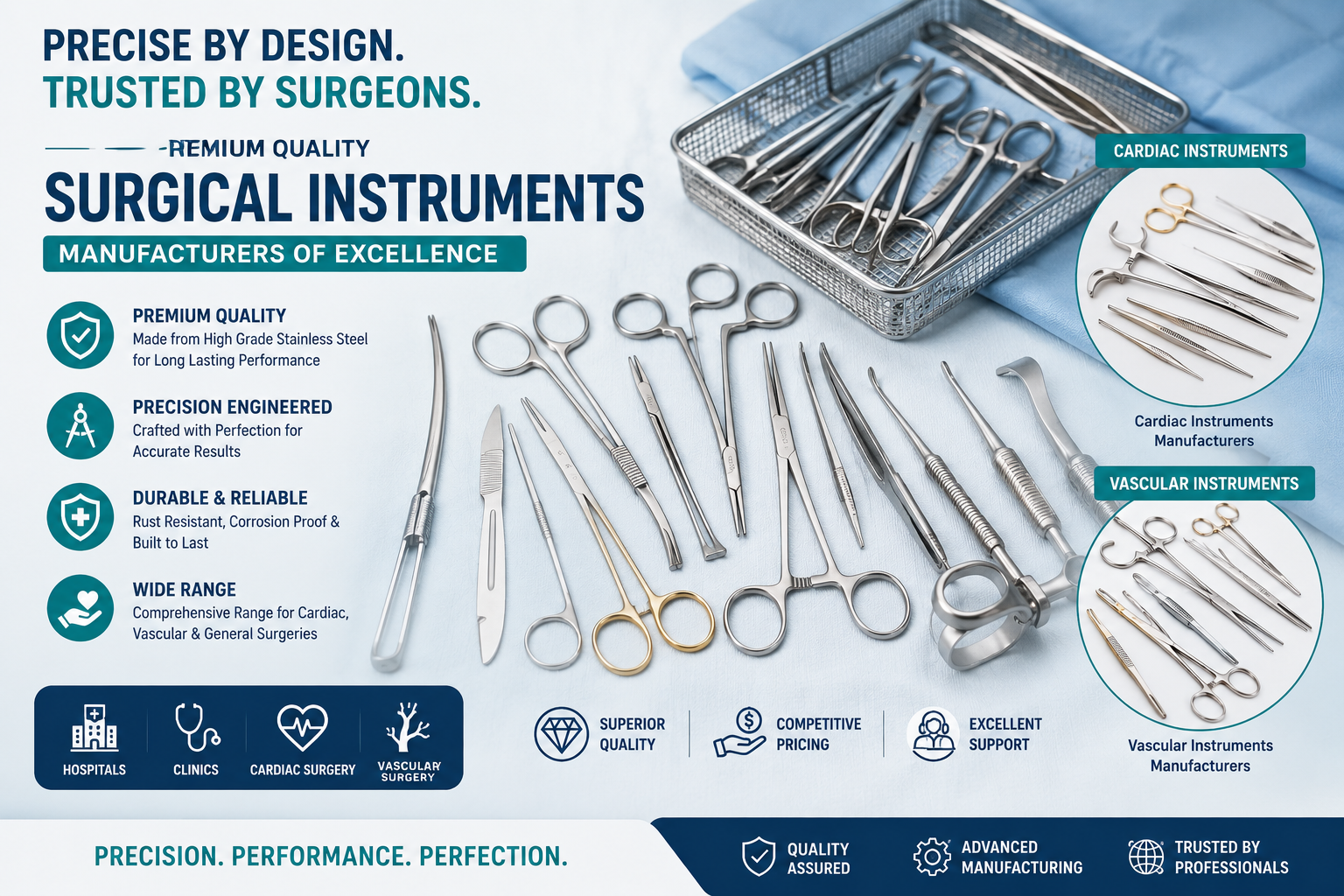
Surgifact’s website lists multiple surgical instrument categories, including Cardiac Instruments, Vascular Instruments, ENT, general surgery, gynaecology, neurology, spine, orthopaedic, urology, ophthalmic, and surgical instrument sets.
Cutting, Holding, Clamping, Retracting — The Real Product Families
Most surgical instruments fall into practical groups:
- Cutting instruments: scissors, scalpels, blades
- Grasping instruments: forceps, tissue holders
- Clamping instruments: artery forceps, vascular clamps
- Retracting instruments: rib spreaders, handheld retractors
- Suturing instruments: needle holders and related tools
- Specialty instruments: cardiac, vascular, orthopaedic, ENT, and microsurgical tools
Here’s the detail buyers often skip: finish quality matters after sterilization, not just during first inspection.
Cardiac and Vascular Instruments Need Finer Control
Cardiac Instruments are used around heart and great vessel procedures, where fine tips, stable grip, and clean movement matter more than heavy build. Surgifact’s cardiac page mentions products such as rib spreaders, retractors, rib shears, duct dissectors, and related surgical tools.
Vascular Instruments are built for vascular surgery, where the product must support durability, corrosion resistance, and long-lasting performance. Surgifact’s vascular page specifically mentions medical-grade stainless steel and high-precision manufacturing.
And yet, some suppliers still sell “same type” tools with weak finishing and vague material claims. That’s how rejection starts.
5 Supplier Checks Before You Place a Bulk Order
1. Ask for Material Clarity
Good answer: grade, finish, intended use, and sterilization suitability.
Bad answer: “Sir, hospital quality hai.”
That line means nothing.
2. Check Certification and Documentation
ISO 13485 is an internationally recognized quality management standard for medical devices, covering design, production, delivery, safety, and regulatory expectations.
Bad answer: “Certificate baad me bhej denge.”
A supplier who cannot share documents before payment will create bigger problems after dispatch.
3. Review Category Depth
If you need Cardiac Instruments Manufacturers or Vascular Instruments Manufacturers, don’t judge only by homepage claims. Check product depth, repeat models, finish options, and dispatch readiness.
Bad answer: “Jo chahiye ban jayega.”
Possible? Maybe. Reliable? Not always.
4. Test Communication Speed
For B2B buying, response delay is a quality signal. If quotation takes 5 days without reason, replacement support will be slower.
5. Ask About Defect Handling
A supplier who says “we’ll see case by case” doesn’t have a policy.
That’s a negotiation you’ll lose after the shipment lands.
How Better Instruments Protect Buyer Margin
Fewer Rejections After Inspection
Good surgical instruments reduce return risk. If a wholesaler receives uneven finishing or loose alignment, the margin disappears in replacement freight.
Better Repeat Orders From Hospitals
Hospitals don’t remember your catalogue. They remember whether the tool performed well during use.
WHO reported that the use of the surgical safety checklist in eight pilot hospitals reduced major inpatient complications from 11% to 7% and deaths from 1.5% to 0.8%. Better systems matter, and instruments are part of that system.
Lower After-Sales Arguments
Clear specs reduce confusion. Nobody wants a buyer saying, “This is not the same finish we approved.”
Stronger Dealer Reputation
Surgical Instruments Dealers build trust slowly and lose it quickly. One weak batch can damage 6 months of field work.
Safer Product Positioning
For Cardiac Instruments Suppliers and Vascular Instruments Suppliers, precision is not a marketing word. It affects how confidently the product can be positioned to hospitals, clinics, and distributors.
Why Jalandhar Location Helps Serious Buyers
Surgifact / Vaishanav Surgical Co. is based at 1382/1046, Raja Garden, Basti Danishmandan, Near Vishal Tools, Jalandhar – 144002, Punjab, India, as listed on the website.
That location matters.
Punjab has strong manufacturing movement, and Jalandhar has long industrial supply familiarity. For buyers searching surgical instruments manufacturers in India, Cardiac Instruments Manufacturers in India, or Vascular Instruments Manufacturers in India, location is not just an address. It affects sample movement, courier coordination, packing follow-up, and repeat dispatch planning.
Most buyers underestimate dispatch discipline.
A late sample delays approval. A delayed approval delays bulk order. A delayed bulk order gives your competitor the opening.
Surgifact’s website also positions the business as a surgical instruments manufacturer and supplier in India for hospitals, clinics, distributors, and healthcare professionals.
Built Around Real Surgical Supply Work
At Surgifact, we work with buyers who don’t have time for vague promises. Our focus is on surgical instruments, Cardiac Instruments, Vascular Instruments, and specialty medical tools that need correct finish, stable handling, and dependable supply.
We have been associated with this business since 1967, and that matters because surgical buying is not learned from brochures alone. Surgifact’s website shows Vaishanav Surgical Co. copyright from 1967 to 2026, which reflects a long operating history in this field.
We know one simple thing from real orders: if the sample finish and bulk finish don’t match, the buyer won’t argue politely the second time.
So we treat product clarity, documentation, packing, and communication as part of the order, not extras.
Send the Right Details, Get a Practical Quote
Send us your requirement list with product names, quantity, preferred finish, target use, packing need, and delivery location.
We usually aim to respond within 1 working day after receiving clear details. MOQ depends on product type, but for common instruments, buyers should ideally share requirements starting from 5 pieces or more per item; specialty cardiac and vascular items may need confirmation after checking model and finish.
For faster pricing, send:
- Product name or photo
- Required quantity
- Material or finish preference
- Dealer, hospital, or brand requirement
- Destination city/country
- Any certificate or packing requirement
We’ll review it properly before quoting, because wrong quoting creates wrong expectations.
Conclusion
Surgical instruments are small in size but serious in impact. The right supplier protects your margin, your buyer relationship, and your repeat order cycle.
With global surgery needs still large — the Lancet Commission notes that 5 billion people lack access to safe, affordable surgical and anaesthesia care — dependable instrument supply will only become more important.
The next strong buyer will not only ask for price; they’ll ask what stands behind the product.
FAQs
1. What are surgical instruments used for in modern surgery?
They are used for cutting, holding, clamping, retracting, suturing, exposing, and supporting tissue during procedures. Surgical instruments supplier selection matters because a small finishing issue can create a big complaint during clinical use.
2. How do I choose reliable Surgical Instruments Dealers?
Check product range, documentation, sample consistency, replacement policy, and response time. A dealer who avoids written specs may still supply, but you’re taking unnecessary risk.
3. Do Cardiac Instruments Suppliers handle bulk orders?
Yes, many Cardiac Instruments Suppliers handle bulk requirements for hospitals, distributors, and brand owners. The caveat is simple: cardiac tools need model-wise clarity, so don’t place bulk orders only from a catalogue thumbnail.
4. Are Cardiac Instruments Dealers different from general surgical dealers?
Often, yes. Cardiac Instruments Dealers need better understanding of delicate instruments, fine tips, retractors, rib spreaders, and specialty surgical use. General dealers may supply them too, but product knowledge can vary.
5. What are the good questions for the Vascular Instruments Suppliers?
You should inquire what grades the materials are, the surface finishing, alignment of clamps, resistance to corrosion, and the capability of the tools to undergo sterilization. A good vascular instruments supplier should be able to answer those questions; they should not respond with “standard quality” just to answer your question.
6. Can Vascular Instruments Dealers reach out to hospitals and wholesalers?
Indeed, they can, but it will depend on how many tools are ordered, and what is currently available. However, if a hospital is making a demand for tools, it will be confirmed that those required tools are available, as some specialized vascular tools aren’t manufactured in the required patterns or dimensions.
7. What are the advantages of a buyer purchasing from a certified surgical instruments manufacturer?
A certified manufacturer is one who has met the criteria set by a certifying body and is therefore a manufacturer with a high quality of assurance. Although certification doesn’t guarantee that each item will meet the expectations of the buyer, it aids the buyer in the auditing, documenting, and supplying processes.