The Victorian era (1837–1901) marked a monumental pivot in the history of military warfare. At the start of Queen Victoria’s reign, the British Army marched onto battlefields dressed in the brilliant, theatrical pageantry of the Napoleonic era. By its close, the harsh realities of industrialized warfare, long-range rifles, and guerrilla tactics forced a dramatic shift toward camouflage and tactical field gear.
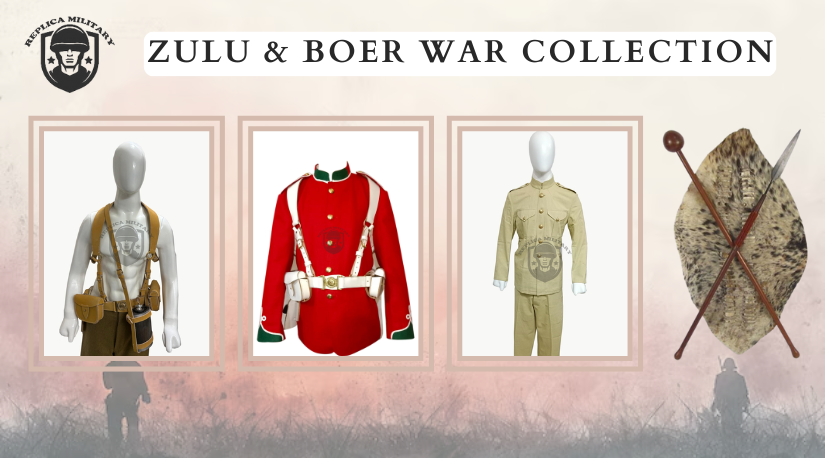
For modern historians, film costume designers, and dedicated living history reenactors, studying the Victorian and British War Uniform and Accessories reveals a fascinating story of a global empire adapting to a rapidly modernizing world.
The Zenith of the Redcoat: Crime and the Zulu War
For the first half of the Victorian era, the British military identity was defined by the iconic scarlet tunic. The famous “Redcoats” were designed for psychological impact on the battlefield—making regiments look imposing while masking the blood of wounded soldiers.
During the Crimean War (1853–1856) and the legendary Anglo-Zulu War (1879), the standard infantryman’s uniform consisted of a heavy scarlet wool tunic paired with dark blue trousers featuring a distinctive red stripe down the outer seam. On their heads, soldiers wore the iconic white pith helmet (often stained with tea or mud in the field to reduce visibility).
However, a uniform is incomplete without its load-bearing field gear. The primary accessories of this era included:
- The Pattern 1871 White Buff Leather Webbing: A complex harness system designed to distribute the weight of heavy cartridge boxes across the soldier’s shoulders and waist.
- The Martini-Henry Rifle Sling and Bayonet Frog: Sturdy leather accoutrements meant to keep the iconic rifle secure during long marches and hold the long sword-bayonet at the ready.
- The Canvas Haversack and Water Bottle: Essential survival gear carried on opposite hips to sustain infantrymen through blistering colonial campaigns.
The Evolution to Khaki: The Boer War and Beyond
The limits of the bright scarlet uniform were fundamentally exposed during the Second Boer War (1899–1902) in South Africa. Facing hidden Boer marksmen armed with smokeless powder rifles, British soldiers in red coats were incredibly easy targets.
This historic tactical crisis forced the army to fully adopt khaki (derived from the Urdu word for “dust”). The final years of the Victorian era saw British troops trading their vibrant scarlet and white gear for drab, sand-colored serge wool tunics and matching trousers. Accompanying leather accessories were transitioned from highly visible white buff leather to subdued brown leather bandoliers designed to carry ammunition clips for the newer Lee-Metford and Lee-Enfield rifles.
The Officer’s Status: While regular infantrymen relied on standard issue canvas and leather, Victorian officers prominently displayed their rank through elegant accessories. They wore tailored frock coats adorned with gold-embroidered epaulets, carried ornate ceremonial swords in polished steel scabbards, and wore crimson silk war sashes across their shoulders.
Preserving Imperial History with Premium Reproductions
Recreating the exact aesthetic of the British Empire requires a deep commitment to historical accuracy. Standard theatrical costumes often fail to capture the heavy drape of period-correct wool, the exact grain of historical leathers, or the specific patina of oxidized brass buttons.
Whether you are staging an educational display of the 24th Regiment of Foot or assembling a precise historical impression for an upcoming reenactment, you can rely on Replicamilitary to deliver museum-grade accuracy. They specialize in crafting authentic Victorian and British War Uniform and Accessories, ensuring that everything from the precise shade of Zulu War scarlet wool down to the exact stitching on a leather cartridge pouch is faithfully reproduced to honor the history of the era.