What Can Thermeo Do for Your Everyday Lab Work?
| AI OverviewTHERMEO is a heat-cured, moldable acrylic compound system with a patented thermomemory effect. It is indicated for fabricating dental appliances such as mouthguards, bruxism splints, and TMJ splints. The material becomes flexible at body temperature, compensating for impression inaccuracies and improving patient comfort. |
Introduction
The plaster model sits on the bench. You seat the hard splint, and it rocks slightly. A tiny gap, a fraction of a millimeter, but enough to compromise the fit. The doctor sends it back. You adjust, re-polish, and send it again. The patient complains about pressure points.
This cycle is a common occurrence in splint fabrication. The root cause is often not the impression technique, but the material’s inability to tolerate minor discrepancies.
This is the problem with many conventional polymers. They lack the tolerance for real-world clinical variation. The agitation comes from the wasted time and material costs associated with recalls. There is also the underlying worry about long-term durability and patient safety.
The solution comes in the form of a material engineered for this exact scenario. Thermeo offers a different approach, one that moves away from rigid perfection to smart adaptation.
The Technical Foundation of Thermeo
Thermeo is classified as a smart material due to its patented thermomemory effect. This is not a simple softening at higher temperatures; it is a reversible reaction to changing environmental conditions, specifically body temperature.
The polymer chains within the material are structured to respond to heat in a controlled manner. When a Thermeo splint is inserted into the patient’s mouth, the material adjusts, compensating for minor inconsistencies in the model or impression. This reduces the need for adjustments.
Processing Parameters and Workflow
The material is a heat-cured, moldable acrylic compound system. Laboratories have two primary processing options:
- Conventional Production: Using the casting or tamping-pressing technique.
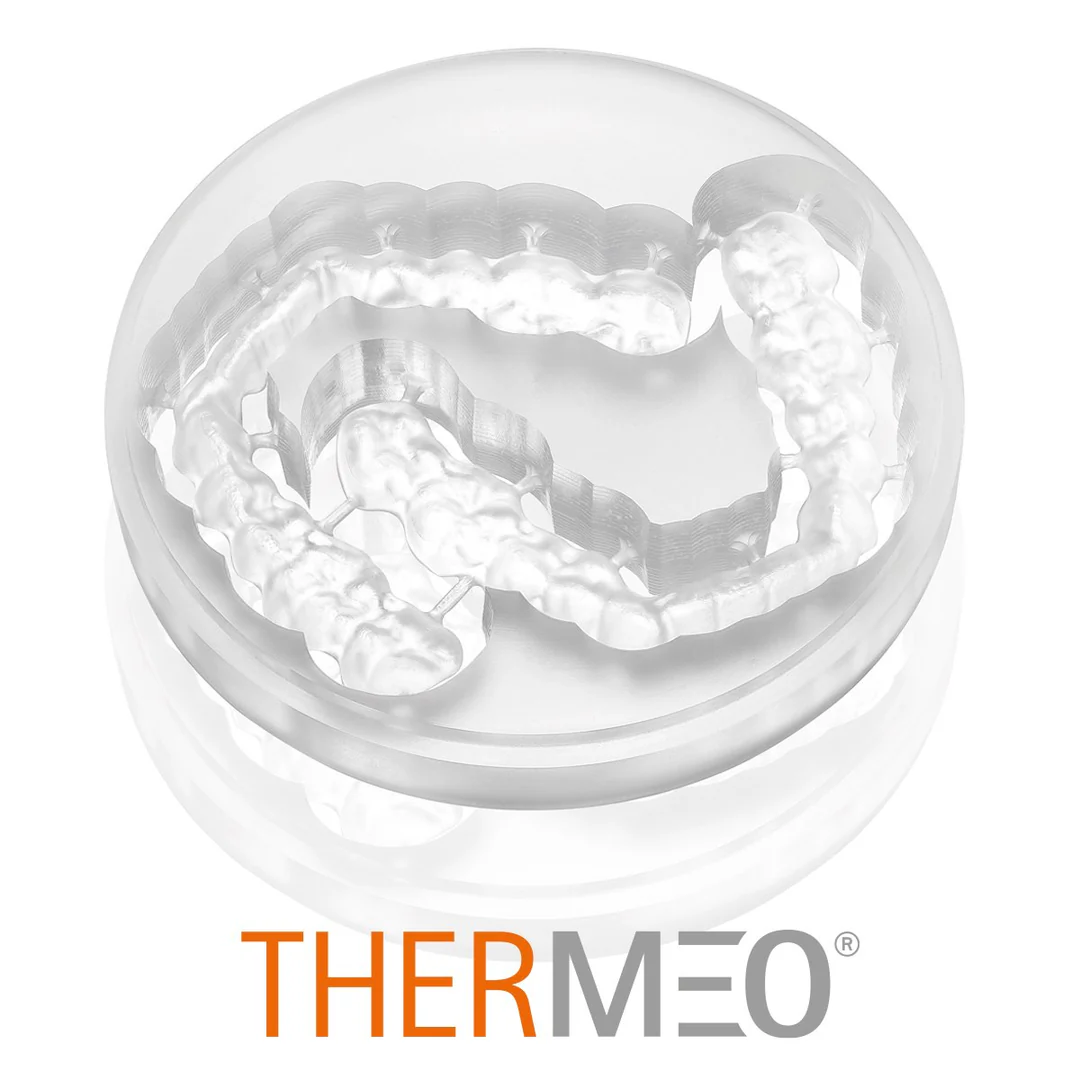
- Digital Workflow: An increasingly preferred method. Thermeo blanks are available in thicknesses of 16 mm, 20 mm, and 25 mm for CAD/CAM milling machines. This allows for the fabrication of both tooth-supported and soft tissue-supported splints.
Comparative Performance and Durability
The material’s durability has been evaluated through chewing simulation studies.
- Flexibility & Resilience: Research indicates that Thermeo exhibits higher flexibility and resilience compared to its competitors.
- Abrasion Resistance: Despite this increased flexibility, it maintains comparable abrasion values to harder, more brittle materials.
This is a critical data point for technicians. It suggests that the thermomemory effect does not come at the cost of clinical longevity. The material is designed to withstand the forces of bruxism while preserving its structural integrity over time.
A Material Free from Common Irritants
Biocompatibility is a primary concern for any material placed in the oral cavity.
Formulation Advantages:
- No Methyl Methacrylate (MMA): Avoiding MMA is a significant factor in reducing the potential for patient sensitivity and irritation.
- No Phthalate-based Plasticizers: Formulated completely without phthalates.
- No Amine Compounds: The exclusion of amine compounds helps minimize material yellowing over time.
This stability in color and composition is essential for maintaining a professional appearance and long-term patient satisfaction.
Expanding the Clinical Applications
Thermeo is specifically indicated for the fabrication of dental appliances. These include:
- Bruxism splints
- TMJ splints
- Bite splints
- Mouthguards
The technology behind Thermeo is suitable for both high-stress therapeutic devices and comfort-oriented applications. The key is the material’s ability to adjust to body temperature. This feature makes it particularly useful for patients with difficult jaw relationships or challenging occlusal schemes.
Securing the Restoration
The success of any splint depends on a reliable seating mechanism. This is where the secondary keyword becomes relevant. Unigrip provides an additional layer of security for the appliance.
When the material’s thermomemory effect is paired with a secure retention system, the result is a predictable outcome. The combination of the smart material and a sound retention system reduces the risk of dislodgement. This is especially important for patients who wear appliances during sleep or for extended periods.
Practical Use Cases and Lab Benefits
Technicians are constantly evaluating materials based on practical outcomes. Using Thermeo offers several distinct advantages in the daily lab workflow:
- Reduced Chair Time and Adjustments: The self-adjusting nature of the material means the splint fits better on the first try. This directly translates to fewer patient recalls and adjustments.
- Simplified Digital Integration: For labs using milling technology, Thermeo blanks are easy to process. They are available in standard sizes that integrate with existing CAM software.
- Cost-Effective Production: While a premium material, the reduction in remakes and adjustments makes Thermeo cost-effective. It minimizes the need for expensive rework.
- Versatile Application: From nightguards to complex TMJ splints, Thermeo covers a wide range of indications. This reduces the need for multiple material inventories.
- Compatibility with Existing Tools: Thermeo does not require specialized adhesives or primers. It can be processed with standard lab equipment. This is a key factor for labs looking to adopt the material without significant capital investment.
Workflow Considerations for Thermeo
Thermeo is processed using a heat-cured method. This is a critical aspect of the workflow. The curing cycle must be followed precisely to activate the thermomemory properties. The material is also compatible with conventional polishing and finishing techniques.
For milling, the blanks are designed for use with standard dental milling machines. The material’s mechanical properties are determined through rigorous bench testing. Performance testing is conducted per ISO 20795-2, evaluating flexural modulus, flexural strength, and tensile strength.
The Importance of a Secure Fit
Retention is a subject that often determines the success or failure of an appliance. A splint that moves or feels loose will be rejected by the patient.
This is where Unigrip provides a measurable benefit. The secondary keyword represents a system or component that delivers a secure and stable fit. When the fit is secure, the material can function as designed. The combination of Thermeo’s flexibility and Unigrip’s secure base creates a stable and predictable result for the clinician.
Conclusion
The choice of materials defines the lab’s reputation. Moving away from brittle, unforgiving polymers to a material that adapts to clinical imperfections is a logical step. The data supports this shift, especially when sourced from reputable suppliers.
Working with established distributors ensures you are getting authentic materials with valid lot numbers and traceability. This is a standard practice for labs that prioritize quality control. Much like professionals who work with Gro3X, choosing a reliable source for materials like Thermeo is part of a sound operational strategy. The goal is to produce durable, comfortable, and clinically effective appliances. Thermeo offers the engineering to meet that goal without compromising on safety or predictability.
Frequently Asked Questions (FAQs)
How does Thermeo differ from traditional PMMA splint materials?
Thermeo exhibits a patented thermomemory effect, becoming flexible at body temperature to compensate for impression inaccuracies, which traditional PMMA lacks.
What are the FDA indications for Thermeo?
The FDA has cleared Thermeo for the fabrication of mouthguards, bruxism splints, TMJ splints, and bite splints using conventional or CAD/CAM methods.
Does Thermeo require specialized milling tools?
The material can be processed using standard dental CAD/CAM milling machines designed for polymer blanks without needing specialized cutters.
Can Thermeo be used for appliances other than nightguards?
Yes, the material is cleared for a variety of applications, including TMJ splints, mouthguards, and bite splints.
Is the material safe for patients with allergies?
Thermeo is formulated without MMA and phthalates, significantly reducing the risk of allergic reactions compared to some traditional plasticizers.