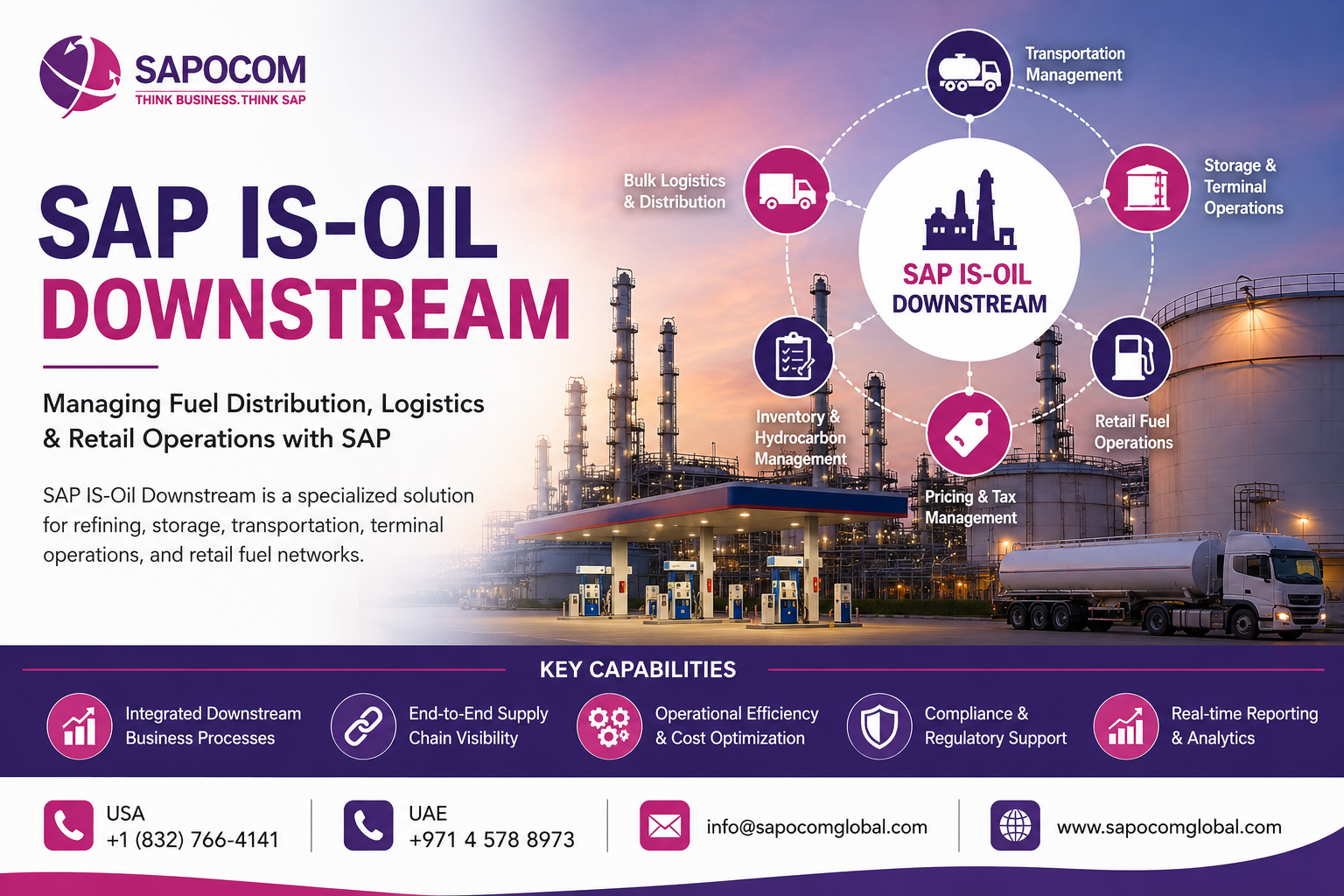
SAP IS-Oil Downstream is an industry-specific SAP solution designed for oil and gas companies that manage refining, storage, transportation, fuel distribution, and retail service station operations. It extends standard SAP ERP functionality with specialized processes for hydrocarbon products, bulk logistics, terminal management, fuel pricing, and petroleum supply chain operations.
The solution is commonly used by refineries, oil marketing companies, fuel distributors, pipeline operators, and energy businesses that need greater visibility across their downstream supply chain.
Understanding the Downstream Segment of the Oil Industry
The oil and gas value chain is typically divided into three segments:
- Upstream – exploration and production
- Midstream – transportation and storage
- Downstream – refining, distribution, and retail sales
The downstream segment begins after crude oil has been processed into finished products such as gasoline, diesel, aviation fuel, lubricants, and petrochemicals.
These products must then move through a complex network of terminals, depots, pipelines, trucks, rail systems, and retail stations before reaching customers.
Managing these operations manually or through disconnected software systems can create inventory inaccuracies, transportation delays, and compliance challenges. SAP IS-Oil Downstream was developed to address these industry-specific requirements.

What Does SAP IS-Oil Downstream Do?
SAP IS-Oil Downstream helps energy companies manage the movement of petroleum products from refineries to storage facilities, distributors, commercial customers, and retail fuel stations.
The platform integrates operational and financial processes across:
- Fuel distribution
- Transportation scheduling
- Inventory management
- Retail operations
- Product pricing
- Tax calculations
- Terminal management
- Logistics planning
Because these activities are connected to core SAP modules, organizations can maintain a single source of operational and financial data.

Key Components of SAP IS-Oil Downstream
Hydrocarbon Product Management (HPM)
Hydrocarbon products behave differently from standard inventory items because volume can change depending on temperature, density, and pressure conditions.
Hydrocarbon Product Management supports:
- Quantity conversion
- Temperature correction
- Density calculations
- Inventory reconciliation
- Product measurement accuracy
These calculations are important for maintaining inventory accuracy and regulatory compliance.
Trader and Scheduler Workbench (TSW)
Trader and Scheduler Workbench, commonly known as SAP TSW, supports bulk commodity transportation and logistics management.
Organizations use TSW to manage:
- Product nominations
- Shipment scheduling
- Transportation planning
- Pipeline logistics
- Marine transportation
- Rail distribution
TSW is particularly valuable for businesses moving large fuel volumes across multiple locations.
Secondary Distribution Management (SDM)
Secondary Distribution Management focuses on fuel distribution from depots to retail service stations and commercial customers.
Capabilities include:
- Fuel order processing
- Delivery scheduling
- Route planning
- Depot inventory management
- Retail replenishment
- Transportation monitoring
Oil marketing companies often use SDM to maintain fuel availability across large retail networks.
Service Station Retailing
Many downstream organizations operate extensive fuel station networks.
SAP downstream supports retail operations through:
- Fuel sales integration
- Retail inventory tracking
- Pricing management
- Loyalty program support
- Financial reporting
This creates visibility between retail operations and enterprise ERP processes.

Why Oil and Gas Companies Use SAP IS-Oil Downstream
The petroleum industry operates under strict operational and regulatory requirements. Standard ERP systems often require extensive customization to support downstream processes.
SAP IS-Oil Downstream provides industry-specific functionality that helps companies:
- Improve inventory visibility
- Reduce logistics inefficiencies
- Monitor fuel movements
- Support compliance reporting
- Manage complex transportation networks
- Connect operational and financial processes
The solution is particularly useful for organizations operating across multiple depots, terminals, and retail locations.
Industries That Use SAP IS-Oil Downstream
Although primarily associated with oil and gas companies, the platform is also used by:
- Refinery operators
- Fuel distributors
- Pipeline companies
- Aviation fuel suppliers
- Petrochemical businesses
- Energy trading companies
- Oil marketing organizations
Businesses handling bulk liquid products often require similar logistics and inventory management capabilities.
SAP IS-Oil Downstream and SAP S/4HANA
Many organizations are currently modernizing legacy ERP environments through SAP S/4HANA migration projects.
SAP continues to support downstream industry processes through:
- Advanced analytics
- Real-time reporting
- Commodity management integration
- Transportation management
- Supply chain visibility
- Cloud deployment options
As companies migrate to SAP S/4HANA, downstream operations remain an important part of digital transformation strategies in the energy sector.
Common Challenges in Downstream Operations
Downstream supply chains are complex because products move through multiple stages before reaching customers.
Common challenges include:
- Inventory discrepancies
- Transportation delays
- Pricing complexity
- Tax compliance requirements
- Demand forecasting issues
- Depot stock balancing
- Retail replenishment planning
SAP IS-Oil Downstream helps organizations address these challenges through integrated operational workflows and centralized reporting.
Final Thoughts
SAP IS-Oil Downstream is a specialized ERP solution built for the operational realities of the petroleum industry. It supports refining, transportation, storage, fuel distribution, and retail operations within a single SAP environment.
For organizations managing large fuel networks, terminals, depots, and transportation assets, the platform provides industry-specific tools that are difficult to achieve through standard ERP systems alone. As energy companies continue investing in SAP S/4HANA and digital supply chain initiatives, SAP IS-Oil Downstream remains an important component of enterprise operations across the global oil and gas sector.