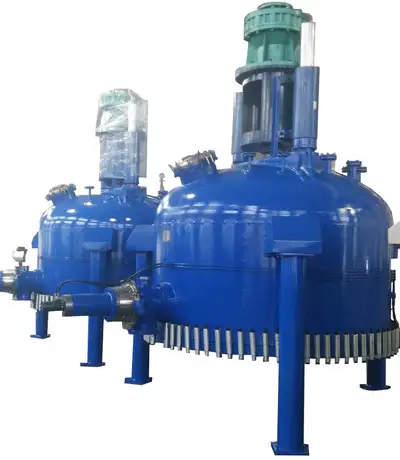
Solid-liquid separation challenges appear across a remarkably wide range of industries, each with its own specific requirements around purity, throughput, material handling, and regulatory compliance that need to be addressed through appropriately designed processing equipment. An agitated nutsche filter has proven adaptable enough to serve effectively across this diverse range of industrial applications, which explains why it has become such a widely adopted piece of process equipment across so many different manufacturing sectors.
Pharmaceutical and Biotechnology Applications
Pharmaceutical manufacturing represents one of the largest and most demanding application areas for this equipment, given the industry’s strict regulatory requirements around contamination control, batch consistency, and worker safety when handling potent or hazardous active pharmaceutical ingredients throughout the manufacturing process. Biotechnology applications have similarly adopted this equipment for processing biological intermediates and purified products that require careful handling to preserve product stability and activity throughout filtration, washing, and drying operations. Both sectors benefit significantly from the equipment’s closed, controllable processing environment, which supports the rigorous documentation and validation requirements that regulatory approval for pharmaceutical and biotechnology products typically demands from manufacturers.
Fine and Specialty Chemical Manufacturing
Fine and specialty chemical producers rely heavily on this equipment for processing high-value, often complex chemical products that require precise control over crystal structure, particle size, and purity to meet demanding customer specifications across various end-use applications. Learn how an agitated nutsche filter supports the flexible, multi-product nature typical of fine chemical manufacturing, where facilities often need to switch between different products on a regular schedule while maintaining strict cleanliness standards to prevent cross-contamination between different production campaigns. This flexibility, combined with the equipment’s ability to handle a wide range of material characteristics, has made it a standard choice across fine and specialty chemical production facilities of many different sizes and specializations.
Agrochemical and Pesticide Production
Agrochemical manufacturing involves handling materials that often require careful containment due to their toxicity, along with precise formulation control to ensure consistent product performance across the large batch volumes typical of agricultural chemical production. This equipment supports both these requirements simultaneously, providing the containment necessary for safe handling of potentially hazardous agrochemical intermediates while also delivering the process control needed to maintain consistent product quality across large-scale production runs. The combination of safety and process control has made this equipment a common choice throughout agrochemical manufacturing facilities, particularly for producers dealing with active ingredients that require careful handling throughout the entire production sequence from initial synthesis through final formulation.
Dye, Pigment, and Coloring Agent Manufacturing
Dye and pigment manufacturing depends heavily on achieving consistent color properties and particle characteristics, both of which are directly influenced by how carefully the product is filtered, washed, and dried during the finishing stages of production before the final product ships to customers. This equipment’s gentle, controllable processing approach helps preserve the specific particle characteristics that determine color strength, dispersion properties, and overall product performance, supporting the consistent quality that dye and pigment customers expect from their suppliers batch after batch. The equipment’s washing capability also proves particularly valuable in this application, since thorough removal of reaction byproducts and impurities directly affects the color purity and brightness of the finished dye or pigment product.
Food, Nutraceutical, and Specialty Ingredient Processing
Food-grade and nutraceutical applications have increasingly adopted this equipment for processing sensitive ingredients that require careful handling to preserve nutritional value, flavor characteristics, or other quality attributes throughout the filtration, washing, and drying sequence. The gentle processing capability and precise temperature control available with modern equipment designs help preserve heat-sensitive nutrients and bioactive compounds that could otherwise degrade under more aggressive processing conditions typical of older, less controllable drying methods. This application area continues to grow as consumer demand for high-quality nutraceutical and specialty food ingredients increases, driving manufacturers toward processing equipment capable of preserving product quality throughout every stage of the finishing process from raw material through to finished packaged product. Across all these industries, the common thread remains the same: manufacturers need equipment they can trust to deliver consistent, high-quality separation results batch after batch, and this technology has repeatedly proven capable of meeting that expectation across an unusually broad range of demanding industrial applications.