
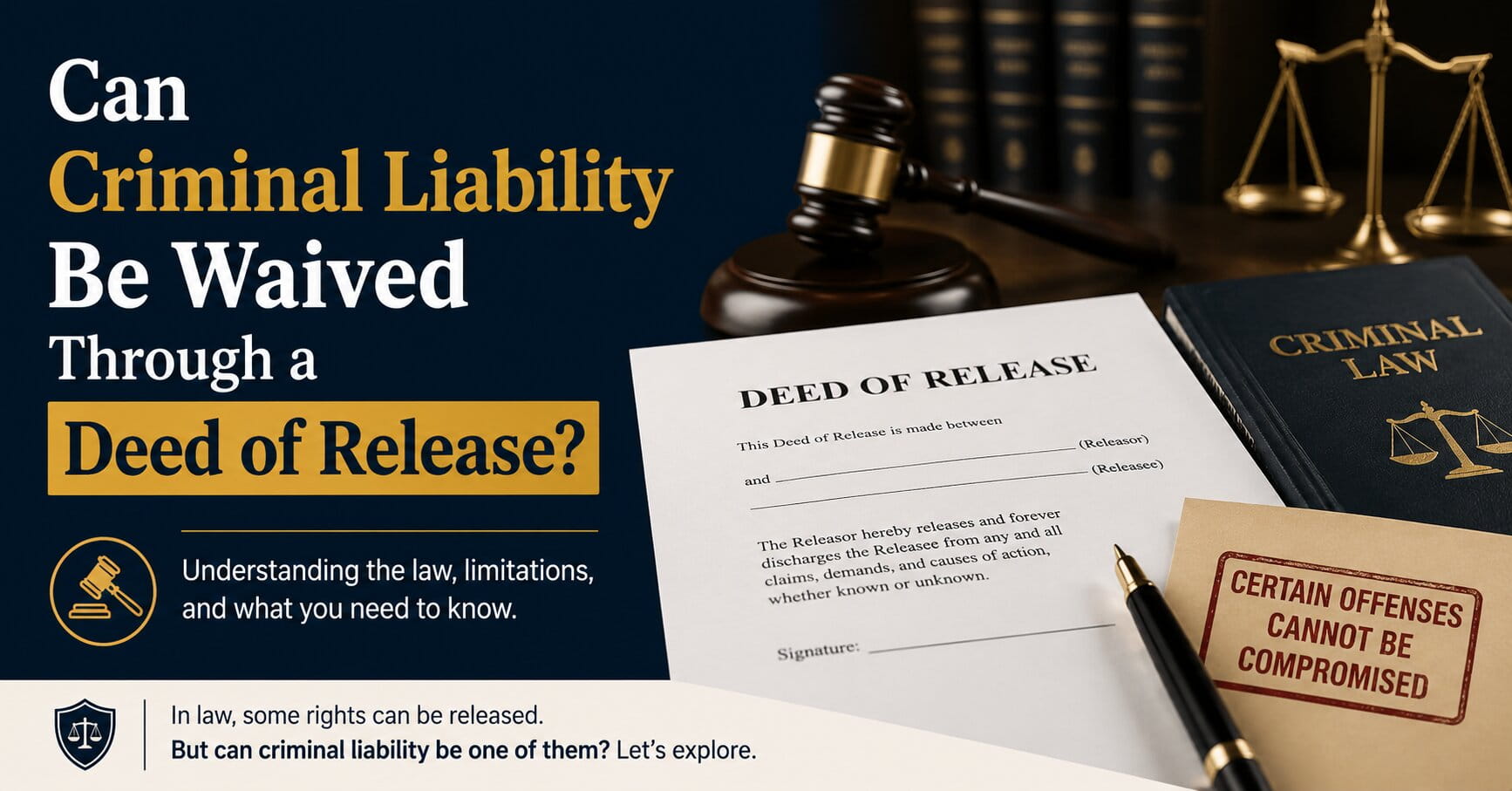
A deed of release is commonly used to settle disputes and prevent future legal claims between parties. In commercial, employment, and civil matters, these agreements can bring certainty and finality by ensuring one party agrees not to pursue further action against another. However, when it comes to criminal liability, the legal position is very different. A deed of release cannot generally waive or eliminate criminal responsibility.
Understanding a Deed of Release
A deed of release is a legally binding document in which one party agrees to release another from specified legal claims, obligations, or liabilities. These agreements are frequently used in:
- Employment disputes
- Commercial settlements
- Partnership dissolutions
- Personal injury claims
- Contract disputes
The purpose of the deed is to resolve private disputes without ongoing litigation. In many cases, the parties agree to compensation or other terms in exchange for the release of future claims.
While a deed of release can prevent civil proceedings, its effectiveness does not extend to criminal offences.
The Difference Between Civil and Criminal Liability
To understand why criminal liability cannot usually be waived, it is important to distinguish between civil and criminal law.
Civil law deals with disputes between private parties. These cases generally involve compensation, damages, or enforcement of rights. Because the dispute is private in nature, parties are often free to negotiate and settle the matter through contracts or deeds of release.
Criminal law, however, concerns conduct considered harmful to society as a whole. Criminal offences are prosecuted by the state, not by private individuals. Even where a victim wishes to forgive the accused or discontinue the matter, the prosecution authority may still proceed with charges if it believes doing so is in the public interest.
As a result, a private agreement cannot override the authority of the courts or prosecuting agencies.
Why Criminal Liability Cannot Be Contracted Away
A deed of release is fundamentally a private contractual arrangement. Criminal liability, on the other hand, arises under statute and public law. Because criminal offences affect the broader community, individuals cannot privately agree to excuse conduct that may amount to a crime.
For example, a person cannot rely on a deed of release to avoid prosecution for offences such as:
- Fraud
- Assault
- Theft
- Bribery
- Corporate misconduct
- Serious workplace safety breaches
Even if the alleged victim signs a release and accepts compensation, law enforcement agencies may still investigate and prosecute the matter.
Courts generally view attempts to exclude criminal responsibility through private agreements as contrary to public policy. Allowing parties to “buy their way out” of criminal accountability would undermine the administration of justice and public confidence in the legal system.
Can a Deed of Release Still Be Relevant in Criminal Matters?
Although a deed of release cannot extinguish criminal liability, it may still have some practical significance in related proceedings.
1. Settlement of Civil Claims
A victim may agree to settle civil claims arising from the same conduct. For instance, in a fraud matter, the parties may resolve financial disputes through repayment arrangements while criminal investigations continue separately.
2. Sentencing Considerations
In some jurisdictions, restitution, compensation, or reconciliation between parties may be considered by a court during sentencing. Demonstrating remorse and compensating the victim may influence the severity of penalties, although it does not remove criminal responsibility.
3. Withdrawal of Complaints in Limited Cases
Certain minor offences may depend heavily on the cooperation of the complainant. If a complainant no longer wishes to proceed after signing a settlement agreement, prosecutors may decide not to continue the case. However, this remains entirely at the discretion of the prosecuting authority and is not guaranteed by the deed itself.
Key Takeaways
A deed of release can be an effective tool for resolving civil disputes, but it cannot generally waive criminal liability. Criminal offences are matters of public law, and prosecution decisions ultimately rest with the state rather than private individuals.
Businesses and individuals should therefore exercise caution when drafting settlement agreements involving potentially unlawful conduct. Attempting to use a deed of release to shield criminal behaviour is unlikely to succeed and may even attract further legal scrutiny.
Seeking practical legal guidance from deed of release lawyers Perth before entering into any settlement involving allegations of misconduct is essential to ensure the agreement is enforceable and does not create unintended legal consequences.