
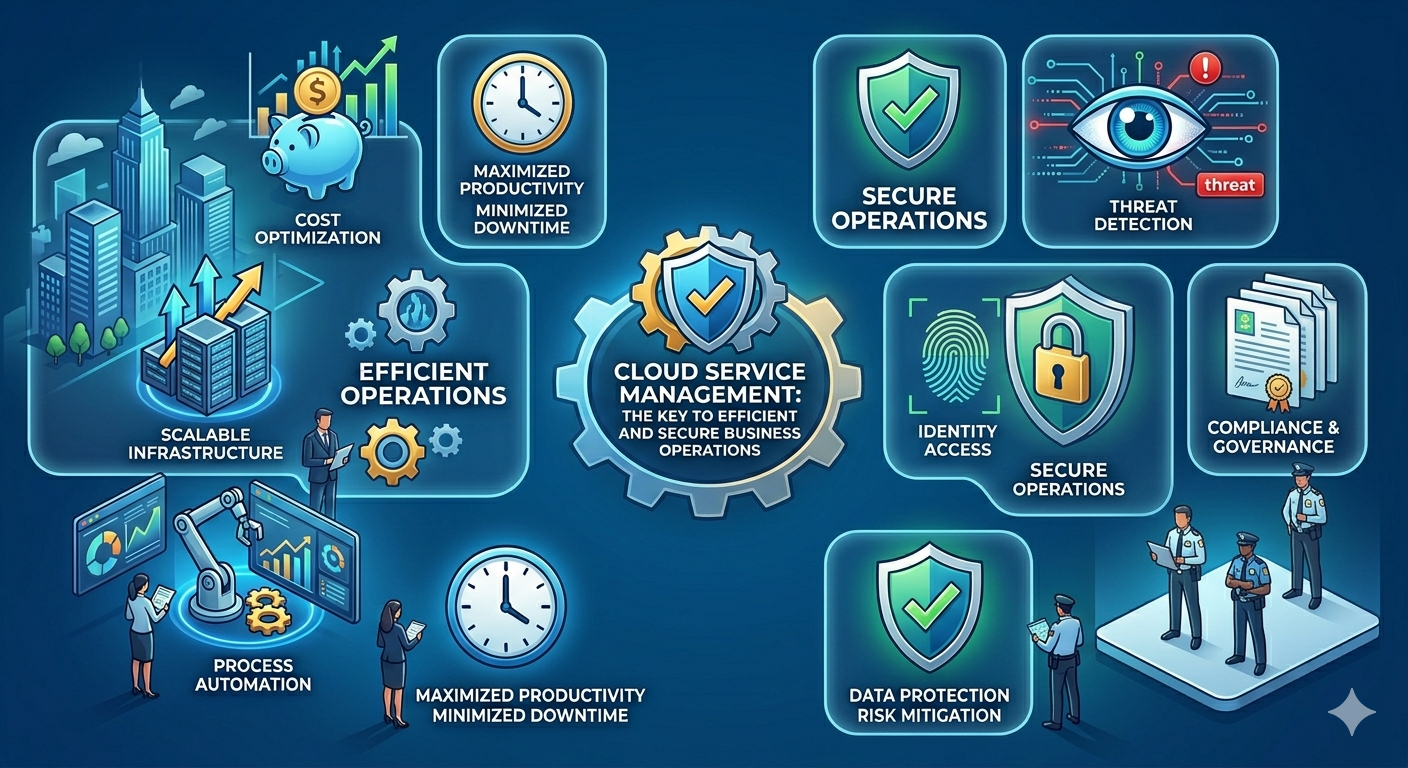
Businesses are rapidly adopting cloud technologies to improve flexibility, scalability, and efficiency. However, effective cloud management is essential for security, performance, and cost control. Cloud Service Management helps organizations monitor, optimize, and secure their cloud infrastructure, ensuring smooth operations, reduced downtime, and better business growth in today’s fast-evolving digital landscape.
What Is Cloud Service Management?
Cloud Service Management involves monitoring, optimizing, and maintaining cloud infrastructure and services to ensure smooth business operations. It includes managing applications, security, storage, performance, and resource allocation across multiple cloud platforms. As businesses adopt remote work and digital transformation, cloud management helps improve scalability, security, and operational efficiency. It provides centralized control, enabling IT teams to monitor systems, reduce downtime, and optimize costs effectively. Cloud service management also enhances collaboration between departments by offering real-time insights into cloud usage and performance. With automation and governance, it supports business growth while ensuring compliance, reliability, and seamless cloud operations.
Importance of Cloud Service Management
As businesses rely more on cloud technology, efficient cloud management has become crucial for maintaining security, performance, and cost control. Without proper management, organizations may face cyber threats, operational disruptions, and unnecessary expenses. Cloud service management helps businesses organize and optimize their cloud environments while ensuring smooth operations across multiple platforms.
Modern IT infrastructures are often complex, especially in hybrid and multi-cloud environments where applications and data are spread across different systems. Cloud service management provides centralized monitoring and control, simplifying operations and improving efficiency. It also helps businesses manage cloud spending by identifying unused resources and optimizing workloads to reduce costs.
Security is another key advantage, as cloud service management includes threat detection, compliance monitoring, and access control to protect sensitive data. Along with improving security and efficiency, it enhances business agility by enabling faster deployment of applications, better service delivery, and greater flexibility in responding to changing market demands.
Key Components of Cloud Service Management
Cloud service management involves several critical components that work together to maintain efficient cloud operations. Each component addresses specific operational and business needs, ensuring organizations can maximize the value of their cloud investments.
Cloud Monitoring and Performance Tracking
Continuous monitoring is one of the most important aspects of cloud management. Businesses need real-time visibility into server performance, application health, network activity, and resource utilization. Monitoring tools help detect performance bottlenecks before they affect users or business operations. For example, if an application experiences increased traffic, monitoring systems can identify the issue early and trigger automatic scaling to maintain performance.
Performance tracking also improves user experience. Slow applications, downtime, and connectivity issues can negatively impact customer satisfaction and productivity. By analyzing system performance data, organizations can optimize infrastructure and improve reliability. Monitoring tools also generate reports that help IT teams make informed decisions regarding upgrades, maintenance, and capacity planning.
Security and Compliance Management
Cloud security management focuses on protecting digital assets, applications, and sensitive information from cyber threats. It includes identity management, encryption, firewall configuration, threat detection, and compliance monitoring. Businesses handling customer information or financial data must follow strict regulatory requirements, making compliance management a critical part of cloud operations.
Security management tools help organizations identify vulnerabilities and respond quickly to potential threats. Automated alerts, access controls, and security audits improve overall protection while reducing the risk of data breaches. Strong cloud security practices build customer trust and ensure business continuity.
Cost Optimization and Resource Allocation
One of the biggest advantages of cloud computing is flexibility, but without proper management, costs can spiral out of control. Cost optimization involves analyzing resource usage and eliminating unnecessary expenses. Businesses can identify underutilized resources, automate workload distribution, and optimize storage allocation to reduce costs.
Resource allocation also ensures applications receive the computing power they need without wasting infrastructure capacity. Efficient allocation improves performance while maintaining budget control. Organizations that actively optimize cloud resources often achieve better operational efficiency and higher returns on investment.
Benefits of Cloud Service Management
Cloud service management offers businesses improved scalability, security, productivity, and business continuity. It allows organizations to quickly scale resources based on demand without affecting performance. Advanced security features like automated updates and threat detection help protect sensitive data from cyber threats. Employees can work efficiently from anywhere through seamless access to cloud applications and data. Automated workflows also reduce manual tasks and improve operational efficiency. Additionally, disaster recovery solutions and automated backups minimize downtime and ensure smooth business operations during unexpected disruptions or emergencies.
Challenges in Cloud Service Management
Despite its advantages, cloud service management comes with several challenges. One common issue is managing multi-cloud environments. Businesses often use services from multiple providers, creating integration and compatibility challenges. Different platforms may have varying security policies, interfaces, and management tools, making operations more complex.
Data security concerns also remain a major challenge. Although cloud providers invest heavily in security, businesses must still implement proper access controls and monitoring systems. Human error, weak passwords, and misconfigured systems can create vulnerabilities that attackers may exploit.
Another challenge is maintaining visibility across distributed cloud environments. Organizations need accurate insights into resource usage, costs, and performance metrics. Without proper monitoring tools, identifying issues and optimizing operations becomes difficult.
Skill gaps within IT teams can also slow cloud management efforts. Advanced cloud technologies require specialized knowledge in automation, cybersecurity, networking, and infrastructure management. Businesses often need ongoing training and support to manage cloud systems effectively.
Best Practices for Effective Cloud Service Management
Businesses can optimize cloud operations through automation, continuous monitoring, strong governance, and regular cost reviews. Automating updates and backups improves efficiency, while monitoring tools detect issues early. Clear security policies and employee training reduce risks. Reviewing cloud usage regularly helps control expenses and ensures cloud investments support long-term business objectives effectively.
Future Trends in Cloud Service Management
The future of cloud service management focuses on AI, automation, hybrid cloud strategies, edge computing, and sustainability. AI-driven tools improve efficiency through predictive analytics and automated optimization. Businesses are adopting multi-cloud environments for flexibility, while edge computing enhances performance. Sustainable cloud practices and energy-efficient infrastructure are also becoming essential for modern operations.
Conclusion
Cloud service management is essential for modern businesses to maintain security, performance, and cost efficiency. It simplifies complex cloud operations through automation, monitoring, and compliance management. As AI, hybrid cloud, and automation technologies advance, businesses adopting effective cloud management strategies can improve scalability, enhance productivity, and stay competitive in evolving digital environments.