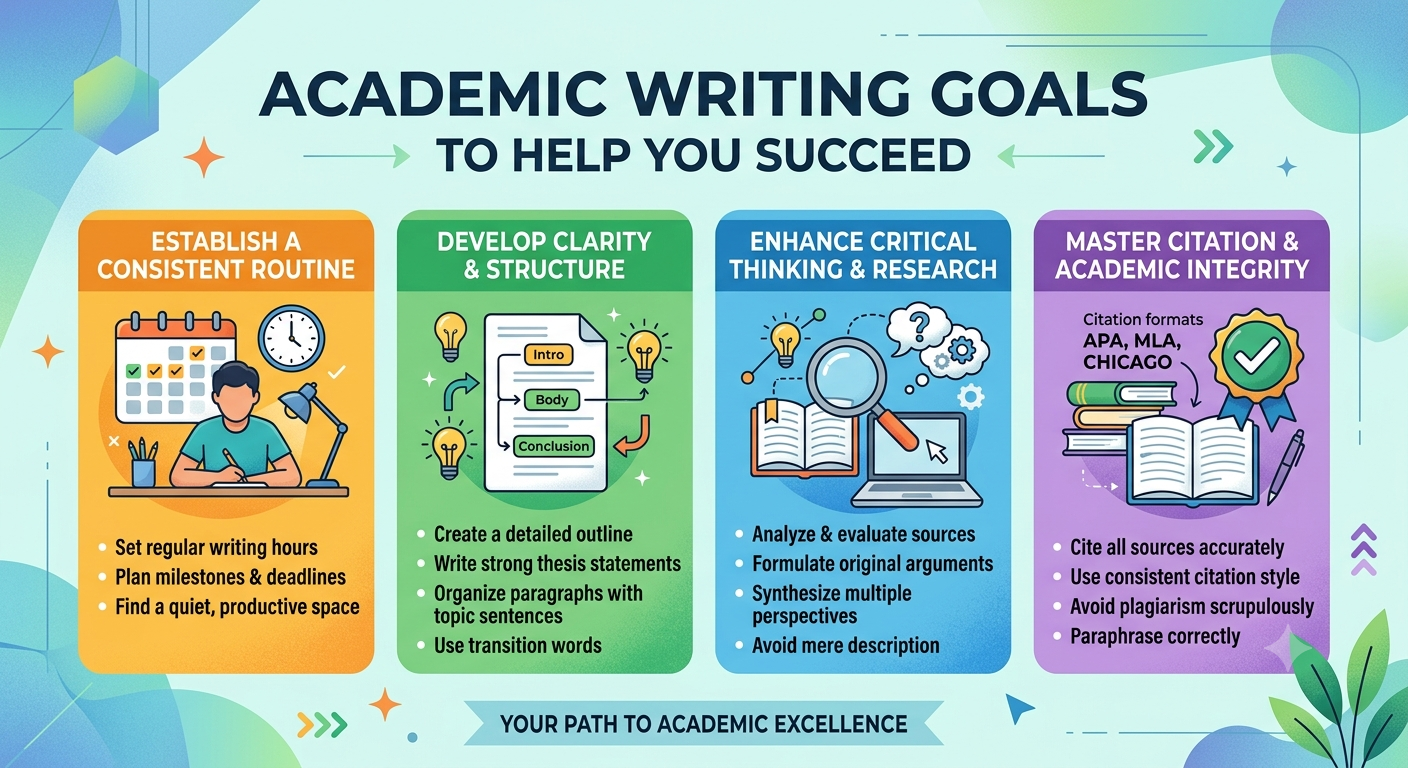
Setting goals is one of the most effective ways to improve your academic writing. Without clear targets, it is easy to drift without making real progress. Goals give direction, motivation, and a way to measure your growth. Whether you are writing your first college essay or preparing a complex dissertation, having a clear set of objectives can make a significant difference to your confidence and performance. This article explores practical writing goals that every student should consider, regardless of their subject or level of study.
Why Goal-Setting Matters in Academic Writing
Many students approach assignments without a plan. They sit down, open a blank document, and hope for the best. This approach often leads to rushed work, missed requirements, and disappointing grades. Goal-setting changes this pattern. It forces you to think about what you want to achieve before you start writing.
Goals also help break down large tasks into manageable steps. A 3,000-word essay can feel overwhelming until you realize it is simply a collection of introductions, body paragraphs, and conclusions. By setting smaller goals for each section, the overall task becomes much more achievable. This approach is useful for students at all levels, from those working on BTEC courses to those tackling advanced professional qualifications.
Goal 1: Understand the Question Before You Write
The most important goal before writing anything is to understand exactly what is being asked. Misreading the question is one of the most common reasons for losing marks. Students often assume they know what the brief means without carefully reading it.
Take time to break down the question. Identify the instruction words, such as “analyze,” “evaluate,” or “compare.” Each of these demands a different approach. If you are unsure what a word means, look it up. This simple habit can prevent you from going off-topic entirely.
In legal subjects, this is especially important. For example, students working with a contract law assignment service to refine their approach often find that understanding the precise legal issue in a scenario is the hardest part. Once the core legal problem is identified correctly, the structure of the answer becomes much clearer.
Goal 2: Develop a Clear Structure for Every Assignment
Structure is the skeleton of your writing. Without it, your ideas have no home, and your reader gets lost. A clear structure allows your reader to follow your argument from beginning to end without confusion.
Every academic piece should have three main parts: an introduction that sets the scene and states your main argument, a body that develops each point logically, and a conclusion that summarizes your findings without introducing new information.
Set a goal to create an outline before writing each assignment. Decide what each paragraph will cover and how it connects to the next. This takes only fifteen to twenty minutes but saves hours of reorganizing later.
Goal 3: Improve Clarity in Every Sentence
Clarity is the hallmark of good academic writing. The goal is not to impress with big words but to communicate your ideas as simply and directly as possible. If a reader has to re-read a sentence to understand it, something has gone wrong.
Work on eliminating unnecessary jargon and overly complex phrasing. Use shorter sentences when the idea is simple and save longer, more complex sentences for detailed explanations. Read your work aloud to identify sentences that feel awkward. If you stumble while reading, your reader will struggle too.
Students working toward vocational qualifications often find this challenging because they are still learning subject-specific terminology. Those using a BTEC assignment service in the UK as a reference point can observe how experienced writers balance technical language with plain explanations. This balance is worth aiming for in all your work.
Goal 4: Master the Art of Critical Analysis
One of the biggest differences between school-level and university-level writing is the expectation of critical analysis. Simply describing a concept or summarizing a theory is not enough. Examiners want to see that you can evaluate, judge, and apply knowledge.
Set a goal to include critical thinking in every paragraph. Ask yourself questions like: What are the strengths and weaknesses of this argument? How does this theory apply to the real world? What evidence supports or contradicts this point?
In management and leadership subjects, this is particularly important. Students in advanced programs often look for support from an LSPM assignment writing service in the UK to understand the depth of analysis required at this level. Strong critical writing examines assumptions, weighs evidence, and draws reasoned conclusions.
Goal 5: Build Strong Research Habits
Research is the foundation of academic writing. Without credible evidence, your arguments lack substance. Set a goal to improve your research skills alongside your writing skills.
Learn to use academic databases, library resources, and official publications. Take organized notes, recording full bibliographic details from the start. This habit makes referencing far easier and prevents last-minute panic.
Equally important is the goal of evaluating sources critically. Not everything you find online is reliable. Check the author’s credentials, the publication date, and whether the source has been peer-reviewed. Strong research leads to strong writing.
Goal 6: Learn to Reference Correctly
Referencing is not just an academic formality; it is a core writing skill. Incorrect referencing can lead to plagiarism, which has serious academic consequences. Set a goal to learn the referencing style required by your course and apply it consistently.
Different subjects use different styles. Law assignments typically use OSCOLA, while business courses often use Harvard referencing. Whatever style is required, make sure your in-text citations and bibliography are accurate and complete.
Build your reference list as you write, not after. Keep a dedicated document or tool for recording source details. This habit saves enormous time and stress as deadlines approach.
Goal 7: Edit and Proofread Every Draft
First drafts are rarely submission-ready. Set a goal to always leave time for editing and proofreading. These final steps are where good writing becomes great writing.
When editing, focus on structure and flow. Are your paragraphs organized logically? Does each one support your main argument? When proofreading, look for spelling mistakes, grammar errors, and punctuation issues.
Reading backwards, sentence by sentence, is a useful proofreading technique. It forces you to focus on individual words rather than getting lost in familiar content.
Goal 8: Manage Your Time Wisely
Time management is a writing skill that many students overlook. Poor time management leads to rushed work and lower grades. Set a goal to start assignments early and work through them in stages.
Break each assignment into phases: research, planning, drafting, editing, and proofreading. Allocate specific amounts of time to each phase and stick to your schedule. This approach prevents the all-night cramming session that rarely produces quality work.
Goal 9: Seek and Apply Feedback
Feedback is one of the most powerful tools for improvement. Set a goal to actively seek feedback from tutors, peers, or study groups. Listen carefully to their comments and identify patterns in their criticism.
If multiple people flag the same issue, it is worth addressing. Keep a personal record of feedback and review it before starting your next assignment. This habit ensures you are always learning and growing as a writer.
Goal 10: Practise Consistently
Finally, set a goal to write regularly. Writing is a skill that improves with practice. The more you write, the more natural it becomes. Even short, informal writing exercises can build fluency and confidence.
Read widely in your subject area to absorb different writing styles. Analyze what makes certain pieces effective and try to apply those techniques in your own work.
Conclusion
Improving academic writing takes time, effort, and clear goals. By setting specific, achievable targets for understanding questions, structuring work, writing clearly, analyzing critically, researching thoroughly, referencing correctly, editing carefully, managing time, seeking feedback, and practicing consistently, you give yourself the best possible chance of success. Whether you are working on legal contracts, vocational BTEC projects, or advanced management strategies, these goals apply across all subjects and qualification levels. Start with one or two goals today and build from there. With patience and persistence, your writing will grow stronger, clearer, and more compelling with every assignment you complete.