Few names are as closely associated with genius as Albert Einstein. His groundbreaking discoveries transformed physics, inspired generations of scientists, and changed the way we understand the universe. Because of his remarkable achievements, people often wonder about einstein’s iq. Was it officially measured? Did he really have an IQ of 160? Or are those numbers simply myths that have spread across the internet?
The truth is both interesting and surprising. There is no verified record showing that Albert Einstein ever took a modern IQ test. The scores commonly attributed to him are estimates rather than documented facts. Even without an official IQ score, Einstein’s work clearly demonstrates an extraordinary level of intelligence, creativity, and scientific insight that few people have ever matched.
In this article, we will examine the facts behind einstein’s iq, explain where the popular estimates came from, compare his intelligence with other famous geniuses, and explore why his brilliance cannot be measured by a single number.
What Was Einstein’s IQ?
The most accurate answer is that no one knows Einstein’s actual IQ.
Albert Einstein never completed a standardized intelligence test that produced an official IQ score. Modern IQ testing was still developing during much of his lifetime, and there are no historical documents confirming that he participated in any recognized assessment.
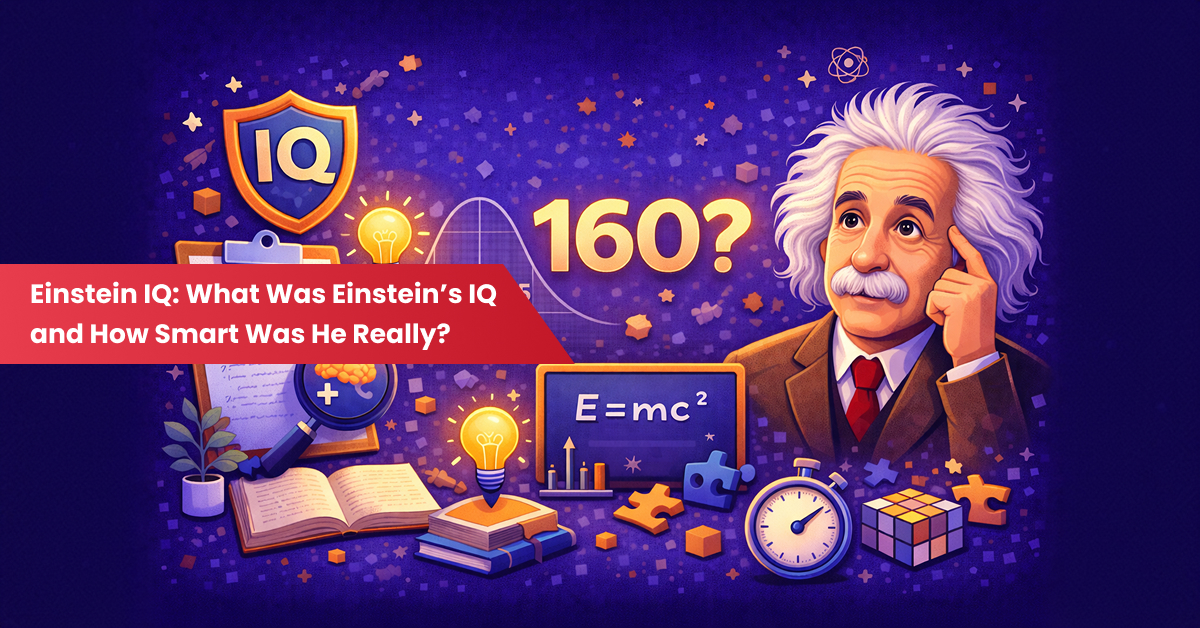
Despite this lack of evidence, many experts estimate einstein’s iq to have been around 160. This estimate is based on his revolutionary scientific achievements, exceptional reasoning abilities, mathematical talent, and remarkable creativity rather than on any official examination.
Although the estimate of 160 is widely accepted, it should always be viewed as an educated guess instead of a confirmed historical fact.
Why Is Einstein’s IQ Often Estimated at 160?
The number 160 appears frequently whenever people discuss einstein’s iq because it represents an exceptionally rare level of intellectual ability.
An IQ of 160 would place someone among the world’s most gifted individuals. People in this range typically demonstrate advanced reasoning, exceptional learning ability, and extraordinary problem solving skills.
Einstein displayed these qualities throughout his scientific career.
In 1905 alone, he published four groundbreaking scientific papers that transformed physics. His discoveries fundamentally changed humanity’s understanding of light, energy, motion, and matter.
Because these achievements required exceptional intellectual ability, many historians and psychologists consider an estimate of 160 to be reasonable.
However, there is no documented evidence proving this exact number.
Why There Is No Official Record
Many people mistakenly believe einstein’s iq was officially tested and recorded.
This is not true.
Although intelligence tests existed during the early twentieth century, they were not widely administered to established scientists. Modern standardized IQ assessments had not yet become common practice.
Since Einstein never completed one of these tests, no verified IQ score exists.
As a result, every published figure associated with Einstein’s intelligence should be considered speculative.
Understanding What IQ Measures
To better understand discussions about einstein’s iq, it helps to know what IQ tests are designed to evaluate.
IQ stands for Intelligence Quotient.
Modern IQ tests measure several cognitive abilities, including:
- Logical reasoning
- Pattern recognition
- Mathematical thinking
- Verbal comprehension
- Working memory
- Processing speed
- Spatial reasoning
- Analytical problem solving
The average IQ score is 100.
Typical score ranges include:
- 85 to 115: Average
- 115 to 130: Above average
- 130 to 145: Gifted
- Above 145: Highly gifted
- Around 160 or higher: Exceptionally rare
If Einstein’s estimated IQ truly fell near 160, he would belong to one of the highest levels of measured intellectual ability.
Einstein’s Greatest Scientific Achievements
Whether or not we ever know einstein’s iq, his accomplishments clearly demonstrate extraordinary brilliance.
The Special Theory of Relativity
Published in 1905, the Special Theory of Relativity introduced revolutionary ideas about space, time, and motion.
It also produced the famous equation:
E = mc²
This equation established the relationship between mass and energy and became one of the most recognized formulas in scientific history.
The General Theory of Relativity
In 1915, Einstein expanded his ideas into the General Theory of Relativity.
This theory explained gravity as the curvature of spacetime rather than simply a force between objects.
The theory has been repeatedly confirmed through scientific observations and remains one of the foundations of modern physics.
The Photoelectric Effect
Einstein also explained how light behaves as discrete packets of energy called photons.
This work earned him the 1921 Nobel Prize in Physics and helped establish the foundations of quantum mechanics.
These achievements explain why discussions about einstein’s iq continue more than a century later.
The Role of Creativity in Einstein’s Intelligence
One reason einstein’s iq remains so fascinating is that Einstein’s brilliance extended beyond traditional analytical thinking.
He possessed exceptional creativity.
Rather than relying only on mathematical calculations, Einstein often used thought experiments.
He imagined scenarios involving beams of light, moving trains, and falling elevators to explore the laws of physics.
These mental exercises allowed him to visualize concepts that could not yet be tested experimentally.
His imagination became one of his greatest scientific tools.
Common Myths About Einstein’s IQ
Several misconceptions continue to circulate online regarding einstein’s iq.
Myth 1: Einstein Officially Scored 160
There is no verified historical record supporting this claim.
The number is simply an estimate.
Myth 2: Einstein Had an IQ Above 200
Some websites claim Einstein’s IQ exceeded 200.
No credible evidence supports these extremely high estimates.
Myth 3: Einstein Failed Mathematics
This myth has been repeated for decades.
Historical records show that Einstein excelled in mathematics from a young age and mastered advanced mathematical concepts well before attending university.
Myth 4: IQ Alone Made Einstein Successful
Even if Einstein possessed an exceptionally high IQ, intelligence alone cannot explain his achievements.
Curiosity, creativity, persistence, and independent thinking all contributed significantly to his success.
Comparing Einstein With Other Famous Geniuses
People often compare einstein’s iq with the reported IQ scores of other brilliant individuals.
Some commonly discussed figures include:
Stephen Hawking
Stephen Hawking is often estimated to have had an IQ around 160, although no official score has been confirmed.
Like Einstein, Hawking transformed theoretical physics through groundbreaking research.
Terence Tao
Terence Tao is considered one of the world’s greatest living mathematicians.
His childhood IQ reportedly exceeded 225, although testing methods differ significantly from historical estimates of Einstein’s intelligence.
Marilyn vos Savant
Marilyn vos Savant became internationally known after recording one of the highest reported IQ scores in modern testing.
Her reported score has often been cited around 228.
Christopher Hirata
Christopher Hirata demonstrated extraordinary scientific talent at a young age and reportedly achieved an exceptionally high IQ during childhood testing.
While these comparisons are interesting, they should be interpreted cautiously because different tests measure intelligence in different ways.
Why IQ Cannot Fully Measure Genius
The ongoing fascination with einstein’s iq highlights an important question.
Can a single number truly measure genius?
Most psychologists agree that the answer is no.
IQ tests measure valuable cognitive skills, but they cannot fully assess qualities such as:
- Creativity
- Curiosity
- Scientific insight
- Emotional intelligence
- Leadership
- Determination
- Originality
- Vision
Einstein excelled in many of these areas.
His ability to imagine entirely new ways of understanding the universe cannot be captured by a numerical score alone.
What Made Einstein Truly Exceptional?
Einstein’s success resulted from a unique combination of qualities.
Relentless Curiosity
He constantly questioned accepted scientific ideas.
Rather than accepting conventional explanations, he searched for deeper truths.
Independent Thinking
Einstein often challenged established beliefs.
His willingness to think differently led to revolutionary discoveries.
Persistence
Many of his greatest theories required years of refinement before publication.
His dedication allowed him to overcome difficult scientific challenges.
Lifelong Learning
Einstein remained intellectually curious throughout his life.
He continued exploring complex scientific questions long after becoming world famous.
Why People Still Search for Einstein’s IQ
The question of einstein’s iq remains popular because Einstein has become the universal symbol of intelligence.
People naturally want a numerical explanation for extraordinary genius.
Assigning an IQ score seems like an easy way to compare Einstein with other famous scientists and intellectuals.
However, this approach oversimplifies what made him remarkable.
His lasting influence came not only from intelligence but also from imagination, perseverance, originality, and a willingness to challenge conventional thinking.
Lessons We Can Learn From Einstein
Einstein’s life provides valuable lessons that remain relevant today.
First, curiosity often leads to the greatest discoveries.
Second, creativity is just as important as analytical ability.
Third, persistence frequently matters more than natural talent alone.
Finally, questioning assumptions can open the door to revolutionary ideas.
These qualities helped Einstein reshape modern science and continue to inspire researchers around the world.
Final Thoughts
The mystery surrounding einstein’s iq continues to capture public attention, but the historical evidence is clear. Albert Einstein never took a modern standardized IQ test, so no official score exists. The commonly cited estimate of around 160 is based on his extraordinary achievements rather than documented testing.
While discussions about IQ are fascinating, they should not overshadow what truly made Einstein exceptional. His revolutionary theories transformed physics, his imagination challenged established ideas, and his relentless curiosity expanded humanity’s understanding of the universe. These accomplishments cannot be fully represented by any numerical score.
Ultimately, Einstein’s legacy rests not on a hypothetical IQ but on the lasting impact of his ideas. His work continues to influence science, technology, and education around the world, reminding us that true genius is defined not only by intelligence but also by creativity, perseverance, and the courage to explore the unknown.