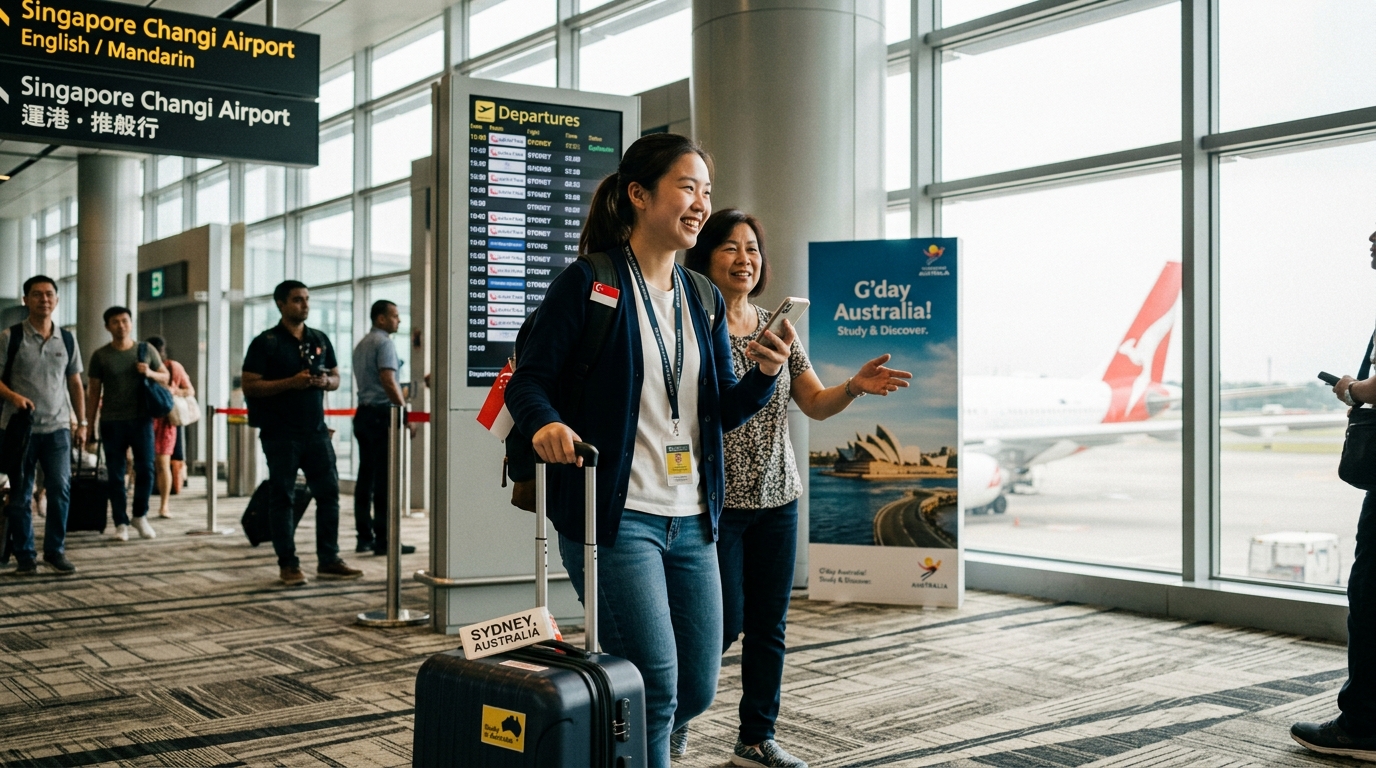
As of June 2026, the landscape for international study in Australia has undergone a significant transformation. Known for its world-class universities and its geographical proximity to Singapore, Australia remains the top destination for Singaporean students. However, with the full implementation of the “Migration 2.0” strategy earlier this year, the application process is now more rigorous than ever.
Whether you are a Polytechnic student looking for credit exemptions, an A-Level graduate eyeing a medical degree, or a professional seeking a postgraduate shift, the requirements have changed. From the new Genuine Student (GS) assessment to updated financial thresholds, this guide provides a 2026-centric roadmap for your journey from the Little Red Dot to the Land Down Under.
The 2026 Visa Landscape: New Rules and the Genuine Student (GS) Test
The most critical change for Singaporeans applying in 2026 is the replacement of the old Genuine Temporary Entrant (GTE) requirement with the Genuine Student (GS) requirement. Unlike the previous long-form essay, the GS test consists of specific, targeted questions within the ImmiAccount application, each limited to 150 words. The focus has shifted from “proving you will leave” to “proving you are a serious student” with a logical academic progression.
Furthermore, the Australian government has officially ended “visa hopping.” As of February 2026, it is no longer possible for Singaporeans to travel to Australia on a Visitor Visa (Subclass 600) and then apply for a Student Visa (Subclass 500) while onshore. All applications must now be lodged from offshore (Singapore) to maintain system integrity. This makes early planning essential, as the Department of Home Affairs now prioritizes applications based on the “risk level” of the education provider.
| Feature | 2026 Requirement (Subclass 500) |
| :— | :— |
| Visa Application Fee | AUD $2,000 (approx. SGD $1,780) |
| Genuine Student Test | 4-5 targeted questions (150 words each) |
| Onshore Switching | Banned for Visitor and Graduate visa holders |
| English Requirement | IELTS 6.0 or equivalent (waived for some SG qualifications) |
| Processing Time | 28 days (Median) to 6 months (Peak) |
From Polytechnic to Degree: Maximizing Credit Transfers
For Singaporean Polytechnic graduates, Australia offers some of the most generous credit transfer arrangements in the world. In 2026, major institutions like the University of Sydney, UNSW, and Monash University have updated their “Credit Recognition Guides” specifically for Ngee Ann, Temasek, Singapore, Nanyang, and Republic Polytechnic diplomas.
Depending on your GPA and the relevance of your diploma to your chosen degree, you can receive between 0.5 to 2 years of “Advanced Standing.” This allows many Singaporean students to complete a three-year Australian Bachelor’s degree in just 1.5 or 2 years. However, the 2026 rules require a more detailed “Unit Guide” or syllabus breakdown from your Polytechnic to ensure modules align with Australian 2026 curriculum standards.
Common Credit Exemption Pathways in 2026:
- Business & Commerce: Typically 1 to 1.5 years of credit for related diplomas with a GPA of 2.8+.
- Engineering: Up to 1.5 years for Washington Accord-accredited diplomas.
- IT & Cybersecurity: Generous exemptions at universities like UTS and Deakin (up to 12 units).
- Design & Architecture: Portfolio-heavy assessment; exemptions vary between 0.5 and 1 year.
- Health Sciences: Nursing and Biomedical science diplomas often lead to a 1-year reduction.
Navigating the 2026-2027 Admission Cycle
For the upcoming February 2027 intake, the application window is already open. Singaporean students must juggle the “two-track” system: the university application and the visa application. Top-tier Group of Eight (Go8) universities have moved their deadlines earlier due to the new “National Planning Levels” (student caps) introduced in late 2025.
If you are applying for high-demand courses like Medicine, Dentistry, or Law, the 2026 requirements involve more than just your A-Level or IB results. For Medicine, most Australian universities now require the UCAT ANZ or ISAT, with interviews (MMI) typically conducted virtually for Singapore-based applicants between September and November.
Key Deadlines for Singaporean Applicants:
- July 2026 Intake: Applications closed (late May 2026).
- February 2027 Intake (Medicine/Law): Aim for August – September 2026.
- February 2027 Intake (General): Final deadline late November 2026.
- July 2027 Intake: Applications open January 2027.
Financial Planning: 2026 Costs and Living Budget
The cost of living in Australia has risen, and the Department of Home Affairs has responded by increasing the mandatory financial capacity evidence. To secure a visa in 2026, a single student must show proof of at least AUD $29,710 (approx. SGD $26,500) for one year of living expenses, excluding tuition fees.
While Sydney and Melbourne remain the most expensive cities, 2026 has brought some relief through localized policy changes. For example, Brisbane has made its 50-cent flat fare for all public transport permanent, significantly lowering the commute cost for students. Similarly, Victoria has introduced free public transport for all students under the age of 18 starting January 2026.
| City | Weekly Rent (Est. PBSA) | Transport Perk (2026) |
| :— | :— | :— |
| Sydney | AUD $580 – $630 | $50 Weekly Opal Cap |
| Melbourne | AUD $520 – $580 | Free for Under 18s (New) |
| Brisbane | AUD $420 – $460 | 50-Cent Permanent Flat Fare |
| Adelaide | AUD $340 – $380 | Standard Student Concession |
| Perth | AUD $350 – $400 | Free Zone in CBD |
Scholarships: Proving Your Potential
Despite the tightening of visa rules, Australian universities are aggressively competing for high-quality Singaporean students through lucrative scholarship programs. In 2026, many of these are “automatic,” meaning you do not need a separate application; the university assesses you based on your admission documents.
For instance, the University of Western Australia (UWA) continues its Singapore Polytechnic Scholarship, offering up to AUD $12,000 per year for the duration of the degree. Meanwhile, the Australia Awards for Singapore (AAS) have been refreshed for 2026, focusing on leadership and regional cooperation. It is vital to secure your Overseas Student Health Cover (OSHC) early, as 2026 premiums have fluctuated, with providers like NIB and Allianz offering specific “Singapore Student Packages.”
Top 2026 Scholarship Opportunities:
- Vice-Chancellor’s International Scholarships: Offered by most Go8 unis; range from 25% to 50% tuition waivers.
- Polytechnic Excellence Awards: Specific to Singaporean diploma holders with a GPA of 3.5+.
- Destination Australia: AUD $15,000 per year for students studying in regional areas (e.g., Gold Coast, Hobart).
- Postgraduate Research Stipends: Full tuition + living allowance for Master’s by Research and PhD students.
Post-Study Realities: The New Subclass 485 Landscape
For those hoping to stay and work in Australia after graduation, the Temporary Graduate Visa (Subclass 485) underwent its biggest change in a decade on March 1, 2026. The application fee has doubled to AUD $4,600, and the age limit has been reduced to 35 for most streams (excluding PhD and Research Masters).
Stay durations have also been recalibrated. Under the 2026 rules, a Bachelor’s degree holder is granted a 2-year work visa, while a Masters by Research or PhD graduate can stay for 3 years. The “extra 2 years” for specific degrees that was popular in 2024 has been discontinued, making the choice of location even more important—studying in a regional city is now the primary way to secure an additional 1 to 2 years of post-study stay.
Work Rights and Compliance in 2026:
- Fortnightly Limit: 48 hours per fortnight during semester; unlimited during holidays.
- Tax & Fair Work: International students have the same rights as locals; the 2026 minimum wage is AUD $24.10/hour.
- Post-Study Stay: Bachelor (2 years), Masters Coursework (2 years), PhD (3 years).
- Regional Bonus: 1-2 extra years for studying in designated regional zones.