Data analytics enables companies to improve their decision-making by transforming raw data into valuable insights. However, the quality of those insights depends heavily on the level of detail available in the data. This level of detail is known as data granularity. Understanding data granularity is important because it affects how accurately analysts can identify trends, patterns, and opportunities.
When companies gather and examine data, they have the option to utilize either very detailed records or condensed information. The right level of granularity depends on the goals of the analysis. Learning this concept can help beginners understand how data is transformed into meaningful business intelligence. If you want to build a strong foundation in analytics and gain practical skills, consider enrolling in a Data Analyst Course in Mumbai at FITA Academy to strengthen your knowledge effectively.
What is Data Granularity?
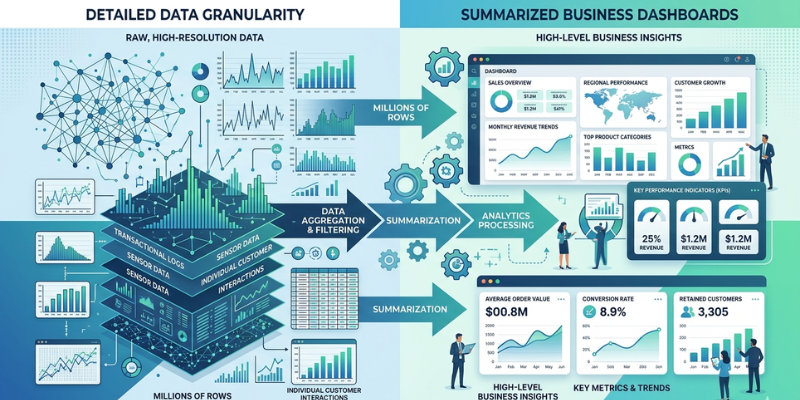
Data granularity indicates the degree of detail found within a dataset. Fine-grained data includes detailed information about individual events, transactions, or activities. For example, a retail store may record every customer purchase separately, including the product, time, and amount spent.
On the other hand, coarse-grained data is more summarized. Instead of storing every transaction, the store may only keep daily or monthly sales totals. Each method has its own benefits, but they fulfill distinct roles in analytics.
Understanding the difference between detailed and summarized data helps analysts select the most appropriate dataset for a specific business question.
Why Data Granularity Matters
The level of granularity directly influences the quality of insights generated from data analysis. Detailed data allows analysts to identify hidden patterns that may not be visible in summarized reports. For example, customer purchasing habits can be studied more accurately when individual transaction data is available.
Granular data also supports better forecasting and decision-making. Organizations can track changes over time, monitor customer behavior, and detect unusual activities more effectively. With the right level of detail, businesses can make informed decisions based on evidence rather than assumptions.
At the same time, storing highly detailed data requires more storage space and processing power. This is why organizations must balance business needs with technical resources.
Fine-Grained vs Coarse-Grained Data
Fine-grained data provides flexibility because it can be aggregated into summaries whenever needed. Analysts can examine information from different perspectives and answer a wider range of questions.
Coarse-grained data is easier to manage and often faster to analyze. It is useful when businesses need high-level reports and performance summaries. However, excessive aggregation can hide important details that may influence business outcomes.
Choosing the correct level of granularity depends on the objectives of the analysis. If your goal is to understand customer behavior, detailed data is often more valuable. If you only need executive-level reporting, summarized data may be sufficient. To deepen your understanding of these practical concepts and their real-world applications, you can explore a Data Analytics Course in Kolkata that covers industry-focused learning opportunities.
Challenges of Managing Data Granularity
Although detailed data offers many benefits, it also creates challenges. Large datasets can become difficult to store, process, and maintain. Organizations may need advanced tools and infrastructure to handle increasing data volumes.
Data privacy is another important consideration. More detailed information can increase the risk of exposing sensitive data. Businesses must ensure that data is protected and used responsibly.
In addition, overly detailed datasets can make analysis more complex. Analysts must carefully determine which level of detail provides meaningful insights without creating unnecessary complexity.
Best Practices for Choosing the Right Granularity
Organizations should define their business objectives before deciding on data granularity. The level of detail should support the questions they want to answer.
It is also helpful to maintain flexibility by storing detailed data whenever possible while creating summarized versions for reporting purposes. This approach allows businesses to perform both detailed investigations and high-level analysis when needed.
Regular reviews of data requirements can help ensure that the chosen granularity continues to support changing business goals and analytical needs.
Data granularity is a fundamental concept in analytics that influences the accuracy, usefulness, and efficiency of data analysis. The right level of detail enables organizations to uncover valuable insights, improve decision-making, and support business growth. By understanding when to use fine-grained or coarse-grained data, analysts can create more effective and meaningful analyses. If you are interested in developing expertise in these essential analytics concepts, consider joining a Data Analytics Course in Delhi to enhance your professional skills and career prospects.
Also check: Cleaning Data the Most Important Skill in Analytics