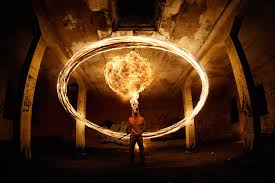
There is a moment—just before the first torch is lit—when the entire carnival seems to hold its breath. The chatter quiets. The string lights overhead dim to a whisper. And then: a spark, a hiss, a bloom of orange against the black canvas of night. In that instant, the crowd stops being spectators and becomes witnesses. This is the moment that defines every fire show, the heartbeat before the blaze, and it is exactly what waits for you at Flicker & Flow.
Where Night Becomes a Stage
The carnival grounds transform after dark. Food stalls that smelled of caramel and grilled corn by daylight now glow like lanterns, and the wooden stage at the center of the fairground becomes something closer to an altar than an arena. Smoke curls upward in lazy ribbons, catching the light of dozens of torches not yet lit. The air smells faintly of kerosene and cut grass, a strange but unforgettable combination that regular attendees say they can recognize blindfolded.
This is Flicker & Flow, an evening built entirely around the pairing of fire and human skill. Unlike traditional circus acts that rely on illusion or misdirection, fire performance offers no such safety net. What the audience sees is exactly what is happening: real flame, real risk, real mastery.
The Performers Take the Stage
The night opens with a single performer, a young woman with close-cropped hair and forearms wrapped in protective leather bands. She holds two unlit clubs, waiting. When the torches finally ignite, a warm gasp moves through the crowd like a current. She begins slowly, almost meditatively, letting the flames trace lazy arcs before building into a full rotation. Each club spins end over end, leaving trails of light that flicker like stars against the darkness. The audience leans forward as one.
“People think it’s about speed,” she says between sets, wiping sweat from her brow as an assistant checks her equipment. “But it’s really about rhythm. If you rush the fire, the fire rushes back at you.”
Her name is featured only by her stage title, The Ember Weaver, a common practice among fire artists who prefer their craft to speak louder than their names. She has been performing for six years and describes her first burn—a minor one, on the wrist—as the moment she truly understood the discipline required. “Fire doesn’t forgive arrogance,” she says. “It rewards attention.”
As the night progresses, the acts grow more elaborate. A duo performs a synchronized routine with fire staffs, their movements mirrored so precisely that the flaming arcs seem to fold into one another, forming shapes in the air—figure eights, spirals, brief fleeting hearts that dissolve as quickly as they appear. The crowd’s applause swells with every trick landed cleanly, every flame caught without flinching.
Later, a solo performer known as Solstice takes the stage with fire fans, moving through what can only be described as a dance choreographed for danger. He weaves the flaming fans close to his body, close enough that onlookers instinctively lean back, though he never once breaks his composure. When asked afterward how he manages the fear, he laughs. “The fear doesn’t go away. You just learn to dance with it instead of against it.”
Faces in the Crowd
It isn’t only the performers who carry stories worth telling. Among the audience, a father lifts his daughter onto his shoulders so she can see over the crowd, her small hands pressed to her mouth in delighted disbelief. “I’ve brought her every year,” he says. “She wants to be a fire dancer when she grows up. I used to worry about that. Now I just think—good. The world needs more people who aren’t afraid to shine.”
An older woman near the front, a self-described “carnival regular” of over a decade, describes the appeal simply: “It’s honest. Everything else in life is filtered, curated, safe. This isn’t safe. It’s real fire, real skill, real nerve. You can’t fake that.”
The Finale
The night builds toward its climax with a full ensemble piece—six performers moving in concert, flaming props weaving between them in patterns too fast and too fluid to fully track. For a few suspended seconds, the entire stage seems to breathe fire, a living, moving constellation. Then, as quickly as it began, the flames are extinguished, the smoke clears, and the performers take their bow in sudden darkness, illuminated only by the glow of the crowd’s phone lights and the residual embers still drifting from their equipment.
Why It Matters
Events like Flicker & Flow endure not because fire is exotic or dangerous, though it is both, but because they represent something increasingly rare: unmediated human skill, practiced in full view, with real consequences for failure. In an age of digital spectacle and special effects, there is something profoundly grounding about watching a person control an element as ancient and untamable as fire, using nothing but discipline, breath, and years of dedicated practice.
Flicker & Flow is not just entertainment. It is a celebration of the discipline required to turn danger into art, and a reminder that some of the most captivating performances are the ones with nothing digital standing between the audience and the flame.