Introduction
Accounting is referred to as the “language of business” because it enables businesses to share their financial condition and results with other people. Businesses adopt a set of standardised accounting principles to ensure that financial information is accurate, consistent and understandable. The rules are the guidelines for accounting, measurement and reporting of financial transactions.
If there were no accounting principles, each business enterprise would be able to report financial data in a variety of ways making it hard for investors, regulators, creditors and stakeholders to compare performance. Accounting Principles is an essential course for any business owner, accounting professionals, students, and anybody who is interested in the financial management.
What Are Accounting Principles?
Financial statements and financial transactions are prepared in accordance with accounting principles that are standardised rules. These rules are designed to provide uniformity and transparency of financial information in the presentation of financial information by businesses.
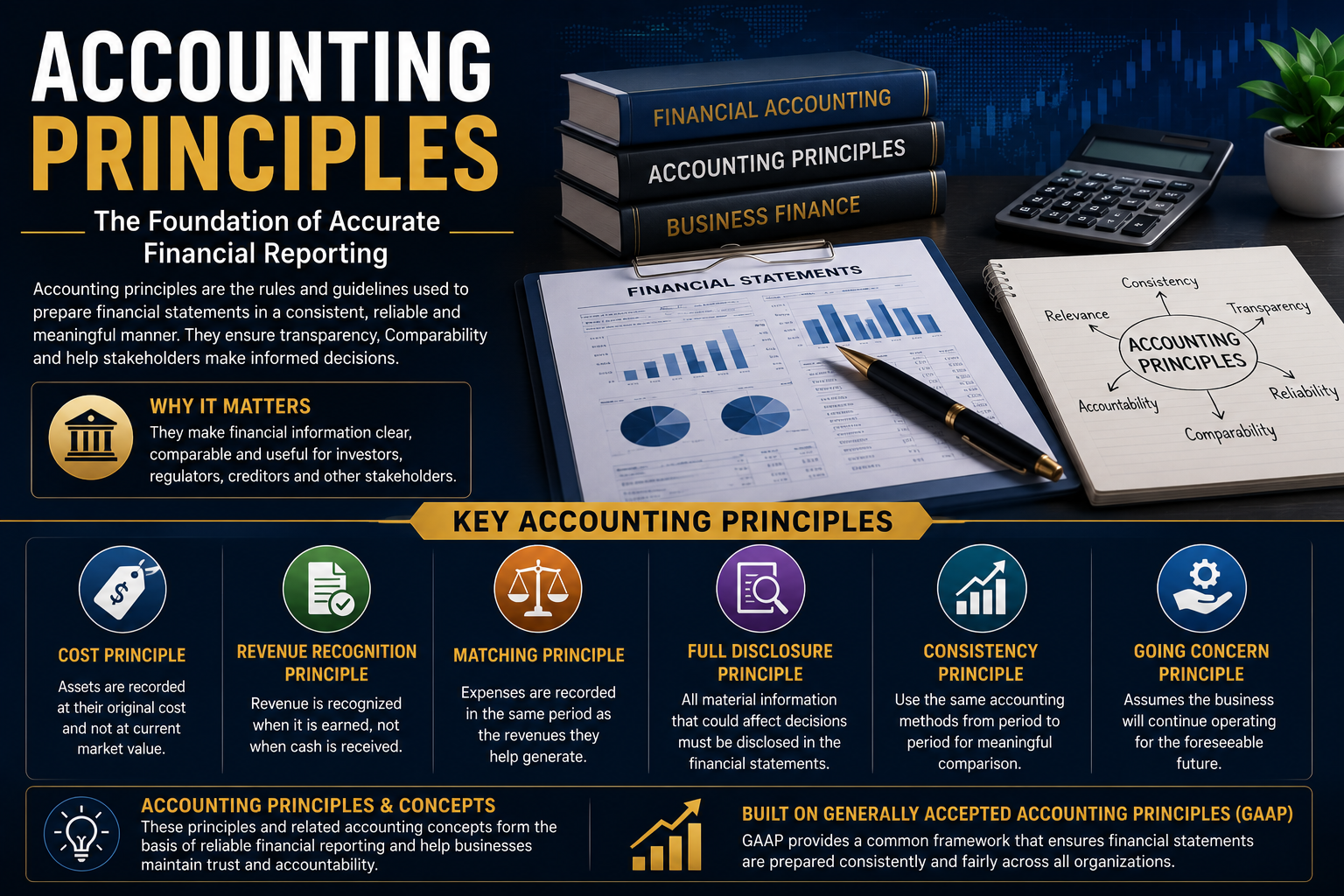
Most contemporary financial reporting systems adopt the principles of generally accepted accounting principles, which form the basis for a series of accounting standards that are followed by organisations. The following are principles of accounting that contribute to the reliability and enhance the confidence of financial reporting.
Principles of accounting enable share holders to assess the financial information correctly and to take decisions.
Why Accounting Principles Are Important
The most important purpose of accounting principles is to establish uniformity in accounting. Financial statements prepared on the basis of generally accepted accounting principles are used by investors, lenders and regulators to determine a company’s financial condition.
Basic accounting principles can help businesses enhance transparency and minimize the chances of inaccurate financial reporting. It is also easier to compare companies that are doing the same business when they are reporting their activities in the same way.
Accounting principles and concepts are not just about the regulations; they play a crucial role in decision-making and financial planning.
Basic Accounting Principles Every Business Should Know
A number of the fundamental accounting concepts are used as a basis of modern accounting systems. These is the way transactions are recorded and reported.
The revenue recognition principle is that revenue is recognized when it is earned, not when it’s received. The Rule of consistency is to adopt the same accounting procedures consistently over time.
These fundamental accounting principles enable financial statements to give a true and fair view of business activities.
Conclusion
The principles of accounting are the basics of today’s financial reporting. Generally accepted accounting principles enable businesses to offer clear, dependable, and homogenous financial data to stakeholders.
These accounting principles, such as the cost principle and full disclosure principle, serve to ensure the accuracy and accountability of financial records for the organisation.These accounting principles include the cost principle, full disclosure principle, and the matching principle in accounting, which help maintain accuracy and accountability in financial records. For those who want a better understanding of business finance and financial reporting, it’s important to understand accounting principles, general accounting principles, and accounting concepts.
For more details visit us – https://accountance.net/