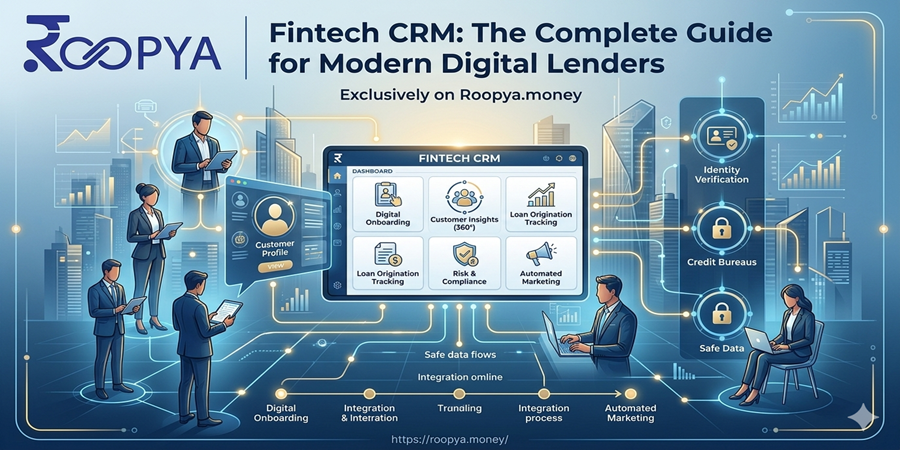
The financial services industry is experiencing a massive digital transformation. Traditional lending processes that relied on spreadsheets, manual follow-ups, disconnected systems, and paper-based documentation are rapidly becoming obsolete. Modern lenders need a centralized platform that helps manage customer relationships, automate workflows, improve conversions, and streamline loan operations.
This is where Fintech CRM comes into play.
A Fintech CRM Software (Customer Relationship Management) platform is specifically designed for banks, NBFCs, fintech companies, microfinance institutions, and digital lenders. Unlike traditional CRM systems, fintech CRMs are built to handle the unique requirements of the lending ecosystem, including borrower onboarding, KYC verification, credit assessment, underwriting, loan origination, customer communication, collections, and compliance management.
As competition increases in the lending market, customer experience becomes a major differentiator. Borrowers expect faster approvals, seamless digital onboarding, personalized communication, and instant support. A powerful fintech CRM enables lenders to meet these expectations while reducing operational costs and improving profitability.
What is Fintech CRM?
Fintech CRM is a specialized customer relationship management system built for financial institutions and lending businesses. It helps organizations manage every interaction with prospects and customers throughout the lending lifecycle.
A fintech CRM serves as the central hub where lenders can:
- Capture and manage leads
- Track loan applications
- Store borrower information
- Automate customer communication
- Monitor sales pipelines
- Perform underwriting workflows
- Generate reports and analytics
- Manage customer retention programs
- Improve collections efficiency
Unlike generic CRM solutions, fintech CRM platforms integrate directly with financial systems, credit bureaus, KYC providers, payment gateways, loan origination systems, and underwriting engines.
Why Fintech Companies Need a CRM
Customer expectations in financial services have changed dramatically. Borrowers now demand:
- Instant responses
- Digital onboarding
- Quick loan approvals
- Personalized offers
- Real-time updates
- Seamless communication
Without a dedicated fintech CRM, managing these expectations becomes difficult.
A fintech CRM helps organizations:
Improve Lead Conversion
Many lenders lose potential borrowers due to delayed follow-ups. CRM automation ensures every lead receives timely engagement.
Centralize Customer Information
Customer data from multiple channels can be stored in a single platform, eliminating data silos.
Increase Operational Efficiency
Automation reduces repetitive manual tasks and allows teams to focus on revenue-generating activities.
Enhance Customer Experience
Personalized interactions improve customer satisfaction and loyalty.
Accelerate Loan Processing
Integrated workflows reduce approval times and speed up disbursements.
Key Features of Fintech CRM
1. Lead Management
Lead management is one of the most important capabilities of a fintech CRM.
The platform captures leads from:
- Website forms
- Digital advertisements
- Social media campaigns
- Referral programs
- Partner channels
- Aggregator platforms
Every lead is automatically assigned, tracked, and nurtured throughout the sales cycle.
2. Customer Onboarding
Digital onboarding simplifies borrower acquisition.
Features include:
- Online application forms
- Document uploads
- Aadhaar verification
- PAN validation
- Video KYC
- eSign integration
This significantly reduces onboarding friction.
3. Loan Application Tracking
Borrowers and internal teams can monitor application progress through every stage.
Typical stages include:
- Lead Created
- Application Submitted
- KYC Completed
- Under Review
- Approved
- Disbursed
- Active Loan
4. Workflow Automation
Automation helps lenders reduce manual effort.
Common automated workflows include:
- Welcome emails
- Application reminders
- Document requests
- Approval notifications
- EMI reminders
- Collection alerts
5. Credit Assessment Integration
Modern fintech CRMs integrate with:
- Credit bureaus
- Alternative data providers
- Fraud detection tools
- Risk scoring engines
This enables faster and more accurate lending decisions.
6. Communication Management
Every customer interaction can be recorded.
Supported channels include:
- SMS
- Phone calls
- Push notifications
This creates a complete customer communication history.
7. Sales Pipeline Management
A visual sales pipeline helps teams monitor:
- Lead status
- Conversion rates
- Pending applications
- Revenue opportunities
Managers gain better visibility into team performance.
8. Analytics and Reporting
Data-driven decisions are critical in lending.
CRM analytics help track:
- Lead conversion rates
- Approval rates
- Loan volumes
- Customer acquisition costs
- Portfolio performance
- Team productivity
Fintech CRM vs Traditional CRM
| Feature | Traditional CRM | Fintech CRM |
|---|---|---|
| Lead Management | Yes | Yes |
| Customer Data | Yes | Yes |
| Loan Origination | No | Yes |
| KYC Integration | No | Yes |
| Bureau Checks | No | Yes |
| Underwriting Workflows | No | Yes |
| Credit Risk Assessment | No | Yes |
| Loan Pipeline Tracking | No | Yes |
| Collections Management | Limited | Yes |
| Compliance Support | Limited | Yes |
Fintech CRM platforms are purpose-built for lenders and provide industry-specific functionality that traditional CRMs lack.
Benefits of Fintech CRM
Faster Loan Approvals
Automation reduces processing time and improves customer satisfaction.
Improved Lead Conversion
Automated follow-ups prevent lead leakage.
Better Customer Retention
Personalized communication strengthens relationships.
Reduced Operational Costs
Automation minimizes manual workloads.
Increased Team Productivity
Employees spend less time on administrative tasks.
Enhanced Compliance
Built-in compliance features reduce regulatory risks.
Improved Data Accuracy
Centralized data reduces duplication and errors.
Higher Revenue
Better customer management leads to increased conversions and cross-selling opportunities.
How AI is Transforming Fintech CRM
Artificial Intelligence is revolutionizing lending operations.
AI-powered fintech CRM solutions can:
Predict Customer Behavior
Analyze historical data to forecast customer actions.
Automate Credit Decisions
AI models help evaluate borrower eligibility faster.
Detect Fraud
Machine learning identifies suspicious activities.
Improve Collections
Predictive analytics identifies high-risk borrowers.
Personalize Marketing
AI recommends the most relevant products for each customer.
Roopya’s lending infrastructure includes analytics, scorecards, workflow automation, decision engines, and underwriting capabilities designed for modern lenders.
Fintech CRM for NBFCs
NBFCs face unique challenges:
- High lead volumes
- Regulatory compliance
- Loan portfolio management
- Collections efficiency
A fintech CRM helps NBFCs:
- Automate onboarding
- Improve underwriting
- Increase approval rates
- Reduce defaults
- Enhance customer engagement
Fintech CRM for Banks
Banks require enterprise-grade CRM solutions capable of managing large customer bases.
Benefits include:
- Unified customer profiles
- Cross-selling opportunities
- Omnichannel communication
- Relationship management
- Regulatory compliance
Fintech CRM for Digital Lenders
Digital lenders operate in a highly competitive environment.
Fintech CRM enables:
- Instant onboarding
- Automated underwriting
- Real-time decisioning
- Faster disbursement
- Scalable operations
Choosing the Right Fintech CRM
Consider the following factors:
Industry Expertise
Choose a platform designed specifically for lending.
Scalability
Ensure the solution can grow with your business.
Integration Capabilities
The CRM should integrate with:
- LOS
- LMS
- KYC providers
- Credit bureaus
- Payment systems
Automation Features
Look for workflow automation and AI-driven capabilities.
Security
Financial data requires enterprise-grade protection.
Reporting
Comprehensive analytics should be available out of the box.
Why Roopya Fintech CRM?
Roopya provides a specialized fintech CRM platform built for lenders, NBFCs, banks, MFIs, and fintech companies. The platform combines CRM, loan origination, underwriting, analytics, scorecards, workflow automation, KYC integrations, and decision-making capabilities within a unified lending infrastructure.
Key capabilities include:
- Lead Management
- Customer Onboarding
- KYC Verification
- Bureau Integrations
- Rule Engine
- Scorecards
- Workflow Automation
- Underwriting
- Loan Origination
- Analytics Dashboard
- Collections Support
The future of lending belongs to organizations that can deliver fast, personalized, and data-driven customer experiences. A modern fintech CRM is no longer a luxury—it is a necessity for lenders seeking sustainable growth.
Whether you are a bank, NBFC, digital lender, microfinance institution, or fintech startup, implementing a specialized fintech CRM can help you improve conversions, reduce costs, enhance customer satisfaction, and scale operations efficiently.
With AI-powered automation, advanced analytics, and integrated lending workflows, fintech CRM platforms like Roopya are transforming the way financial institutions acquire, serve, and retain customers.
FAQs
1. What is Fintech CRM?
Fintech CRM is a customer relationship management platform specifically designed for financial institutions, lenders, banks, NBFCs, and fintech companies.
2. How does Fintech CRM help lenders?
It helps manage leads, automate customer communication, streamline onboarding, improve underwriting, and increase loan conversions.
3. Is Fintech CRM different from traditional CRM?
Yes. Fintech CRM includes lending-specific features such as KYC, credit checks, underwriting workflows, and loan tracking.
4. Can Fintech CRM integrate with Loan Origination Software?
Yes. Modern fintech CRMs integrate seamlessly with LOS and LMS platforms.
5. How does CRM improve loan conversion rates?
By automating follow-ups, nurturing leads, and improving customer engagement throughout the lending journey.
6. Is Fintech CRM suitable for NBFCs?
Absolutely. It helps NBFCs automate operations, reduce costs, and improve portfolio performance.
7. Does Fintech CRM support compliance requirements?
Yes. Most fintech CRM platforms include compliance and audit management features.
8. Can AI improve CRM performance?
Yes. AI helps automate decisions, detect fraud, personalize communication, and improve collections.