The financial services industry is rapidly embracing digital transformation, and lenders can no longer rely on spreadsheets or manual processes to manage their loan portfolios. Whether you’re an NBFC, fintech startup, microfinance institution, cooperative bank, or digital lender, choosing the right Loan Management Software can directly impact operational efficiency, borrower satisfaction, compliance, and profitability.
An advanced loan management platform should do much more than track repayments. It should automate the entire lending lifecycle—from customer onboarding and loan approval to EMI collection, reporting, and recovery management.
According to the capabilities highlighted on Roopya’s platform, modern lenders increasingly benefit from AI-powered automation, cloud deployment, digital onboarding, analytics, and integrated collections to streamline lending operations.
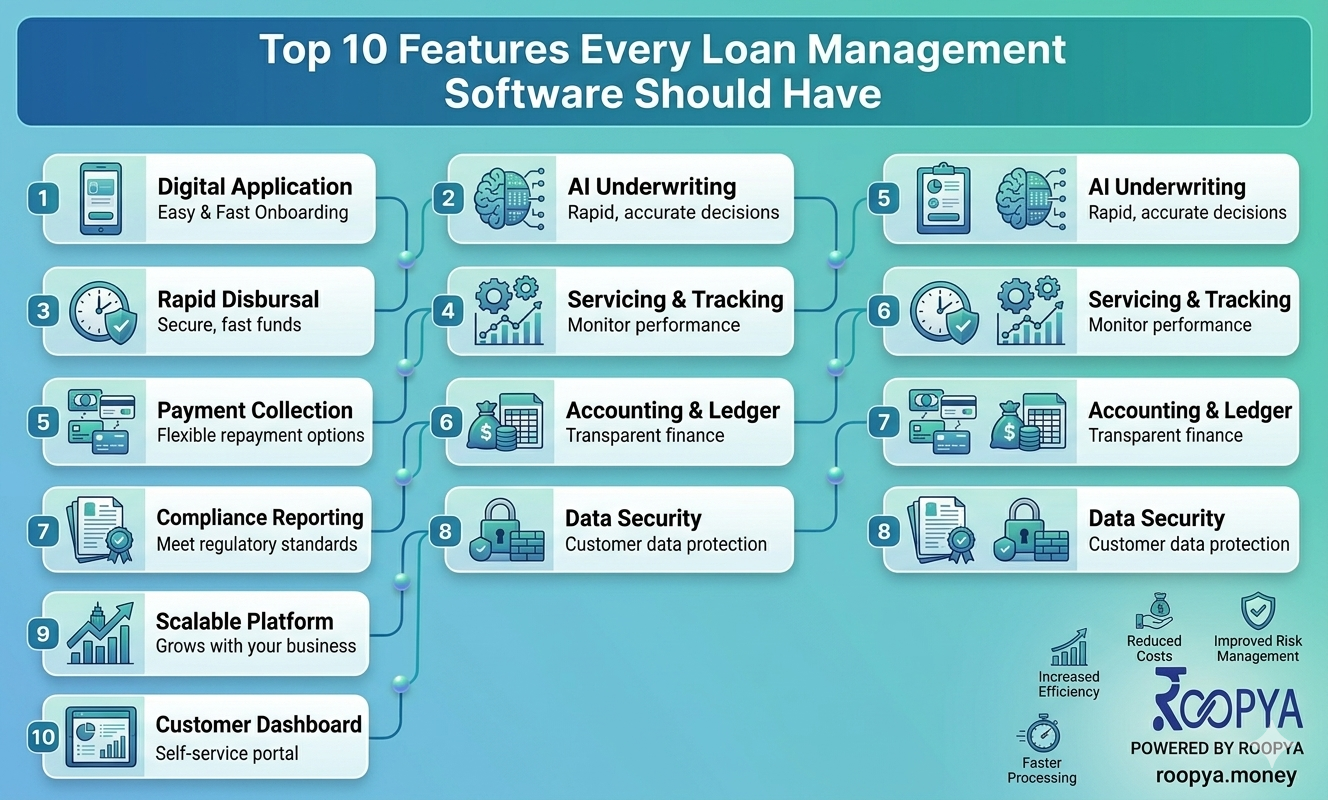
If you’re planning to invest in a lending solution, here are the top 10 features every Loan Management Software should have.
1. End-to-End Loan Lifecycle Management
The best loan management software should handle every stage of the lending journey through a unified platform.
This includes:
- Customer onboarding
- Loan application processing
- Credit assessment
- Loan approval
- Documentation
- Disbursement
- EMI scheduling
- Repayment tracking
- Collections
- Loan closure
Instead of using multiple disconnected systems, lenders can centralize operations and reduce manual intervention.
A complete lifecycle approach also improves visibility and ensures consistency across departments.
2. AI-Powered Loan Processing and Credit Decisioning
Artificial Intelligence is changing how lenders evaluate borrowers.
Modern loan management software should include:
- AI-based credit scoring
- Automated underwriting
- Fraud detection
- Risk assessment
- Predictive default analysis
- Intelligent approval workflows
These capabilities reduce human errors while accelerating loan approvals.
For NBFCs handling thousands of applications every month, AI significantly improves productivity and portfolio quality.
3. Automated EMI and Repayment Management
Managing repayments manually becomes impossible as loan volumes grow.
An efficient system should automate:
- EMI calculations
- Payment schedules
- Auto reminders
- Late fee calculation
- Interest computation
- Payment reconciliation
- Foreclosure processing
- Part-payment handling
Automated repayment management improves customer experience while reducing missed payments.
4. Digital Customer Onboarding with eKYC
Today’s borrowers expect completely digital experiences.
Modern lending software should support:
- Online applications
- Aadhaar-based verification
- PAN verification
- OCR document scanning
- eKYC integration
- Digital signatures
- Document uploads
- Instant validation
Digital onboarding reduces paperwork and enables lenders to approve loans much faster.
It also minimizes operational costs and human dependency.
5. Smart Collection and Recovery Management
Collections directly affect profitability.
An ideal Loan Management System should include:
- Automated payment reminders
- SMS notifications
- Email alerts
- WhatsApp communication
- DPD bucket management
- Collection tracking
- Recovery workflows
- Settlement management
- Field collection support
Automation enables recovery teams to prioritize high-risk borrowers while improving overall collection efficiency.
6. Real-Time Dashboards and Advanced Analytics
Data-driven lending decisions require comprehensive reporting.
The software should provide dashboards for:
- Loan portfolio performance
- Collection efficiency
- Delinquency analysis
- NPA monitoring
- Approval ratios
- Disbursement reports
- Revenue tracking
- Borrower behavior
- Branch performance
Interactive analytics help management identify trends early and make informed business decisions.
7. Cloud-Based Infrastructure
Cloud technology has become essential for modern lending organizations.
Cloud-based Loan Management Software offers:
- Anywhere access
- Automatic backups
- High availability
- Easy scalability
- Reduced infrastructure costs
- Multi-branch support
- Faster deployment
- Centralized data management
Cloud deployment also enables remote teams to collaborate efficiently.
As businesses grow, cloud systems can scale without requiring expensive hardware upgrades.
8. Compliance and Security Features
Financial institutions handle highly sensitive customer information.
Therefore, security should never be optional.
An enterprise-grade lending platform should include:
- Data encryption
- Role-based access control
- Multi-factor authentication
- Audit logs
- Secure APIs
- RBI compliance support
- Credit bureau reporting
- Regulatory reporting
- User activity monitoring
Compliance-ready software helps reduce legal risks while maintaining customer trust.
9. API Integrations and Third-Party Connectivity
No lending platform works in isolation.
The best software should integrate seamlessly with:
- Payment gateways
- Banking systems
- Credit bureaus
- Accounting software
- CRM platforms
- SMS gateways
- Email providers
- eSign services
- eKYC providers
Open APIs reduce manual work and create a connected digital lending ecosystem.
Integration flexibility is especially important for fintech companies scaling rapidly.
10. Customizable Workflows and Scalability
Every lender has unique business requirements.
A quality Loan Management Software should allow customization of:
- Loan products
- Interest calculations
- Approval hierarchy
- Credit rules
- Workflow automation
- Reports
- Notifications
- Collection strategies
The system should also scale as your portfolio grows from hundreds to millions of loans.
Flexible architecture ensures long-term value and reduces future migration costs.
Additional Features Worth Considering
Besides the top 10 essentials, premium loan management platforms should also offer:
- AI-powered fraud detection
- Mobile lending support
- Borrower self-service portal
- Digital document management
- Automated NACH processing
- Multi-language interface
- Co-lending support
- Embedded finance capabilities
- Portfolio segmentation
- Multi-product lending support
These advanced capabilities can provide a competitive edge in India’s fast-evolving lending market.
Why Modern NBFCs Need Advanced Loan Management Software
Manual lending operations often create:
- Delayed approvals
- High operational costs
- Data inconsistencies
- Compliance risks
- Poor customer experiences
- Increased default rates
A digital Loan Management Software platform automates repetitive tasks and empowers teams to focus on growth.
Solutions like Roopya demonstrate how AI-first, cloud-native lending platforms can unify loan origination, servicing, collections, analytics, and compliance within a single ecosystem.
How Roopya Can Help
If your organization is looking to modernize lending operations, Roopya provides an AI-powered, cloud-based Loan Management Software solution designed for:
- NBFCs
- Fintech companies
- Banks
- Microfinance Institutions
- Housing Finance Companies
- Consumer lenders
- Vehicle finance companies
- SME lenders
Its platform supports digital onboarding, AI-driven credit decisioning, EMI management, automated collections, analytics, and API integrations to simplify the entire lending lifecycle.
Selecting the right Loan Management Software is one of the most important technology decisions for any lender.
The ideal platform should not only automate loan servicing but also improve collections, reduce risk, ensure compliance, and enhance customer satisfaction.
Before investing, make sure your software includes:
✅ End-to-end lifecycle management
✅ AI-powered decisioning
✅ Automated EMI management
✅ Digital onboarding
✅ Smart collections
✅ Real-time analytics
✅ Cloud deployment
✅ Enterprise security
✅ API integrations
✅ Scalable customization
As India’s lending ecosystem continues to evolve, organizations that adopt intelligent, automation-driven platforms will be better positioned to scale efficiently and compete in the digital era.
Frequently Asked Questions (FAQ)
1. What is Loan Management Software?
Loan Management Software is a digital platform that automates the complete loan lifecycle, including borrower onboarding, loan servicing, EMI tracking, collections, reporting, and compliance.
2. Why is Loan Management Software important for NBFCs?
It helps NBFCs reduce manual work, improve operational efficiency, automate collections, ensure compliance, and deliver faster loan processing.
3. What features should the best Loan Management Software include?
It should include AI-powered underwriting, digital onboarding, automated EMI management, analytics, cloud deployment, API integrations, security, and customizable workflows.
4. Can Loan Management Software integrate with payment gateways?
Yes. Modern platforms support integration with payment gateways, banks, credit bureaus, CRMs, and accounting systems.
5. Is cloud-based Loan Management Software secure?
Yes. Enterprise-grade cloud solutions use encryption, role-based access control, audit logs, and multi-factor authentication to protect sensitive financial data.
6. Does Loan Management Software help improve loan collections?
Yes. Automated reminders, payment tracking, DPD management, and recovery workflows significantly improve collection efficiency.
7. Is AI used in modern Loan Management Systems?
Yes. AI helps automate credit scoring, underwriting, fraud detection, predictive analytics, and borrower risk assessment.
8. Can small fintech companies use Loan Management Software?
Absolutely. Cloud-based solutions are scalable and suitable for startups as well as large financial institutions.