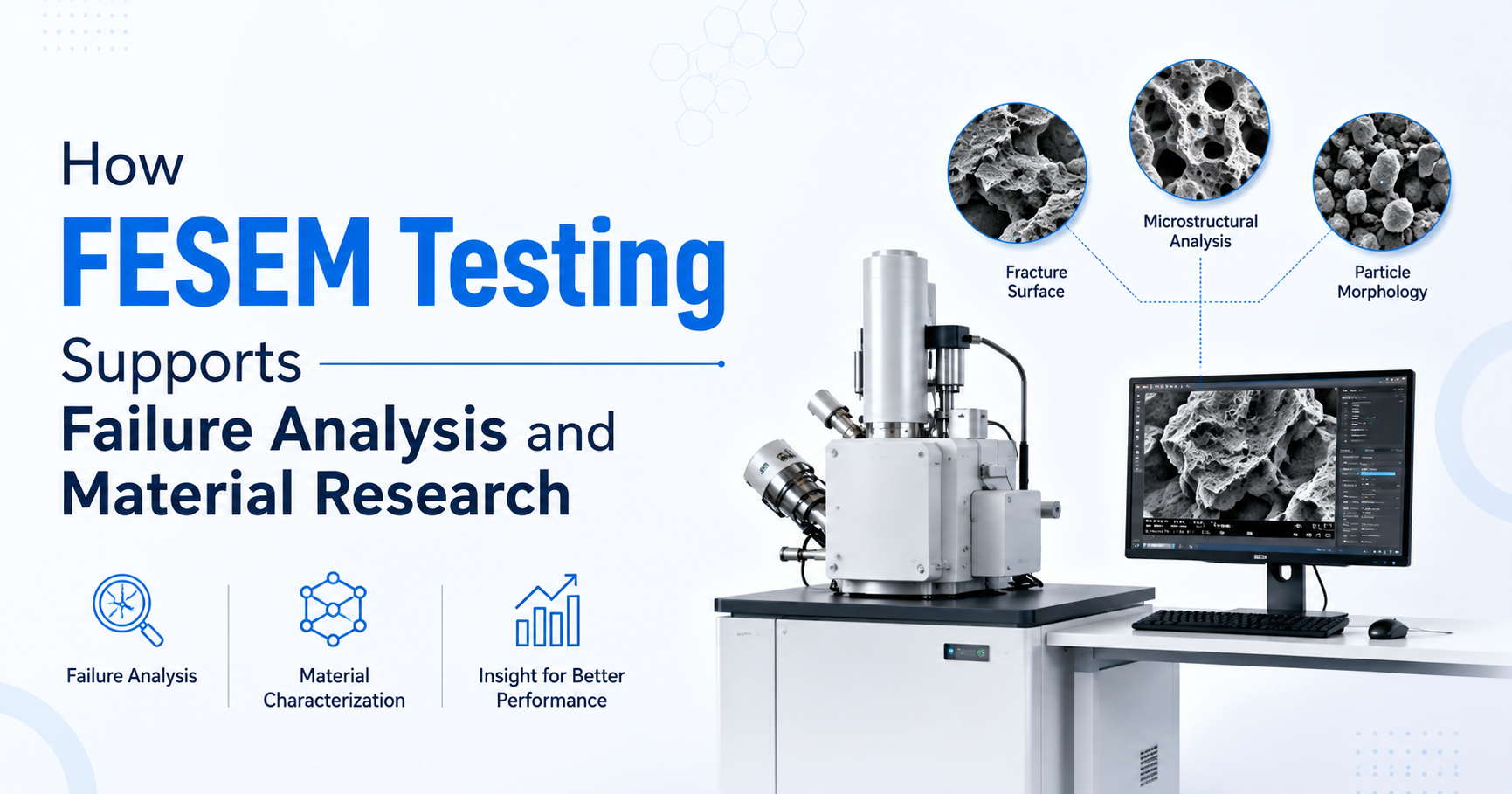
In today’s advanced manufacturing and research environment, understanding why a material fails is just as important as designing it correctly. Whether it’s a fractured metal component, a defective semiconductor, or a damaged polymer, identifying the root cause of failure is essential for improving product quality, reliability, and performance.
This is where Field Emission Scanning Electron Microscopy (FESEM) plays a crucial role. FESEM testing provides ultra-high-resolution images and detailed surface information that help engineers, researchers, and quality control professionals investigate material defects at the micro and nanoscale.
What is FESEM Testing?
Field Emission Scanning Electron Microscopy (FESEM) is an advanced imaging technique that uses a focused beam of electrons emitted from a field emission source to scan the surface of a specimen.
Unlike conventional optical microscopes, FESEM offers:
- Nanometer-scale resolution
- Greater depth of field
- High magnification (up to several hundred thousand times)
- Excellent image clarity
- Detailed surface morphology analysis
These capabilities make FESEM an indispensable tool for material characterization and failure investigations.
Why Failure Analysis Matters
Failure analysis is the process of determining the root cause of material or component failure.
Understanding failures helps organizations:
- Improve product reliability
- Prevent recurring defects
- Reduce manufacturing costs
- Enhance safety
- Optimize material selection
- Increase product lifespan
Without proper microscopic analysis, many defects remain invisible, making FESEM one of the most valuable analytical techniques available.
How FESEM Supports Failure Analysis
1. Identifies Surface Defects
FESEM can detect microscopic defects that are impossible to observe using conventional microscopes.
Common defects include:
- Micro cracks
- Surface fractures
- Pitting
- Corrosion
- Wear marks
- Delamination
- Voids
- Contamination
These observations help engineers determine how and why failure occurred.
2. Crack Origin Investigation
One of FESEM’s greatest strengths is locating the exact origin of a crack.
The microscope reveals:
- Crack propagation paths
- Fracture patterns
- Fatigue failure
- Brittle fracture
- Ductile fracture
- Stress corrosion cracking
This information is essential for improving component design.
3. Fracture Surface Analysis
FESEM produces highly detailed fracture surface images.
Researchers can identify:
- Overloading
- Mechanical fatigue
- Thermal damage
- Material defects
- Manufacturing flaws
Each fracture type exhibits unique microscopic characteristics that help determine the failure mechanism.
4. Contamination Detection
Unexpected contaminants often lead to product failures.
FESEM can identify:
- Foreign particles
- Dust contamination
- Metallic inclusions
- Residues
- Coating impurities
When combined with EDS (Energy Dispersive X-ray Spectroscopy), FESEM can also determine the elemental composition of these contaminants.
5. Coating Failure Evaluation
Protective coatings may fail due to poor adhesion or environmental conditions.
FESEM helps examine:
- Coating thickness
- Peeling
- Delamination
- Surface roughness
- Corrosion beneath coatings
This information helps manufacturers improve coating processes.
Role of FESEM in Material Research
Material research focuses on understanding material structure and behavior to develop better products.
FESEM contributes by providing detailed insights into:
Microstructure Analysis
Researchers study:
- Grain boundaries
- Crystal morphology
- Particle distribution
- Porosity
- Surface texture
Microstructural analysis helps optimize material properties.
Nanomaterial Characterization
FESEM is widely used in nanotechnology research.
It enables scientists to examine:
- Nanoparticles
- Nanofibers
- Carbon nanotubes
- Graphene
- Thin films
High-resolution imaging is essential for understanding nanoscale structures.
Composite Material Evaluation
Composite materials consist of multiple components.
FESEM helps analyze:
- Fiber distribution
- Matrix bonding
- Interface quality
- Fiber breakage
- Delamination
These observations improve composite performance.
Polymer Research
FESEM supports polymer development by examining:
- Surface morphology
- Phase separation
- Crack formation
- Filler dispersion
- Degradation
This information assists manufacturers in producing stronger polymer products.
Semiconductor Research
In electronics, FESEM is critical for:
- Wafer inspection
- Thin film analysis
- Microchip defect detection
- Circuit evaluation
- Surface contamination studies
Semiconductor manufacturers rely on FESEM for quality assurance.
Industries That Benefit from FESEM Testing
FESEM testing supports a wide range of industries.
Automotive
- Engine component analysis
- Wear testing
- Fatigue investigations
- Coating evaluation
Aerospace
- Fracture investigations
- Alloy characterization
- Corrosion studies
- Composite inspection
Electronics
- PCB failure analysis
- Semiconductor inspection
- Microelectronics research
Pharmaceuticals
- Particle size analysis
- Drug morphology
- Powder characterization
Metallurgy
- Grain structure analysis
- Weld investigations
- Corrosion studies
Nanotechnology
- Nanomaterial characterization
- Advanced materials research
Academic Research
Universities and research institutions use FESEM extensively for:
- Scientific publications
- Material development
- Engineering research
Advantages of FESEM Testing
FESEM offers numerous benefits compared to traditional microscopy methods.
Ultra-High Resolution
Captures nanoscale details with exceptional clarity.
Superior Depth of Field
Produces three-dimensional surface appearance.
Minimal Sample Damage
Low accelerating voltages reduce specimen damage.
High Magnification
Enables detailed observation of microscopic structures.
Fast Imaging
Provides rapid analysis with high accuracy.
Versatile Applications
Suitable for metals, polymers, ceramics, biological samples, semiconductors, and composites.
FESEM Combined with EDS Analysis
Many laboratories combine FESEM with Energy Dispersive X-ray Spectroscopy (EDS).
This combination enables:
- Surface imaging
- Elemental analysis
- Chemical composition mapping
- Contamination identification
- Alloy verification
Together, FESEM and EDS provide comprehensive failure analysis.
Why Choose a Professional FESEM Testing Laboratory?
A reliable FESEM testing laboratory offers:
- Advanced FESEM instruments
- Experienced material scientists
- Accurate analytical reports
- Quick turnaround time
- Customized testing solutions
- Compliance with international testing standards
Professional laboratories help industries solve complex material-related challenges efficiently.
Future of FESEM in Material Research
As materials become increasingly sophisticated, FESEM technology continues to evolve.
Emerging developments include:
- AI-assisted image analysis
- Automated defect detection
- Higher-resolution imaging
- Faster data acquisition
- Integration with advanced analytical techniques
- Enhanced 3D surface reconstruction
These advancements will further improve research capabilities and industrial quality control.
Conclusion
FESEM testing has become an indispensable tool for failure analysis and material research. Its ability to reveal microscopic defects, analyze fracture surfaces, characterize advanced materials, and support elemental analysis makes it invaluable across industries.
From automotive and aerospace to electronics, pharmaceuticals, and nanotechnology, FESEM enables researchers and manufacturers to identify failure mechanisms, improve product quality, and accelerate innovation. By partnering with a trusted FESEM testing laboratory, organizations gain access to precise, high-resolution analysis that supports informed decision-making and continuous product improvement.
Whether you’re investigating product failures or developing next-generation materials, FESEM testing provides the detailed insights needed to achieve reliable and high-performance outcomes.
Frequently Asked Questions (FAQs)
1. What is FESEM testing used for?
FESEM testing is used for high-resolution imaging of material surfaces, failure analysis, microstructural characterization, contamination detection, and nanomaterial research.
2. How does FESEM help in failure analysis?
FESEM identifies microscopic defects, crack origins, fracture patterns, corrosion, wear, and contamination, helping determine the root cause of component failure.
3. Which industries use FESEM testing?
Industries such as automotive, aerospace, electronics, metallurgy, pharmaceuticals, nanotechnology, and academic research commonly use FESEM testing.
4. Can FESEM identify the elemental composition of a sample?
Yes. When combined with Energy Dispersive X-ray Spectroscopy (EDS), FESEM can determine the elemental composition and distribution within a sample.
5. Why should I choose a professional FESEM testing lab?
Professional laboratories provide advanced instrumentation, expert analysis, accurate reporting, and reliable results that support quality control, product development, and research objectives.