The Evolution of Ear Reshaping: Moving Toward Subtlety and Balance
Facial aesthetic balance depends entirely on proportions, symmetry, and subtle transitions between features. When ears project noticeably outwards or lack natural structural folds, they can draw disproportionate attention and cause lingering self-consciousness for individuals of any age. Historically, ear reshaping relied on rigid, aggressive tissue excision that often resulted in stiff, overly pinned, or sharp ear margins. However, modern surgical philosophy has shifted toward preservation, refinement, and anatomical integrity. Seeking Otoplasty surgery in Delhi offers access to contemporary techniques that prioritize soft, organic contours and individualized aesthetic balance over cookie-cutter cosmetic modification.
The primary objective of modern ear pinna correction is to create an ear structure that appears completely unoperated. Human ears are intricate three-dimensional structures made up of delicate elastic cartilage, tight skin coverage, and nuanced folds such as the antihelical fold, conchal bowl, and lobule. Modern surgical protocols aim to restore or re-create these subtle landmarks without producing artificial sharpness or unnatural tension. Patients residing in Greater Kailash, South Delhi, and across the wider Delhi NCR can now undergo sophisticated, minimally invasive ear pinna refinement that seamlessly aligns with their unique facial characteristics.
Understanding the Modern Approach to Otoplasty Surgery in Delhi
Achieving an aesthetically harmonious ear requires a deep understanding of external ear anatomy and dynamic cartilage behavior. The protrusion of an ear is generally caused by two distinct anatomical features: an underdeveloped or flattened antihelical fold, an oversized or deep conchal bowl, or a combination of both. In the past, procedures often involved cutting completely through the cartilage framework, which frequently left harsh, unnatural ridges visible through thin skin. Modern plastic surgery replaces these invasive methods with gentle cartilage-sparing protocols.
By utilizing biocompatible internal fixation sutures, such as Mustardé mattress sutures to form a smooth antihelical fold and Furnas setback sutures to anchor the conchal bowl to the mastoid fascia, surgeons can reshape the ear framework cleanly and securely. Because the underlying cartilage framework is gently folded and sculpted rather than aggressively severed, the surrounding soft tissues settle smoothly over the new structure. This subtle approach ensures that light reflects naturally off the curves of the ear, providing an authentic, pleasing contour from every viewing angle.
Personalized Surgical Planning for Children and Adults
Ear pinna correction is unique in aesthetic surgery because it caters equally to young children and mature adults, though the biological state of the cartilage differs significantly between age groups. In pediatric patients, ear cartilage is soft, flexible, and highly responsive to gentle shaping. By age five or six, the human ear has attained nearly ninety percent of its full adult size, making early childhood an ideal time for intervention before peer interactions at school begin to affect emotional confidence. Early surgical planning focuses on guiding pliable cartilage into balanced positions using lightweight internal sutures.
In contrast, adult ear cartilage is stiffer, thicker, and carries stronger shape memory due to decades of structural calcification. When mature patients seek correction, the surgical plan must account for this increased resistance. An experienced cosmetic plastic surgeon in Delhi addresses adult cartilage by combining subtle surface scoring or weakening techniques with robust suture anchoring. This ensures that the cartilage adopts its new contour without springing back over time. Regardless of patient age, personalized pre-operative mapping guarantees that the final projection matches individual facial symmetry.
Minimizing Discomfort and Ensuring Hidden Surgical Access
A major concern for patients considering ear reshaping is the fear of visible scars or painful, restrictive recovery periods. Modern ear sculpting is designed to minimize visible marks by placing all primary access points in concealed anatomical folds. The primary incision is executed along the post-auricular sulcus, which is the natural crease situated directly behind the ear where it joins the side of the head. Working through this hidden entrance allows the surgical team full access to the underlying cartilage without leaving any visible marks on the front surface of the ear.
In addition to discrete placement, surgical recovery has become significantly smoother thanks to modern anesthesia protocols and refined tissue handling. Adult procedures are routinely performed under local anesthesia with light conscious sedation on an outpatient basis, while pediatric cases are conducted safely under gentle general anesthesia. Post-operative discomfort is manageable and typically described as a mild, dull ache during the first forty-eight hours, which responds well to standard oral analgesics. Patients are able to return home the same day and resume light daily routines shortly thereafter.
Navigating Financial Planning: Factors Influencing Cost Transparency
Understanding the investment involved in ear reshaping is an important part of a patient’s decision-making process. Patients frequently inquire about the overall otoplasty surgery cost in Delhi during their preliminary consultations. Because every ear present distinct structural variations, treatment expenses are determined by specific clinical factors tailored to the individual rather than a generalized flat rate.
Key factors influencing overall costs include whether the correction is required on one ear or both ears, the complexity of the underlying cartilage reshaping, the choice of local versus general anesthesia, and facility utilization. When researching the complete plastic surgery cost in Delhi, patients should focus on clinical standard, surgical expertise, and safety protocols rather than searching for budget options. High-quality care includes comprehensive pre-operative evaluations, sterile surgical facilities, expert nursing support, and dedicated post-operative follow-up visits, ensuring complete financial clarity without unexpected extra charges.
Trust, Safety, and Expertise: The Med Esthetiks Standard
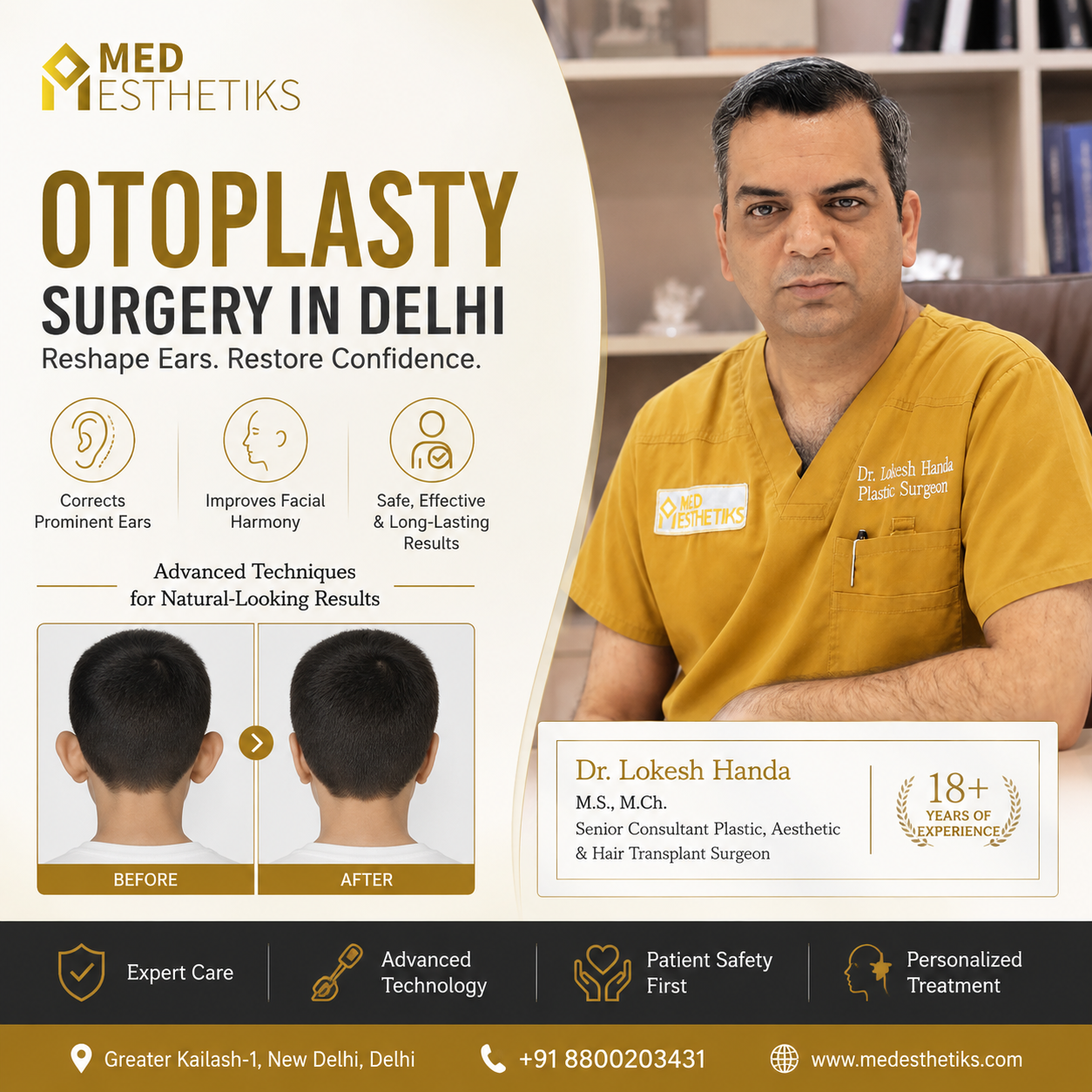
Achieving balanced, long-lasting aesthetic outcomes depends entirely on selecting a qualified, highly skilled surgical team. At Med Esthetiks, clinical excellence is led by Dr. Lokesh Handa, M.S., M.Ch., a prominent Senior Consultant Plastic, Aesthetic and Hair Transplant Surgeon with over eighteen years of specialized surgical practice. Highly regarded as a top plastic surgeon in Delhi and a trusted best otoplasty surgeon in Delhi, Dr. Handa brings deep technical mastery, surgical precision, and patient empathy to every consultation.
As a widely recognized best plastic surgeon in Delhi and skilled plastic surgery doctor in Delhi, Dr. Handa prioritizes patient safety, ethical treatment planning, and personalized surgical design. Every patient visiting our flagship plastic surgery clinic in Delhi undergoes an extensive diagnostic assessment to analyze facial proportions, cartilage elasticity, and skin thickness. Recognized as a best cosmetic clinic in Delhi, Med Esthetiks integrates state-of-the-art facilities in Greater Kailash, New Delhi, with comprehensive follow-up care to ensure that every patient achieves natural-looking ear contours in a warm, comfortable clinical environment.
Post-Operative Recovery and Aftercare for Long-Term Results
The success of modern ear reshaping relies heavily on conscientious post-operative aftercare. Following surgery, a supportive headband dressing is applied to protect the ears, secure the underlying cartilage in its new position, and minimize post-procedure swelling. This initial dressing remains in place for approximately five to seven days, after which it is replaced by a lighter, breathable headband that patients wear primarily while sleeping for the next four to six weeks.
Patients are instructed to sleep with their head elevated on extra pillows during the initial recovery phase to encourage rapid swelling resolution. Strenuous exercise, heavy lifting, and physical contact sports must be paused for at least four to six weeks to protect the internal suture network while structural scar tissue matures. By adhering to these simple aftercare steps, patients protect their newly sculpted ear contours as native tissues stabilize, ensuring permanent, natural-looking results that endure for a lifetime.
Frequently Asked Questions About Modern Otoplasty Surgery
How does modern otoplasty create a natural fold without visible sharp edges?
Modern otoplasty achieves smooth, natural-looking ear contours by employing cartilage-sparing techniques instead of aggressive cartilage cutting. Surgeons use precise biocompatible mattress sutures, known as Mustardé sutures, to gently curve and fold the cartilage backward, creating an authentic antihelical fold. Because the cartilage framework remains intact and is shaped using gentle tension rather than sharp incisions, the overlying skin drapes naturally over the new contour. This prevents the formation of unnatural cartilage ridges or harsh unnatural folds, allowing the ear to reflect light smoothly and blend harmoniously with overall facial features.
What is the typical recovery timeline for returning to work or school after ear pinning?
Most adult patients can comfortably return to office desk jobs and light daily activities within five to seven days after procedure completion, once the main surgical dressing is removed. Children typically return to school within seven to ten days, provided they refrain from active playground games during recess. A lightweight protective band must be worn at night for four to six weeks to prevent accidental ear folding during sleep. Strenuous workouts, swimming, and contact sports should be deferred for six weeks to allow complete structural healing of the internal cartilage sutures.
Can otoplasty surgery correct severe structural asymmetry between both ears?
Yes, modern ear reshaping surgery is highly effective at correcting asymmetrical ear projection, size differences, or unequal fold development. During pre-operative surgical planning, the plastic surgeon conducts precise measurement mapping to assess the specific structural variance of each ear individually. Surgical techniques are then customized for each side; one ear may require conchal setback sutures while the other needs antihelical fold creation. This tailored, dual-side strategy allows the surgeon to equalize projection, restore natural proportion, and achieve maximum overall facial balance between both ears.
Will internal permanent sutures used in ear reshaping cause long-term discomfort?
Internal permanent sutures, such as Mustardé and Furnas sutures, are crafted from biocompatible, medical-grade materials designed to remain permanently and safely embedded within body tissues. These specialized sutures hold the cartilage framework in place while internal scar tissue gradually forms over several months. Once healing is complete, the native scar tissue permanently maintains the new ear contour. The internal sutures remain securely encapsulated within the deep tissue layers without causing pain, physical discomfort, skin irritation, or sensation issues, allowing patients to enjoy permanent results without feeling internal hardware.
Is ear reshaping surgery performed under local or general anesthesia at the clinic?
The selection of anesthesia depends primarily on the age and comfort level of the patient. For adult patients and older teenagers, ear reshaping is routinely performed under local anesthesia combined with light conscious sedation. This ensures the patient remains completely comfortable and pain-free while avoiding the longer recovery times associated with general anesthesia. For young children undergoing pediatric ear correction, procedure safety and emotional comfort are prioritized by performing the surgery under gentle, carefully monitored general anesthesia administered by experienced pediatric anesthesiologists in a fully equipped clinical environment.
How long do the aesthetic results of modern otoplasty surgery last?
The results achieved through modern cartilage-sparing otoplasty are permanent and designed to last a lifetime. During the first few months following procedure completion, natural internal healing forms firm fibrous scar tissue around the sculpted cartilage framework. This mature scar tissue permanently locks the ear in its revised position, preventing the cartilage from springing back to its original projection. As long as patients follow early post-operative guidelines and avoid traumatic injury during the initial recovery phase, the refined ear contours remain stable, balanced, and aesthetically pleasing permanently throughout adulthood.
Are there any risks of hearing impairment associated with external ear surgery?
Ear reshaping surgery carries absolutely no risk of impairing normal hearing or affecting the internal auditory mechanics. Otoplasty is strictly limited to the external cartilage framework and skin of the outer ear pinna. The surgical procedure does not enter the external ear canal, nor does it disturb the tympanic membrane, middle ear bones, or inner ear auditory nerves responsible for sound transmission and processing. Because internal hearing structures remain completely untouched, the procedure preserves normal auditory function entirely while successfully refining the external aesthetic contours of the ear.
What steps should patients take to prepare for an otoplasty consultation in Delhi NCR?
Preparing for an ear reshaping consultation involves gathering relevant medical history, identifying specific aesthetic goals, and preparing questions regarding surgical expectations and recovery timelines. Patients should be prepared to discuss any history of keloid formation, previous ear trauma, or underlying health conditions. During the consultation at the clinic, the surgeon evaluates ear symmetry, cartilage flexibility, and skin quality while taking medical photographs for digital planning. Having an open, honest discussion about your goals allows the surgical team to design a personalized treatment plan aligned with your expectations.
Restoring Facial Balance with Modern Surgical Precision
Choosing modern Otoplasty surgery in Delhi offers an effective, permanent pathway to achieving balanced, natural-looking ear contours. By replacing outdated, invasive techniques with advanced cartilage-sparing protocols, specialized surgeons can re-create delicate structural folds and reduce ear protrusion without leaving visible marks or producing stiff, artificial outcomes. Whether addressing ear asymmetry in early childhood or refining facial proportions in mature adulthood, modern ear reshaping delivers stable, pleasing results that harmonize seamlessly with your unique facial features.
Partnering with an experienced surgical team ensures that your aesthetic transformation is backed by clinical safety, meticulous planning, and compassionate aftercare. With individual diagnostic mapping, discreet post-auricular access, and personalized recovery support, patients across Delhi NCR can pursue structural ear correction with absolute peace of mind. Investing in expert care at a dedicated practice guarantees natural results that enhance overall facial harmony for a lifetime.
Schedule Your Otoplasty Consultation at Med Esthetiks Today
Begin your journey toward balanced facial proportions and renewed self-confidence by booking a private evaluation with Dr. Lokesh Handa at Med Esthetiks. As a premier destination for specialized plastic and aesthetic care, our team offers individualized clinical assessments and advanced surgical techniques designed to deliver natural, permanent ear contours. Contact our Greater Kailash-1 center in New Delhi today at +91 8800203431 or visit our website to schedule your personalized otoplasty consultation.